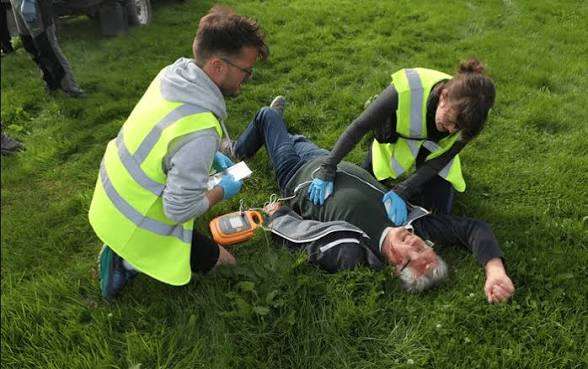
A scream from the kitchen. A crash in the warehouse. A colleague on the floor beside a live machine. Every instinct tells you to rush in and help. But the first rule of first aid is one that surprises many people: the first person you must protect is yourself.
If a rescuer becomes a second casualty, the situation gets worse, not better. Now there are two people needing help, and one fewer to give it. That is why every first aid course, including an Emergency First Aid at Work (EFAW) course in London, begins with how to assess a scene safely. In this guide, we explain in plain English how to size up an accident scene, which hazards to look for, how to make the scene safe and when to step back and wait for the emergency services. If you want to see a real course page as you read, here is the Emergency First Aid at Work course in London.
Important Notes First
- This guide is general information, not training. A trainer can run realistic scenarios and show you how to size up a scene in practice.
- Never put yourself at serious risk. If the danger is too great, call 999 and wait.
- Do not attempt rescues that need special equipment or training. Examples include confined spaces, high voltage electricity, fire, water and unstable structures.
- Call for help early. You can always cancel a call, but you cannot get back lost time.
- This guide is mainly for workplaces. Road traffic and public scenes carry extra risks.
The Short Answer
Before you help anyone, take a few seconds to look around. Check for danger to yourself, to the casualty and to bystanders. If you can make the scene safe without risking yourself, do so, for example by switching off equipment or warning others. If you cannot, call 999 and keep everyone away until the emergency services say it is safe. Then check how many people are hurt, call for help, send someone to fetch the first aid kit and AED and begin first aid.
Why Scene Safety Comes First
There are good reasons why first aiders are taught to look before they leap.
- A second casualty helps nobody. If you are injured, burnt, shocked, overcome by fumes or struck by a vehicle, you cannot help, and the emergency services will have two people to treat.
- Many workplace accidents happen in hazardous places. The cause of the first injury may still be there.
- Helpers can rush in blindly. Studies of rescues show that many would be rescuers are hurt because they did not check the danger first.
- A calm check helps you do better first aid. Knowing the scene lets you work out what has happened, how many people are involved and what to ask for.
The first step in the standard first aid sequence, in almost every UK course, is checking for danger.
Stop, Look, Think: A 10 Second Scene Check
When you arrive at an incident, pause for a few seconds and run through these questions in your head.
- What has happened? A fall, a collision, a fire, a chemical spill, an electric shock, a machinery accident?
- Is it still happening? Is the danger still active, such as moving equipment, leaking gas or spreading fire?
- What are the hazards to me? Anything that could hurt me if I go closer?
- What are the hazards to the casualty? Could they be hurt further if they stay where they are?
- What are the hazards to others? Bystanders, colleagues, passers by?
- How many casualties are there? Is it one person, or more?
- Can I make it safe? Quickly, simply and without risk?
- Do I need to call for help now? Should I call 999 before going closer?
- Who can help me? Bystanders to call 999, fetch the kit, keep the area clear, meet the ambulance.
- What do I do first? Approach, make safe, or stay back and call?
The aim is a quick decision, not a long investigation.
Common Workplace Hazards to Look For
Here are the main hazards to check, with simple ways to handle each. The right action depends on your training and the situation.
Moving machinery and equipment
Look for running machines, conveyors, blades, presses and vehicles. If you can safely reach the emergency stop or isolator, use it, and tell others not to restart it. Do not reach into machinery that has not been stopped. Ask for help from someone who knows the equipment.
Electricity
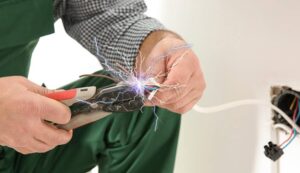
Look for fallen wires, damaged cables, wet floors near sockets, sparks or smoke from equipment, and a casualty who may be in contact with live electricity. Do not touch the person until the power is off. If you can safely switch off at the source, or unplug the equipment, do so. If you cannot, or if it is high voltage equipment or overhead cables, keep well away and call 999. Even after power is off, stay alert.
Fire and smoke
Look for flames, smoke, heat and the smell of burning. Do not enter a smoke filled room. Raise the alarm, evacuate people from the area, call 999 and leave rescue to the fire service unless you are trained and it is safe to use equipment such as a fire extinguisher on a small fire with an escape route behind you. Closing doors can slow the spread of fire and smoke.
Gas, fumes and chemicals
Look for strange smells, hissing, spilt liquids, warning labels and people coughing or feeling dizzy. Gas leaks, carbon monoxide, solvents, cleaning products and industrial chemicals can overcome rescuers as well as casualties. Hold your breath, move upwind if you are outside, get people out of the area if you can do so safely, open windows and doors if appropriate and call 999. Do not switch on lights or use mobile phones close to a suspected gas leak, and do not use naked flames. Check the safety data sheet for hazardous substances, if there is one.
Confined spaces
Tanks, pits, sewers, trenches, silos and similar places can contain poisonous or oxygen poor air. Many fatal accidents involve a second person who goes in to help. Never enter a confined space to rescue someone without proper equipment and training. Call 999 and ask for the fire and rescue service.
Heights and unstable structures
Look for ladders, scaffolding, platforms, shelving and structures that could collapse or fall. Do not climb unstable structures. Keep others away from the area, and wait for the emergency services if the casualty cannot be reached safely.
Traffic and vehicles
Workplaces may have forklifts, lorries, vans and site vehicles, and outdoor incidents may be near roads. Ask for vehicles to be stopped, use hazard lights, wear high visibility clothing if you have it and keep out of the path of traffic. On public roads, take care, do not stand in live lanes and call 999. On a motorway, the safest place is behind a barrier, away from the carriageway.
Water
Do not enter water to rescue someone unless you are trained. Call 999, and if you can, throw a rope, a lifebuoy or something that floats, from the bank.
Falling objects, glass and sharp items
Look for broken glass, unstable stock, hanging loads and sharp edges. Keep others back and take care where you step and kneel.
Slippery floors and spills
Wet floors, oil and ice can cause more falls. Warn others, and mark the area.
Violence and threats
If an incident involves an aggressive person, a weapon or an ongoing threat, your safety comes first. Call 999, keep away, and let the police make the scene safe. Do not try to confront anyone. Help the casualty only when it is safe to do so.
Blood and body fluids
Blood and other body fluids can carry infection. Wear disposable gloves if you have them, cover any cuts of your own, avoid touching your face and wash your hands afterwards. See our guide on first aid for severe bleeding.
Hot surfaces, steam and fire risks in kitchens
Switch off heat sources, move hot items away safely and take care with steam and hot oil. See our guide on how to treat a burn in the workplace.
Weather and the environment
Look out for extreme heat, cold, rain, ice, wind and poor lighting, which can make the scene dangerous and affect the casualty.
People and crowds
Bystanders can get in the way, or be at risk themselves. Ask them to stand back, or to help with specific tasks.
Making the Scene Safe: What You Can Do
If you can reduce the danger without putting yourself at risk, here are sensible steps.
- Switch off or isolate the hazard. Stop machinery, turn off power at the source, shut off gas or water at the valve, if you know how and it is safe.
- Warn others. Shout a clear warning, and put up cones, signs or tape if available.
- Keep people back. Ask bystanders to clear the area and stay out.
- Stop traffic. Ask drivers to stop, and use hazard lights.
- Ventilate. Open doors and windows if it is safe, for fumes or smoke.
- Use protection. Gloves, eye protection and high visibility clothing, where available.
- Remove the casualty from danger only if essential. See below.
- Call for specialist help. The fire and rescue service, police or ambulance as needed.
If you cannot make the scene safe, do not go in. Call 999, tell them clearly what the hazard is and wait.
Should You Move the Casualty?
Moving an injured person can make injuries worse, especially to the neck and back. The general rule in first aid is: do not move a casualty unless they are in immediate danger, or you cannot help them where they are.
It may be necessary to move them if:
- They are in the path of fire, fumes, flooding, traffic or a collapsing structure.
- They need to be moved to give life saving care, such as CPR, because they are in an awkward position.
- Their airway is blocked and cannot be cleared where they are.
If you must move someone, move them as little as you can, and as safely as you can, supporting the head, neck and back as far as possible, and get help to do it if you can. Do not put yourself at risk to move them.
Count the Casualties and Think About Priorities
Once the scene is safe, check how many people are hurt.
- Look and listen. Check for noisy casualties and quiet ones. People who are shouting and moving are breathing and conscious. People who are silent or still may be in more danger.
- Call for help early, and tell the call handler how many casualties there are.
- Treat life threatening problems first. Unresponsive people who are not breathing normally, severe bleeding and blocked airways come before minor injuries.
- Use helpers. Give clear, specific jobs to bystanders.
- Keep calm and keep checking. Things can change quickly.
If there are many casualties, tell the call handler. The emergency services will prioritise and send more resources. See our guide on shock in first aid and our guide to adult CPR step by step for what to do next.
Calling 999: What to Say
A clear call helps the emergency services respond quickly. Keep calm, speak slowly and answer the call handler’s questions.
- Which service you need, or ask for an ambulance, fire or police.
- Where you are. The full address, building, floor, entrance and any landmarks. Mention what is easiest for the crew to find.
- What has happened.
- How many people are hurt, and how.
- Any hazards. For example, fire, gas, chemicals, machinery or violence.
- Your name and phone number.
Put your phone on speaker so you can follow advice with your hands free. Send someone to meet the ambulance at the entrance, and to guide it to the casualty.
Protecting Yourself: Personal Safety Checklist
Before you approach, ask yourself whether you are safe.
- Am I in danger? If yes, step back.
- Do I have what I need? Gloves, a first aid kit, a phone, a torch if it is dark.
- Am I wearing the right protection? For example, high visibility clothing near vehicles, safety footwear on sites.
- Do I know the hazard? If not, ask someone who does.
- Do I have help? Get a colleague to come with you.
- Do I have an escape route?
- Have I told someone where I am going?
- Am I calm enough to help? Take a breath.
You are allowed to say no. If the danger is too great, calling 999 and waiting is the right first aid.
What to Do After You Have Made the Scene Safe
Once it is safe to approach, the usual first aid sequence begins.
- Check for a response. Speak to the person and gently shake their shoulders.
- Check breathing. For no more than 10 seconds.
- Call 999 and send someone for the first aid kit and AED, if needed.
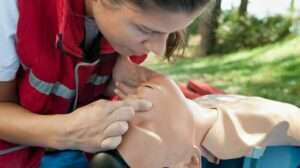
- Give first aid according to what you find: CPR for someone unresponsive and not breathing normally, the recovery position for someone unresponsive but breathing, pressure for severe bleeding, and so on.
- Keep checking the scene. Hazards can change, such as a fire spreading or a structure shifting.
- Hand over to the ambulance crew.
Protecting the Scene for Investigation
After a serious workplace accident, the scene may need to be investigated, to find out what happened and prevent it happening again. As far as is safe and sensible:
- Do not disturb the scene more than you need for first aid and safety. Do not tidy up, clean or move equipment unnecessarily.
- Note what you saw. The position of equipment, spills, guards and anything unusual.
- Take photographs only after casualties are safe, if your employer allows.
- Keep witnesses together if possible, and note their names.
- Tell your employer or manager. They decide on reporting to the authorities. Some serious injuries and dangerous occurrences must be reported under the Reporting of Injuries, Diseases and Dangerous Occurrences Regulations, often called RIDDOR.
Saving life always comes before preserving the scene.
After the Incident
Once the casualty has been handed over, there are things to do.
- Record what happened. Date, time, place, hazards, what you did and what help arrived.
- Report it to your employer.
- Check yourself for injury or exposure. Blood, chemicals, smoke or strain.
- Restock the first aid kit.
- Look after yourself and others. Scenes can be upsetting. Talk to someone you trust, and use any support your employer offers.
- Review. Employers should look at what caused the accident and how to prevent it, and whether first aid arrangements worked.
What Employers Should Do
The Health and Safety (First Aid) Regulations 1981 require employers to provide adequate and appropriate first aid for their employees. For scene safety, employers can help by:
- Identifying hazards. Through risk assessments, so first aiders know what to expect in different areas.
- Training first aiders. As a starting point for low hazard workplaces, HSE suggests at least one appointed person for fewer than 25 employees, at least one first aider trained in Emergency First Aid at Work for 25 to 50 employees, and at least one first aider trained in First Aid at Work for every 100 employees above that, or part of 100. Higher hazard workplaces need more. A first aid needs assessment gives the best answer.
- Making emergency isolators easy to find, clearly marked and reachable.
- Providing protective equipment, such as gloves and high visibility clothing, with the first aid kit.
- Having clear emergency procedures. Who calls 999, who isolates the hazard, who meets the ambulance, who looks after bystanders.
- Practising drills. So everyone knows what to do.
- Making sure first aiders know their limits, and understand that they should not enter dangerous areas.
- Providing support after incidents.
How an EFAW Course Teaches Scene Assessment
An Emergency First Aid at Work course starts with assessing an incident safely. On the day, you can expect to:
- Learn the role of a first aider, including your limits and your safety.
- Practise a scene check. Looking for hazards, thinking about what to do and deciding whether to approach.
- Work through realistic scenarios. For example, a colleague collapsed near equipment, or a spill in a kitchen.
- Learn how to make a scene safe, where it is reasonable to do so.
- Practise calling for help clearly. And giving a good handover.
- Learn about infection control. Gloves, hygiene and safe disposal.
- Learn when not to move a casualty.
- Be assessed in person. A qualified trainer watches your skills.
The course is a one day, regulated Level 3 qualification, and HSE guidance says it should include at least six hours of training time, not counting breaks. You also learn adult CPR, how to use an AED, the recovery position, how to help a choking adult, how to control serious bleeding, how to manage shock and how to treat minor injuries. The certificate is valid for three years. HSE strongly recommends a short refresher each year, although it is not a legal requirement.
Choosing a Good Course in London
Look for:
- A regulated Level 3 Award in Emergency First Aid at Work (RQF) from a recognised awarding organisation.
- At least six hours of training time, not counting breaks.
- Hands on practice, with realistic scenarios that include scene assessment.
- Practical assessment in person. HSE guidance expects this for a workplace first aider, so online only courses are generally not suitable.
- Qualified, experienced trainers.
- Small classes. Many awarding organisations set a maximum of around 12 learners per trainer.
- A clear certificate and a clear total price.
HSE stopped approving first aid training providers in 2013, so be cautious of any claim that a course is HSE approved. In London in 2026, public prices for a one day course commonly range from about £65 to £150 per person. One provider page, linked above, lists £89 per person for classroom training and £75 per person for groups of five or more, at the time of writing in October 2026. Prices change, so always confirm. You can review the Emergency First Aid at Work training page to see how one provider presents its course, price and booking options.
Why London Workplaces Should Be Ready
London has a huge range of workplaces, from busy kitchens and building sites to warehouses, shops and offices, many spread over several floors and close to busy roads. Hazards can be close together, and bystanders and traffic add to the risk. Roads and public transport can be congested, so ambulances may take time to arrive, and a calm, safe response by a trained first aider in the first minutes matters. There is also a very large number of training providers and dates in London, and many deliver training at your workplace, which is a practical way to practise scene assessment in your real environment.
Final Thoughts
So, how do you safely assess an accident scene before giving help? Stop, look and think. Check for danger to yourself, the casualty and others. Make the scene safe if you can do so without risk, and if not, call 999 and wait. Count the casualties, call for help early, send someone for the first aid kit and AED, and only move a casualty if they are in immediate danger. Then begin first aid, keep checking the scene and hand over clearly. Your safety is not a distraction from first aid. It is the first step.
A calm few seconds at the start makes everything after it safer and more effective. When you are ready to practise with a trainer, take a look at the Emergency First Aid at Work course in London and choose a date that suits you.
Frequently Asked Questions
1. How do you safely assess an accident scene?
Stop, look and think. Check what has happened, whether the danger is still present and what hazards there are to you, the casualty and others. Make the scene safe if you can do so without risk, call 999 early, count the casualties and begin first aid only when it is safe to approach.
2. Why must a first aider check for danger first?
Because a rescuer who is injured becomes a second casualty and cannot help anyone. Checking for danger first protects you, the casualty and bystanders, and is the first step in the standard first aid sequence.
3. What hazards should I look for at a workplace accident?
Moving machinery, electricity, fire and smoke, gas and chemicals, confined spaces, heights and unstable structures, traffic, water, falling objects, glass, slippery floors, violence, blood and body fluids, hot surfaces and bad weather.
4. Should I move an injured person?
Not unless they are in immediate danger, such as from fire, fumes or traffic, or you cannot give life saving first aid where they are. Moving a casualty can worsen injuries, especially to the neck and back, so move them as little as possible.
5. What should I do if there is a live electrical hazard?
Do not touch the person until the power is off. If you can safely switch off at the source or unplug the equipment, do so. If you cannot, or if it is high voltage equipment or overhead cables, keep well away and call 999.
6. What should I do if I cannot make the scene safe?
Do not go in. Call 999, tell them clearly what the hazard is and where you are, keep others back and wait for the emergency services to make it safe.
7. What should I say when I call 999?
Which service you need, the full location, what has happened, how many people are hurt, any hazards, and your name and phone number. Put the phone on speaker, follow the call handler’s advice and send someone to meet the ambulance.
8. Should I keep the scene untouched for investigation?
As far as is safe and sensible, yes, but saving life always comes first. Avoid unnecessary tidying, note what you saw, keep witnesses together and tell your employer, who decides on reporting to the authorities.
9. Does an EFAW course teach scene assessment?
Yes. An Emergency First Aid at Work course begins with the role of a first aider and assessing an incident safely, with scenarios and practice. It is a one day regulated Level 3 qualification with at least six hours of training time.
10. Where can I learn first aid in London?
You can book an Emergency First Aid at Work course through a training provider that offers the regulated qualification, either as a public course or as training at your workplace. Check the practical content, the awarding organisation, the class size and the total price before you book.