For many people, the hardest part of CPR is not the pushing. It is the thought of putting their mouth on a stranger’s. Worries about hygiene, awkwardness, or simply not knowing how can make people freeze, and a frozen bystander helps nobody.
The good news is that current UK guidance is clear and reassuring. In this guide, we explain in plain English whether you need to give mouth to mouth in CPR, what the latest guidelines say, how rescue breaths work for those who are trained and what to do if you would rather not give them. We also show how it connects to what you learn on an Emergency First Aid at Work (EFAW) course in London. If you want to see a real course page as you read, here is the Emergency First Aid at Work course in London.
Important Notes First
- This guide is general information, not training. Rescue breaths are a physical skill that is best learned on a manikin with a trainer.
- This guide covers adults. CPR for children and babies is different, and rescue breaths matter more for them, so learn it on a paediatric first aid course.
- In a real emergency, call 999 first. The call handler can talk you through CPR and tell you what to do.
- Any CPR is better than no CPR. Never let worry about breaths stop you from starting.
The Short Answer
You do not have to give mouth to mouth. If you have not been trained to give rescue breaths, or you are unable or unwilling to do so, give continuous chest compressions only, without stopping, until help takes over. If you are trained and willing, give 30 chest compressions followed by 2 rescue breaths, and keep repeating. Either way, call 999 and use an AED as soon as one is available.
What the Latest Guidelines Say
The Resuscitation Council UK published updated Adult Basic Life Support guidelines on 27 October 2025, based on the European Resuscitation Council guidelines 2025. On rescue breaths, they say:
- If you have been trained to provide rescue breaths, alternate 30 chest compressions with 2 rescue breaths.
- When giving rescue breaths, deliver just enough air to make the chest start to rise, and avoid excessive ventilation.
- If you are unable to ventilate the chest after two attempts, consider a foreign body airway obstruction, which means that something may be blocking the airway.
- If you are not trained to provide rescue breaths, perform continuous chest compressions without interruptions.
The guidelines also describe the role of the 999 call handler. They say that the call handler should assume that the caller does not know how to perform CPR, and give chest compression only instructions. If the caller then says that they know how to give rescue breaths, the call handler should help them do 30 to 2 CPR.
In other words, the system is designed so that nobody is left without guidance, and nobody is made to do something they have not been trained to do.
Why Compression Only CPR Is Acceptable
There are several good reasons why guidelines accept chest compressions alone for untrained or unwilling rescuers.
Starting is what matters most
The biggest risk in cardiac arrest is that nobody starts CPR. The 2025 guidelines stress that it is more important that people feel able to do something to help than become focused on small details or concerned about causing harm, and that no greater harm can occur than failing to act when someone requires CPR and defibrillation.
It is simpler
Compression only CPR is easy to remember and easy to do, and call handlers can talk anyone through it over the phone. There is no need to tilt the head, seal a mouth or judge when the chest rises.
It avoids interruptions
When you stop to give breaths, blood flow stops. Continuous compressions keep blood moving to the brain and heart.
It removes barriers
Some people are uncomfortable with mouth to mouth, whether because of hygiene, fear of infection or cultural or personal reasons. Compression only CPR means they can still help.
It still works
In the first minutes after a cardiac arrest, the blood still contains oxygen, and chest compressions can circulate it. That is why compressions are the priority, and why bystander CPR and AED use increase the chances of survival by two to four times, according to the Resuscitation Council UK.
When Rescue Breaths Matter More
Although compression only CPR is fine for most lay rescuers, rescue breaths are valuable, and trained rescuers are encouraged to give them. They can be especially important in situations where the cardiac arrest is caused by a lack of oxygen rather than a heart rhythm problem, or when CPR has been going on for longer. Examples include:
- Drowning.
- Choking that has led to collapse.
- Drug overdose or poisoning affecting breathing.
- Severe asthma or other breathing emergencies.
- Children and babies, whose cardiac arrests are more often caused by breathing problems.
- Prolonged CPR, when the oxygen in the blood is used up.
These are reasons why training in rescue breaths is worthwhile, and why paediatric first aid courses emphasise them. They are not reasons to hold back from compression only CPR if you are untrained or unable.
How to Give Rescue Breaths: Step by Step
If you have been trained and are willing, here is the sequence for an adult. A trainer will show you how, with a manikin and a face shield.
Step 1: Start chest compressions first
Give 30 compressions in the centre of the chest, at least 5 cm but not more than 6 cm deep, at 100 to 120 a minute, allowing the chest to recoil fully. See our guide to adult CPR step by step.
Step 2: Open the airway
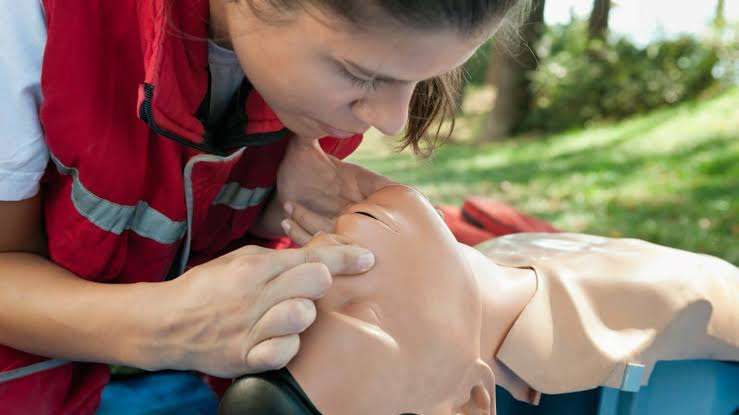
After 30 compressions, tilt the head back gently and lift the chin, using two fingers under the point of the chin and a hand on the forehead. This lifts the tongue away from the back of the throat.
Step 3: Pinch the nose
Using the finger and thumb of the hand on the forehead, pinch the soft part of the nose closed.
Step 4: Seal your mouth over theirs
Take a normal breath, open your mouth wide and seal your lips around their mouth. If you are using a face shield or pocket mask, place it as instructed.
Step 5: Blow steadily
Blow into their mouth steadily over about one second, watching their chest. You want just enough air to make the chest start to rise. Do not blow hard or fast, and do not give a very large breath. Over inflating can push air into the stomach and make vomiting more likely.
Step 6: Let the chest fall
Take your mouth away, and watch the chest fall.
Step 7: Give a second breath
Repeat once more. That is two breaths in total.
Step 8: Return to compressions straight away
Place your hands back in the centre of the chest without delay, and give 30 more compressions. Keep the pause for breaths as short as possible.
Step 9: Keep going
Continue 30 compressions to 2 breaths until help takes over, the person starts to show clear signs of life, you are too exhausted or it becomes unsafe. If another rescuer is present, swap roughly every two minutes with as little delay as possible.
If the chest does not rise
If the chest does not rise with a breath, check that the head is tilted and the chin lifted, check the mouth for anything you can see and easily remove, and try again. If you cannot ventilate the chest after two attempts, consider that the airway may be blocked, and carry on with compressions. Do not waste time. Then try breaths again after the next cycle of compressions.
Using a Face Shield or Pocket Mask
A face shield or pocket mask is a small, light device that creates a barrier between your mouth and the casualty’s. It usually has a one way valve so that breath goes in, but the casualty’s breath and any fluids do not come back to you.
- Keep one in your first aid kit, your bag or your car.
- Learn to use it on a course, because using one is a skill.
- Place it carefully. The shield should cover the mouth and nose, depending on the type, with the valve over the mouth.
- Follow the instructions supplied with it.
If you do not have one, you do not have to give breaths. Compression only CPR is acceptable.
What About Infection?
Many people worry about catching something from mouth to mouth. The Resuscitation Council UK says that the risk of infection to rescuers performing CPR is low. Even so, you can reduce it further by using a face shield or pocket mask, and by washing your hands afterwards. For more, see our guide on how to protect yourself from infection when giving first aid. If you are not comfortable, give chest compressions only.
Common Worries, Answered
What if I do not know how to do rescue breaths?
Then do not worry. Give continuous chest compressions only. The 999 call handler will guide you and will assume that you have no training.
What if I am uncomfortable giving mouth to mouth?
That is completely understandable. You can choose compression only CPR, and that is just as acceptable under the guidelines.
What if the person has vomited, or has blood around the mouth?
You can carry on with compressions only. If you wish to give breaths, turn the person’s head to the side to let fluids drain, wipe the mouth quickly with a cloth, and use a face shield, though you should not delay compressions.
What if I am worried about hurting them?
The risk of harm from CPR is low, and you should not be concerned about causing injury if the person is not in cardiac arrest. If they are unresponsive and not breathing normally, they need CPR. Ribs can break, which is common in effective CPR, and is not a reason to stop.
What if I am worried about getting it wrong?
Any CPR is much better than none, and the call handler will help. Training increases your confidence and skill.
Do I need to stop compressions to give breaths if I am alone?
If you are alone, and trained, give 30 compressions then 2 breaths. If you are not trained or unwilling, give continuous compressions. Either way, keep interruptions short.
Can the call handler tell me to give breaths?
The call handler is likely to give chest compression only instructions. If you tell them you know how to give breaths, they can help you do 30 to 2 CPR.
Is it different for someone who has collapsed after exercise?
The guidelines note that early after a cardiac arrest, especially in athletes, a person may show a near normal or panting breathing pattern, which can mislead rescuers. The advice is to call 999 for any unresponsive person, and if in doubt, treat as cardiac arrest.
What Else Changed in the 2025 Guidelines?
The core CPR numbers remain the same, at least 5 cm but not more than 6 cm for depth, and 100 to 120 compressions a minute, but there are some changes and additions worth knowing. Here are the main ones.
- Call 999 first. For any unresponsive person, call 999 without delay, then assess breathing while waiting for the call to be answered. Rescuers no longer need to confirm abnormal breathing before calling. The call handler can help you decide if you are unsure.
- Breathing patterns. Slow, laboured breathing, gasping or panting must be recognised as signs of cardiac arrest. If a person is unresponsive with abnormal breathing, assume cardiac arrest, and if there is any doubt, start CPR.
- Soft surfaces. Do not move a person from a soft surface such as a bed to the floor. Start CPR on the bed and, if needed, compress the chest deeper to compensate for the soft mattress.
- Pad placement and bras. If the pads can be placed on bare skin without removing the bra, that is acceptable, but if the bra gets in the way, remove it. Prioritise life saving interventions.
- AED access. AEDs should be prominently signposted, kept in unlocked cabinets, accessible 24 hours a day and registered with The Circuit. Signage should say that no training is needed to use one.
- Support for rescuers. Finding someone in cardiac arrest can be traumatic, and lay rescuers and bystanders may benefit from support. The Resuscitation Council UK has a dedicated page for people affected by cardiac arrest.
Training providers update their courses to follow current guidelines, so it is worth asking your provider how they teach the sequence. If you took a course some time ago, your skills are still useful, and a refresher will bring you up to date.
What an EFAW Course Teaches About Breaths
On an Emergency First Aid at Work course, you learn both ways of giving CPR. On the day, you can expect to:
- Learn compression only CPR as the starting point for everyone.
- Learn rescue breaths with a manikin and a face shield or pocket mask.
- Practise the 30 to 2 cycle, timing your breaths and returning quickly to compressions.
- Learn to judge a breath. Just enough air to make the chest start to rise.
- Learn what to do if the chest does not rise.
- Practise with a partner, swapping roles to avoid fatigue.
- Combine CPR with an AED.
- Work through scenarios, such as a colleague collapsing in the office.
- Be assessed in person. A qualified trainer watches your skills.
The course is a one day, regulated Level 3 qualification, and HSE guidance says it should include at least six hours of training time, not counting breaks. You also learn how to assess an incident safely, use an AED, place someone in the recovery position, help a choking adult, control serious bleeding, manage shock and treat minor injuries. The certificate is valid for three years. Skills such as CPR can fade without practice, so HSE strongly recommends a short refresher each year, although it is not a legal requirement.
What Workplaces Should Do
The Health and Safety (First Aid) Regulations 1981 require employers to provide adequate and appropriate first aid for their employees. For CPR, workplaces can:
- Provide face shields or pocket masks in first aid kits, and make sure first aiders know how to use them.
- Provide and sign an AED, if the needs assessment suggests it, and register it on The Circuit.
- Train first aiders. As a starting point for low hazard workplaces, HSE suggests at least one appointed person for fewer than 25 employees, at least one first aider trained in Emergency First Aid at Work for 25 to 50 employees, and at least one first aider trained in First Aid at Work for every 100 employees above that, or part of 100. Higher hazard workplaces need more. A first aid needs assessment gives the best answer.
- Make clear that compression only CPR is fine for staff who are not trained or are unwilling to give breaths, so nobody feels pressured.
- Offer refreshers and practice.
- Support staff after an incident. Time, a quiet space and access to employee support.
Choosing a Good Course in London
Look for:
- A regulated Level 3 Award in Emergency First Aid at Work (RQF) from a recognised awarding organisation.
- At least six hours of training time, not counting breaks.
- Hands on practice with manikins, face shields and a training AED.
- Teaching that follows current guidelines.
- Practical assessment in person. HSE guidance expects this for a workplace first aider, so online only courses are generally not suitable.
- Qualified, experienced trainers.
- Small classes. Many awarding organisations set a maximum of around 12 learners per trainer.
- A clear certificate and a clear total price.
HSE stopped approving first aid training providers in 2013, so be cautious of any claim that a course is HSE approved. In London in 2026, public prices for a one day course commonly range from about £65 to £150 per person. One provider page, linked above, lists £89 per person for classroom training and £75 per person for groups of five or more, at the time of writing in October 2026. Prices change, so always confirm. You can review the Emergency First Aid at Work training page to see how one provider presents its course, price and booking options.
Why London Needs Confident Bystanders
London workplaces and public places are busy and crowded, and roads and public transport can be congested, so ambulances may take time to reach a patient. In those first minutes, a bystander who is willing to start compressions, whether or not they give breaths, can make a real difference. There is also a very large number of training providers and dates in London, and many deliver training at your workplace, which is a practical way to help a whole team feel ready.
Final Thoughts
So, do you need to give mouth to mouth in CPR? No. If you are untrained, unable or unwilling, give continuous chest compressions only, hard and fast in the centre of the chest, and call 999. If you are trained and willing, give 30 compressions followed by 2 rescue breaths, using just enough air to make the chest start to rise, and keep the pauses short. Use an AED as soon as one arrives, and carry on until help takes over. The most important thing is to start.
If you would like to feel confident either way, practice with a trainer is the best way. When you are ready, take a look at the Emergency First Aid at Work course in London and choose a date that suits you.
Frequently Asked Questions
1. Do you have to give mouth to mouth when doing CPR?
No. If you have not been trained to give rescue breaths, or you are unable or unwilling to, give continuous chest compressions only until help takes over. If you are trained and willing, alternate 30 compressions with 2 rescue breaths.
2. Is compression only CPR as good as CPR with breaths?
Compression only CPR is accepted by UK guidelines for untrained or unwilling rescuers, and is much better than doing nothing. Trained rescuers are encouraged to give 30 compressions and 2 breaths, which can matter more in some situations such as drowning or in children.
3. How do you give rescue breaths to an adult?
After 30 compressions, tilt the head back and lift the chin, pinch the nose, seal your mouth over theirs and blow steadily for about one second, giving just enough air to make the chest start to rise. Give two breaths, then return straight to compressions.
4. How much air should I give in a rescue breath?
Just enough to make the chest start to rise. Avoid excessive ventilation, because blowing too hard or too much can push air into the stomach.
5. What if the chest does not rise when I give a breath?
Check that the head is tilted and the chin lifted, check the mouth for anything you can see and easily remove, and try again. If you cannot ventilate the chest after two attempts, consider that the airway may be blocked, and carry on with compressions.
6. Can I catch an infection from giving mouth to mouth?
The Resuscitation Council UK says that the risk of infection to rescuers performing CPR is low. You can reduce it further with a face shield or pocket mask, and by washing your hands afterwards. If you are not comfortable, give compression only CPR.
7. What will the 999 call handler tell me to do?
They are likely to give chest compression only instructions, assuming you do not know how to give breaths. If you tell them you know how, they can help you do 30 to 2 CPR. Put the phone on speaker and follow their instructions.
8. Do I need to call 999 before checking breathing?
Under the 2025 guidelines, call 999 for any unresponsive person without delay, then assess breathing while waiting for the call to be answered. If they are unresponsive with abnormal breathing, assume cardiac arrest and start CPR. The call handler can help if you are unsure.
9. Does an EFAW course teach rescue breaths?
Yes. An Emergency First Aid at Work course teaches compression only CPR and rescue breaths with a manikin and a face shield, along with AED use. It is a one day regulated Level 3 qualification with at least six hours of training time.
10. Where can I learn CPR in London?
You can book an Emergency First Aid at Work course through a training provider that offers the regulated qualification, either as a public course or as training at your workplace. Check the practical content, how the provider teaches current guidelines, the class size and the total price before you book.