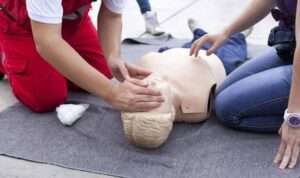

It is the first aid skill that most people hope they will never need and are most afraid of getting wrong. Someone collapses. They are not responding. They are not breathing normally. What do you actually do? In what order? How hard do you push, and how fast?
In this guide, we walk through adult CPR step by step, following the sequence taught on an Emergency First Aid at Work (EFAW) course in London and based on the 2021 Resuscitation Council UK guidelines. We also explain the common worries, the mistakes to avoid and why practising with a trainer matters so much. Please read this as an introduction, not a replacement for a practical course. If you want to see a real course page as you read, here is the Emergency First Aid at Work course in London.
Important Notes Before You Read
- This guide is for adults. CPR for babies and children is different, so learn it on a paediatric first aid course.
- It is general information, not training. Reading about CPR is not the same as practising it. A trainer can check your hand position, depth and rhythm.
- In a real emergency, call 999 first. The call handler can guide you through CPR over the phone.
- Never practise chest compressions on a real person who is breathing normally. Use a manikin on a course, or a firm cushion for hand position only.
The Short Answer
If an adult is unresponsive and not breathing normally, call 999, ask for an AED and start chest compressions straight away. Push hard and fast in the centre of the chest, to a depth of at least 5 cm but not more than 6 cm, at a rate of 100 to 120 compressions a minute. If you are trained and willing, give 2 rescue breaths after every 30 compressions. If you are not, keep going with compressions only. Use the AED as soon as it arrives, and carry on until help takes over.
When Is CPR Needed?
CPR, or cardiopulmonary resuscitation, is for someone who is unresponsive and not breathing normally. The 2021 Resuscitation Council UK guidelines say to start CPR in any unresponsive person with absent or abnormal breathing.
The word abnormal matters. In the first few minutes after a cardiac arrest, a person may take slow, noisy, gasping breaths. This is sometimes called agonal breathing, and it must not be confused with normal breathing. If in doubt, treat it as cardiac arrest and start CPR.
Step by Step: Adult CPR
Here is the sequence, in the order you would use it.
Step 1: Check for danger
Before you touch anyone, look around. Make sure that you, the person and any bystanders are safe. Look for traffic, fire, electrical hazards, broken glass, spilt liquids or anything else that could harm you. If the scene is not safe, do not put yourself at risk. Call 999 and wait for the emergency services.
Step 2: Check for a response
Kneel beside the person. Say loudly, Are you all right? and gently shake their shoulders. If they respond, they are not in cardiac arrest, and you should find out what is wrong and get help as needed. If they do not respond, carry on.
Step 3: Shout for help
Call out for help. If someone is nearby, point to a specific person and give clear instructions, for example: You, call 999 and put it on speaker. You, find a defibrillator. Specific instructions work much better than a general shout.
Step 4: Open the airway
Tilt the head back gently and lift the chin, using two fingers under the point of the chin and a hand on the forehead. This opens the airway so that you can check for breathing.
Step 5: Check for normal breathing
While keeping the airway open, look, listen and feel for normal breathing. Look for chest movement, listen for breath sounds and feel for breath on your cheek. Spend no more than 10 seconds on this.
- If the person is breathing normally, place them in the recovery position, call 999 if you have not already done so, and monitor them until help arrives.
- If they are not breathing normally, or you are unsure, treat it as cardiac arrest and go to the next step.
Step 6: Call 999 and send for an AED
If you are alone, call 999 yourself, put the phone on speaker and place it beside you, so that you can listen to the call handler and keep your hands free. If someone else is with you, ask them to call 999 and to fetch the nearest AED. The call handler can guide you through CPR, and can help locate a defibrillator.
If you are alone and there is no phone signal, or an AED is very close, use your judgement. In general, start CPR as soon as you can.
Step 7: Start chest compressions
This is the most important step. Here is how to do it.
- Position. Kneel beside the person, with their chest bare if possible, or over clothing if not.
- Hand placement. Place the heel of one hand in the centre of the chest, on the lower half of the breastbone. Place the heel of your other hand on top, and interlock your fingers, keeping them off the ribs.
- Body position. Lean over the person so that your shoulders are directly above your hands, with your arms straight and your elbows locked.
- Depth. Press straight down to a depth of at least 5 cm but not more than 6 cm. This takes real effort.
- Release. After each push, release all the pressure without losing contact with the chest, so that it can recoil fully.
- Rate. Aim for 100 to 120 compressions a minute. That is roughly two compressions a second. Equal time pressing and releasing helps you keep a steady rhythm.
- Count. Count aloud to 30.
Do not stop to check for signs of life during compressions unless the person starts to show clear signs of recovery.
Step 8: Give rescue breaths, if you are trained and willing
After 30 compressions, give 2 rescue breaths.
- Tilt the head back and lift the chin to open the airway.
- Pinch the soft part of the nose closed with the finger and thumb of the hand on the forehead.
- Take a normal breath, seal your mouth around the person’s mouth and blow steadily for about one second, watching for the chest to rise.
- Let the chest fall, and give a second breath.
- Return your hands to the centre of the chest straight away and give 30 more compressions.
Keep the pauses short. Do not take more than about 10 seconds to give the two breaths. Continue with 30 compressions to 2 breaths.
If you are not trained, or unable or unwilling to give rescue breaths, give chest compressions only, continuously, at 100 to 120 a minute. Compression only CPR is much better than doing nothing, and call handlers will often advise it for untrained members of the public.
Step 9: Use an AED as soon as it arrives
An automated external defibrillator, or AED, is a machine that can deliver an electric shock to help restart the heart. It is designed for ordinary people to use, and it gives clear spoken instructions.
- Switch it on. Some turn on when you open the lid.
- Follow the voice and picture prompts.
- Attach the pads to the person’s bare chest as shown on the pads. If the chest is wet, dry it quickly, and if it is very hairy, follow the machine’s instructions.
- Let the machine analyse the heart rhythm. Make sure nobody is touching the person.
- If a shock is advised, make sure that nobody is touching the person, and press the shock button when told. Some machines deliver the shock automatically.
- Restart CPR immediately after the shock, or if no shock is advised, and carry on following the prompts.
While one person uses the AED, others should keep up compressions until the machine says to stop.
Step 10: Keep going until help takes over
Continue CPR until:
- Professional help arrives and takes over.
- The person shows clear signs of life, such as coughing, opening their eyes, speaking or moving purposefully, and starts to breathe normally.
- You are too exhausted to continue.
- It becomes unsafe to continue.
If other people are available, swap over roughly every two minutes, with as little delay as possible, because compressions are tiring and quality drops with fatigue. If the person starts to breathe normally, place them in the recovery position and keep watching their breathing, ready to start again if it stops.
A Quick Summary You Can Remember
- Danger. Is it safe?
- Response. Do they respond?
- Shout for help.
- Airway. Open it.
- Breathing. Normal? No more than 10 seconds.
-
- Call, and ask for an AED.
- Compressions. Centre of the chest, at least 5 cm and not more than 6 cm, 100 to 120 a minute.
- Breaths. Two after every 30, if trained and willing.
- AED. Switch on, follow the prompts.
- Keep going until help takes over.
Common Worries, Answered
What if I hurt them?
Chest compressions can break ribs, and this is common in effective CPR. It is not a reason to stop. A person in cardiac arrest is not alive without help, so the priority is to keep blood and oxygen moving.
What if I get it wrong?
Doing something is far better than doing nothing. Even imperfect CPR can help. The aim of training is to make it as good as possible, but do not let fear of mistakes stop you from starting.
Can I get in trouble for helping?
The law in England and Wales looks kindly on people who act sensibly and in good faith to help others. The Social Action, Responsibility and Heroism Act 2015 says courts should consider this when they decide on negligence. This is general information, not legal advice.
What if I am uncomfortable with mouth to mouth?
You can give compression only CPR. Keep pushing hard and fast, and use a face shield or pocket mask for breaths only if you have one and are happy to use it.
What if the person is not an adult?
This guide is for adults. CPR for children and babies is different, with changes to hand position, depth and breaths. If you care for young children, take a paediatric first aid course.
What if I am not sure whether they are breathing normally?
If you are unsure, treat it as cardiac arrest. Do not waste time. Gasping or noisy breathing that is not regular and normal is a sign of cardiac arrest, not recovery.
Why These Steps Matter: The Numbers
More than 30,000 people have an out of hospital cardiac arrest in the UK each year, according to the British Heart Foundation, and fewer than one in ten survive. Every minute without CPR and defibrillation reduces the chance of survival by up to 10 percent. Early CPR and defibrillation can double a person’s chance of survival. That is why the first steps, calling for help, starting compressions and using an AED, matter so much.
How an EFAW Course Teaches CPR
Reading the steps is one thing. Doing them is another. On an Emergency First Aid at Work course, you learn CPR in a practical, hands on way.
- A trainer demonstrates. You see the steps and hear the reasons.
- You practise on a manikin. You kneel, find the right hand position and push to the right depth.
- You get feedback. The trainer corrects small mistakes, such as hand position, rhythm and arm position.
- You use a training AED. You switch it on, place the pads and follow the prompts.
- You swap and repeat. You practise several times, so the movements become natural.
- You work through scenarios. For example, a colleague collapsing at their desk.
- You are assessed in person. A qualified trainer watches your skills.
The course is a one day, regulated Level 3 qualification. HSE guidance says it should include at least six hours of training time, not counting breaks. The certificate is valid for three years. You also learn how to help a choking adult, place someone in the recovery position, control serious bleeding, manage shock and treat minor injuries.
Why Practice Matters
Skills such as CPR can fade without practice. Research suggests that the quality of chest compressions can begin to drop within about three to six months. That is why HSE strongly recommends a short refresher each year, although it is not a legal requirement, and why renewal means retaking the full course before your three year certificate expires. A little regular practice, for example walking through the steps in your head every month, helps keep your skills fresh. For more, see our guide on how quickly first aid skills fade.
Why Workplaces Need Trained People
The Health and Safety (First Aid) Regulations 1981 require employers to provide adequate and appropriate first aid for their employees. As a starting point for low hazard workplaces, HSE suggests at least one appointed person for fewer than 25 employees, at least one first aider trained in Emergency First Aid at Work for 25 to 50 employees, and at least one first aider trained in First Aid at Work for every 100 employees above that, or part of 100. Higher hazard workplaces need more. A first aid needs assessment gives the best answer. Knowing where your workplace AED is, and who the first aiders are, is part of being prepared.
Choosing a Good Course in London
If you want to learn CPR properly, choose a course with real practice.
- A regulated Level 3 Award in Emergency First Aid at Work (RQF) from a recognised awarding organisation.
- At least six hours of training time, not counting breaks.
- Plenty of hands on practice with manikins and a training AED.
- Practical assessment in person. HSE guidance expects this for a workplace first aider, so online only courses are generally not suitable.
- Qualified, experienced trainers.
- Small classes. Many awarding organisations set a maximum of around 12 learners per trainer.
- A clear certificate and a clear total price.
HSE stopped approving first aid training providers in 2013, so be cautious of any claim that a course is HSE approved. In London in 2026, public prices for a one day course commonly range from about £65 to £150 per person. One provider page, linked above, lists £89 per person for classroom training and £75 per person for groups of five or more, at the time of writing in October 2026. Prices change, so always confirm. You can review the Emergency First Aid at Work training page to see how one provider presents its course, price and booking options.
Why London Needs Trained First Aiders
London workplaces and public places are busy and crowded, and many people commute long distances. Roads and public transport can be congested, so ambulances may take time to reach a patient, and the people nearby are often the first help available. There is also a very large number of training providers and dates in London, and many deliver training at your workplace, which is a practical way to train a whole team in CPR together.
Final Thoughts
So, how do you do CPR on an adult? Check for danger, check for a response, shout for help, open the airway and check for normal breathing for no more than 10 seconds. If they are not breathing normally, call 999, send for an AED and start chest compressions in the centre of the chest, at least 5 cm but not more than 6 cm deep, at 100 to 120 a minute. Give 2 breaths after every 30 compressions if you are trained and willing, or keep going with compressions only. Use the AED as soon as it arrives, and carry on until help takes over.
Reading this is a good start, but practice makes it real. When you are ready, take a look at the Emergency First Aid at Work course in London and choose a date that suits you.
Frequently Asked Questions
1. How do you do CPR on an adult?
Check for danger and a response, shout for help, open the airway and check for normal breathing for no more than 10 seconds. If they are not breathing normally, call 999, send for an AED and start chest compressions in the centre of the chest, at least 5 cm but not more than 6 cm deep, at 100 to 120 a minute.
2. How fast and how deep should adult chest compressions be?
According to the 2021 Resuscitation Council UK guidelines, compress to a depth of at least 5 cm but not more than 6 cm, at a rate of 100 to 120 compressions a minute, allowing the chest to recoil fully after each push.
3. What is the ratio of compressions to breaths in adult CPR?
If you are trained and willing to give rescue breaths, give 2 breaths after every 30 compressions. If you are unable or unwilling to give breaths, give continuous chest compressions only.
4. Do I have to give rescue breaths?
No. If you are untrained, unable or unwilling, compression only CPR is much better than doing nothing. Keep pushing hard and fast in the centre of the chest until help arrives.
5. When should I call 999 for CPR?
As soon as you find that the person is unresponsive and not breathing normally. Put the phone on speaker so that the call handler can guide you while your hands are free, and ask for an AED.
6. How do I use an AED?
Switch it on, follow the spoken prompts, attach the pads to the bare chest as shown, make sure nobody is touching the person while it analyses and delivers a shock if advised, then restart CPR straight away and keep following the prompts.
7. When can I stop CPR?
When professional help takes over, when the person shows clear signs of life and starts to breathe normally, when you are too exhausted to continue or when it becomes unsafe. If other people are available, swap roughly every two minutes.
8. Will CPR break ribs?
It can, and this is common in effective CPR. It is not a reason to stop. Keeping blood and oxygen moving is the priority for a person in cardiac arrest.
9. Can I learn CPR from an article or video?
You can learn the steps, but you cannot check your technique. A practical course with a trainer, a manikin and a training AED lets you practise hand position, depth and rhythm and get feedback. HSE guidance expects practical training for a workplace first aider.
10. Where can I take an Emergency First Aid at Work course in London?
You can book through a training provider that offers the regulated qualification, either as a public course or as training at your workplace. Check the practical content, the class size, the awarding organisation and the total price before you book.