Many workplaces, shopping centres, gyms and train stations now have a bright box on the wall with a heart symbol and a lightning bolt. Inside is an automated external defibrillator, or AED. Most people walk past it without a second look, and many would feel nervous if they ever had to open it.
The good news is that AEDs are designed for ordinary people. They give spoken instructions, and they will not deliver a shock unless it is needed. In this guide, we explain how to use an AED safely, step by step, in plain English. We cover the sequence with CPR, the special situations, the safety rules and what a workplace should do to be ready. This is an introduction, not a replacement for training. A practical course lets you handle a training AED and practise with a trainer. If you want to see a real course page as you read, here is the Emergency First Aid at Work course in London.
Important Notes First
- Call 999 first in a real emergency. Put the phone on speaker. The call handler can guide you and may help you find an AED.
- This guide is for adults. Some AEDs have special settings or pads for children. Follow the machine’s instructions and learn about children on a paediatric first aid course.
- Always follow your own machine’s prompts. Models differ in small ways, and the voice instructions on the day are your main guide.
- This is general information, not training. A trainer can show you your workplace’s machine and check your technique.
The Short Answer
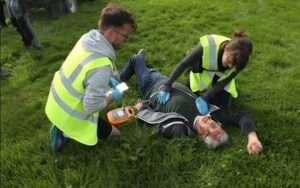
If an adult is unresponsive and not breathing normally, call 999, start chest compressions and send someone for the nearest AED. When it arrives, switch it on and follow the voice prompts. Attach the pads to the person’s bare chest as shown, make sure nobody is touching them while the machine analyses, and press the shock button only if the machine tells you to. Then restart CPR straight away and keep going until help takes over.
An AED will not shock a person who does not need it. So using one when you are unsure is safe.
What Is an AED?
An AED is a portable machine that checks the heart’s rhythm and, if needed, delivers an electric shock to try to restart a normal rhythm. Many cardiac arrests are caused by a chaotic heart rhythm that stops the heart pumping blood. A shock can sometimes reset it, a bit like rebooting a computer.
Key features of an AED:
- Voice and picture prompts. It tells you what to do, step by step.
- Two sticky pads. They attach to the chest and connect to the machine by wires.
- Automatic analysis. The machine decides whether a shock is needed.
- A shock button, or an automatic shock. Some machines tell you to press a button, and others deliver the shock themselves after a warning.
AEDs are made for people with no medical background. The Resuscitation Council UK recommends that people are trained to use one as part of first aid training, because it builds confidence, but anyone can use an AED in an emergency.
Why AEDs Matter
The numbers show why speed matters. More than 30,000 people have an out of hospital cardiac arrest in the UK each year, according to the British Heart Foundation, and fewer than one in ten survive. Every minute without CPR and defibrillation reduces the chance of survival by up to 10 percent. The Resuscitation Council UK has stated that defibrillation within three to five minutes of collapse can produce survival rates as high as 50 to 70 percent. Early CPR and early defibrillation are two key parts of the chain of survival.
Step by Step: Using an AED With CPR
Here is the sequence in the order you would use it.
Step 1: Make sure it is safe
Check for danger before you touch anyone. Look for traffic, fire, electrical hazards or anything that could harm you. If it is not safe, wait for the emergency services.
Step 2: Check the person
Check for a response and for normal breathing, for no more than 10 seconds. If the person is unresponsive and not breathing normally, treat it as cardiac arrest.
Step 3: Call 999 and send for an AED
Call 999, or ask someone to, and ask for an AED. Put the phone on speaker. If you are alone, call 999 first, then start CPR. If an AED is very close and you can reach it without delay, use your judgement, but do not leave the person for long.
Step 4: Start chest compressions
Start CPR straight away: heel of one hand in the centre of the chest, the other hand on top, push at least 5 cm but not more than 6 cm, at 100 to 120 compressions a minute. Do not wait for the AED to arrive before starting.
Step 5: When the AED arrives, switch it on
Open the case or lid. Some machines switch on automatically, and others have an on button. Once on, the AED will start giving voice instructions. Put it beside the person’s head or chest, within easy reach. If you are alone, you may need to pause compressions briefly to switch it on. If someone else is with you, they should keep up compressions while the pads go on.
Step 6: Expose the chest
Remove or cut away clothing from the person’s chest. If there is a bra, remove it so the pads can sit flat on the skin. Pads must touch bare skin.
Step 7: Prepare the skin if needed
Quickly deal with the following, but do not delay the shock for any of them.
- A wet chest. Dry it with a towel or cloth so the pads will stick.
- Very hairy chest. Most AED kits include a small razor. Shave a patch only if hair is excessive and is stopping the pads from sticking. Otherwise, press the pad firmly, or use a second set of pads if you need to rip off the first.
- Medication patches. If there is a patch where a pad should go, remove it with a gloved hand if you can, wipe the skin and apply the pad. If removing it would delay the shock, place the pad in a position that avoids the patch.
- Jewellery or metal. Remove any that is in the way of the pads.
Step 8: Attach the pads
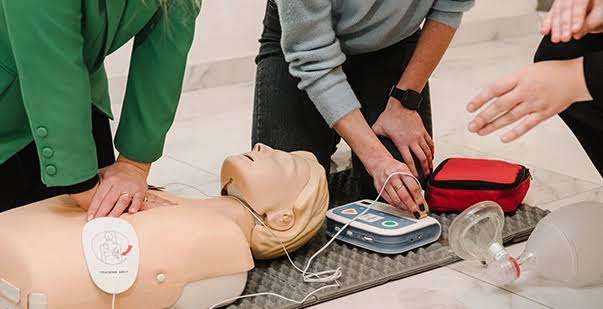
Peel the backing from each pad and stick them firmly to the bare chest, as shown on the pad or on the machine. The standard positions are:
- First pad: the upper right side of the chest, below the collarbone and to the right of the breastbone.
- Second pad: the left side of the chest, below the armpit, along the side of the ribcage, which is called the mid axillary line.
Press each pad down firmly, from one edge to the other, so that it makes full contact. Most pads have a picture showing where each one goes. Plug the pad connector into the machine if it is not already attached.
Step 9: Let the AED analyse
The machine will say something like analysing the heart rhythm, do not touch the patient. At this point:
- Stop compressions, if you were giving them.
- Make sure that nobody is touching the person.
- Stay clear until the machine finishes.
Step 10: Follow the instruction
The machine will tell you one of two things.
Shock advised.
- Make sure that nobody is touching the person. Say loudly, Stand clear, and check that everyone is clear.
- Press the shock button when the machine tells you to, or wait for the machine to deliver the shock if it is a fully automatic model.
- Do not touch the person during the shock.
No shock advised.
- The machine has found that a shock would not help. Do not press anything.
- Restart CPR straight away, and follow the machine’s prompts.
Step 11: Restart CPR immediately
After a shock, or if no shock is advised, restart CPR straight away, with 30 compressions to 2 breaths if you are trained and willing, or continuous compressions if not. The machine will usually prompt you and will count down about two minutes before it analyses again.
Step 12: Keep following the prompts
The AED will repeat the cycle: analyse, shock if needed, then CPR. Keep following its instructions. Leave the pads on the chest, and do not switch the machine off.
Step 13: Keep going until help takes over
Continue until:
- Paramedics arrive and take over.
- The person shows clear signs of life and starts to breathe normally.
- You are too exhausted to continue.
- It becomes unsafe to continue.
If the person starts to breathe normally, place them in the recovery position, leave the pads attached and keep watching their breathing. The AED may still need to analyse again if they stop breathing.
Safety Rules for Using an AED
These are the main safety points. Most are built into the machine’s prompts, but it helps to know why.
- Nobody touches the person during analysis or a shock. This keeps everyone safe and lets the machine read the heart rhythm properly.
- Check that everyone is clear before the shock. Say it out loud, and look around.
- Do not use an AED in standing water. Move the person to a dry area if you can do so quickly, and dry the chest. Water can interfere with the shock and pose a risk.
- Dry the chest. A wet chest stops pads sticking and can cause burns or poor contact.
- Remove medication patches and anything metal in the way. They can block the shock or cause burns.
- Pacemakers and implanted devices. If you see or feel a hard lump under the skin, usually below the collarbone, with a small scar, place the pad at least 8 cm away from it, or use an alternative position as shown on the pads.
- Keep oxygen away. If oxygen is being used, move it away from the person’s chest during a shock, and direct the flow away from the chest.
- Do not use damaged pads or machines. If the machine gives a fault warning, follow its instructions, and carry on with CPR.
- Do not delay. Do not spend long on any of the preparation steps. Quick CPR and a quick shock matter most.
- Use the pads supplied with the machine. Pads are designed to work with specific machines.
Common Worries, Answered
Can I hurt someone by using an AED?
The machine only advises a shock when it detects a rhythm that can be treated with one. It will not shock a person who does not need it. So it is safe to use it when you are unsure.
What if the person is breathing normally?
If the person is responsive or breathing normally, they do not need an AED. Do not use one. Place them in the recovery position, call 999 if you have not already done so and monitor them.
Can I use an AED without training?
Yes. AEDs are designed to be used by anyone, with voice prompts. Training helps you feel more confident and act faster, which is why the Resuscitation Council UK recommends it.
What if I am not sure the pads are in the right place?
Follow the pictures on the pads. Most pads are labelled, and slight differences in position still work. Placing them quickly is more important than getting them perfect.
What if there are many people around?
Give clear jobs. One person calls 999, one fetches the AED, one keeps up compressions, one clears the space and one waits outside to direct the ambulance.
What if the person is a child?
This guide covers adults. Some AEDs have special pads or a child setting. If none is available, adult pads may be used according to the machine’s instructions and local guidance. Learn about children on a paediatric first aid course.
What if I am on my own and the AED is far away?
Call 999 first, start CPR and follow the call handler’s advice. If the AED is very close, they may ask you to fetch it. Use your judgement, and do not leave the person for long.
How an EFAW Course Teaches AED Use
On an Emergency First Aid at Work course, you learn AED use as part of the CPR session.
- A trainer demonstrates. You see a training AED being switched on and used.
- You handle the machine. You open it, switch it on and listen to the prompts.
- You place practice pads. You stick them on a manikin in the right positions.
- You practise the shock routine. You learn to say stand clear and check that nobody is touching.
- You combine it with CPR. You practise restarting compressions straight after the shock.
- You discuss special situations. For example, wet chests, patches and pacemakers.
- You work through scenarios. For example, a colleague collapsing at their desk.
- You are assessed in person. A qualified trainer watches your skills.
The course is a one day, regulated Level 3 qualification. HSE guidance says it should include at least six hours of training time, not counting breaks. You also learn how to help a choking adult, place someone in the recovery position, control serious bleeding, manage shock and treat minor injuries. The certificate is valid for three years. For more on CPR, see our guide to adult CPR step by step.
What Workplaces Should Do About AEDs
The Health and Safety (First Aid) Regulations 1981 require employers to provide adequate and appropriate first aid for their employees. The law does not say that every workplace must have an AED, but your first aid needs assessment may point to one, especially for larger sites, public facing sites or places far from an ambulance. If you have one, here is a checklist.
- Place it where it can be reached quickly. A visible, well signed, accessible location, not a locked room.
- Make sure everyone knows where it is. Include it in inductions and notices.
- Check it regularly. Look at the status indicator, usually a light or a symbol, and check the pads and battery expiry dates, following the manufacturer’s instructions.
- Keep spare pads and a small kit nearby. Often a razor, scissors, gloves, a towel and a face shield.
- Name a person responsible. For checks, replacements and records.
- Train staff. Include AED practice in first aid training and refreshers.
- Register it. Public access defibrillators can be registered on The Circuit, the national defibrillator network, so ambulance services can direct callers to the nearest one.
- Replace pads and batteries after use or before expiry.
- Review after any use. Check the machine, replace supplies and offer support to anyone involved.
As a starting point for low hazard workplaces, HSE suggests at least one appointed person for fewer than 25 employees, at least one first aider trained in Emergency First Aid at Work for 25 to 50 employees, and at least one first aider trained in First Aid at Work for every 100 employees above that, or part of 100. Higher hazard workplaces need more. A first aid needs assessment gives the best answer.
Keeping Your Skills Fresh
Skills can fade without practice. Research suggests that the quality of CPR can begin to drop within about three to six months, though AED skills tend to hold up better because the machine talks you through. HSE strongly recommends a short refresher each year, although it is not a legal requirement, and a refresher does not renew your certificate. Learn where your workplace AED is, look at it when you walk past and practise with a training unit at your refresher.
Choosing a Course That Includes AED Practice
When you compare providers, look for:
- A regulated Level 3 Award in Emergency First Aid at Work (RQF) from a recognised awarding organisation.
- At least six hours of training time, not counting breaks.
- Hands on practice with manikins and a training AED.
- Practical assessment in person. HSE guidance expects this for a workplace first aider, so online only courses are generally not suitable.
- Qualified, experienced trainers.
- Small classes. Many awarding organisations set a maximum of around 12 learners per trainer.
- A clear certificate and a clear total price.
HSE stopped approving first aid training providers in 2013, so be cautious of any claim that a course is HSE approved. In London in 2026, public prices for a one day course commonly range from about £65 to £150 per person. One provider page, linked above, lists £89 per person for classroom training and £75 per person for groups of five or more, at the time of writing in October 2026. Prices change, so always confirm. You can review the Emergency First Aid at Work training page to see how one provider presents its course, price and booking options.
Why London Needs Confident AED Users
London workplaces and public places are busy and crowded, and roads and public transport can be congested, so ambulances may take time to reach a patient. A defibrillator on the wall is only useful if someone is willing and able to use it. There is also a very large number of training providers and dates in London, and many deliver training at your workplace, which is a practical way to teach a whole team where the AED is and how to use it.
Final Thoughts
So, how do you use an AED safely, step by step? Call 999 and start CPR, send for the AED, switch it on and follow the voice prompts. Expose and dry the chest, attach the pads to bare skin, let the machine analyse while nobody touches the person and press the shock button only if told to, after checking that everyone is clear. Restart CPR immediately, keep following the prompts and carry on until help takes over.
An AED will not shock someone who does not need it, so do not be afraid to use one. When you are ready to practise with a trainer, take a look at the Emergency First Aid at Work course in London and choose a date that suits you.
Frequently Asked Questions
1. How do you use an AED step by step?
Call 999 and start CPR, send for the AED, switch it on and follow the prompts, attach the pads to the bare chest, let the machine analyse while nobody touches the person, press the shock button only if told, restart CPR straight away and continue until help takes over.
2. Where do the AED pads go?
One pad goes on the upper right side of the chest below the collarbone, to the right of the breastbone. The other goes on the left side of the chest below the armpit, along the side of the ribcage. Most pads have a picture showing the positions.
3. Can an AED hurt someone who does not need a shock?
No. An AED analyses the heart rhythm and will only advise a shock when it detects a rhythm that can be treated with one. It is safe to use when you are unsure.
4. Can I use an AED without training?
Yes. AEDs are designed for anyone to use and give spoken instructions. The Resuscitation Council UK recommends training as part of first aid training because it builds confidence and speed.
5. Is it safe to use an AED on a wet person?
Dry the chest first, and if the person is lying in water, move them to a dry area if you can do so quickly. Water can stop pads sticking and can interfere with the shock.
6. What if the person has a pacemaker or a medication patch?
If you see or feel a hard lump from a pacemaker, place the pad at least 8 cm away from it. If there is a medication patch where a pad should go, remove it with a gloved hand and wipe the skin, unless that would delay the shock, in which case place the pad to avoid the patch.
7. Do I stop CPR while the AED analyses?
Yes. Stop compressions and make sure nobody touches the person while the machine analyses and delivers a shock. Restart CPR straight away afterwards, and follow the machine’s prompts.
8. When should I stop using the AED?
When paramedics take over, when the person shows clear signs of life and starts to breathe normally, when you are too exhausted to continue or when it becomes unsafe. Leave the pads attached and do not switch the machine off.
9. What should a workplace do to keep an AED ready?
Place it where it can be reached quickly, make sure staff know where it is, check the status indicator, pads and battery regularly, name a person responsible, train staff and register it on The Circuit if it is publicly accessible.
10. Where can I learn to use an AED in London?
You can book an Emergency First Aid at Work course through a training provider that offers the regulated qualification, either as a public course or as training at your workplace. Check that it includes hands on AED practice, and check the class size, the awarding organisation and the total price before you book.