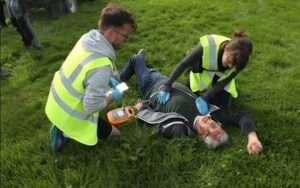
Of all the questions people ask about CPR, this is the most common one: how hard do I actually press? Many people worry that they will not push hard enough. Others are scared of hurting the person. Both worries are natural, and both can get in the way of acting.
In this guide, we explain how hard to press during adult CPR, how fast to go, what it should feel like and how Emergency First Aid at Work (EFAW) courses in London teach it. We base the numbers on the 2021 Resuscitation Council UK guidelines. Please treat this as an introduction, not a replacement for a practical course, because the best way to learn the right force is to practise on a manikin with a trainer. If you want to see a real course page as you read, here is the Emergency First Aid at Work course in London.
Important Notes First
- This guide is about adults. Children and babies need different depth and technique, so learn them on a paediatric first aid course.
- Call 999 first in a real emergency. The call handler can guide you.
- Do not practise chest compressions on a real person who is breathing normally. Use a manikin on a course, or a firm cushion to practise hand position and rhythm only.
- This is general information, not training. A trainer can check your technique.
The Short Answer
For an adult, press down at least 5 cm but not more than 6 cm, at a rate of 100 to 120 compressions a minute, in the centre of the chest, and let the chest come back up fully after every push. In plain terms: press hard, press fast and do not stop for longer than you must.
Most people, when they first try it on a manikin, are surprised by how much effort that takes. That is normal, and it is exactly what a course helps you get used to.
What the Guidelines Say
The 2021 Resuscitation Council UK guidelines say that for adults you should start chest compressions as soon as possible, deliver them on the lower half of the breastbone, in the centre of the chest, and compress to a depth of at least 5 cm but not more than 6 cm. They also give a rate of 100 to 120 compressions a minute, and say to alternate 30 compressions with 2 rescue breaths if you are trained and willing, or to give continuous chest compressions if you are unable or unwilling to give breaths.
The key numbers are:
- Depth: at least 5 cm, not more than 6 cm.
- Rate: 100 to 120 a minute.
- Position: centre of the chest, on the lower half of the breastbone.
- Recoil: release all pressure after each push, without losing contact, so the chest can come back up.
- Pauses: keep interruptions as short as possible.
These are the same figures that EFAW courses teach, because trainers follow current guidelines.
Why Depth Matters
Chest compressions work by squeezing the heart between the breastbone and the spine, which pushes blood around the body when the heart is not pumping on its own. If you press too lightly, the heart is not squeezed enough, and little blood moves. If you press too deeply, you risk causing more injury without much extra benefit. The 5 to 6 cm range is the balance that the guidelines recommend for adults.
A useful way to picture it is that you are pressing down by roughly a third of the depth of the chest. That is a lot more than most people expect.
Why Speed Matters
Rate matters because blood flow depends on how often the heart is squeezed. Too slow, and not enough blood moves. Too fast, and the heart does not have time to refill between compressions. The recommended range of 100 to 120 a minute works out at roughly two compressions every second.
One popular way to keep the beat is to think of songs with a steady rhythm in that range, such as Stayin’ Alive by the Bee Gees, which is often mentioned in CPR awareness campaigns. Some trainers use a metronome or a feedback manikin that beeps or lights up. Choose whatever helps you stay steady, but make sure the rhythm is not too fast.
How Hard Is Hard Enough? What It Feels Like
When you learn on a manikin, you will probably notice these things.
- It takes real effort. You need to use your body weight, not just your arms.
- It is tiring quickly. Many people feel their arms and shoulders working within a minute or two.
- The chest moves further than you expect. Reaching 5 cm feels like a lot.
- A good manikin gives feedback. It may click, beep or show lights to tell you when you reach the right depth.
- Your trainer will correct you. Small changes in position and posture make a big difference.
In a real person, it will also feel like significant resistance, and you may feel or hear ribs break. This is common in effective CPR. It is not a reason to stop. A person in cardiac arrest cannot be revived without blood moving to the brain and heart, so the priority is to keep going.
How to Press Hard Without Wearing Yourself Out
Trainers teach a few simple techniques to deliver force efficiently.
1. Get your position right
Kneel beside the person, close to their chest. Make sure you are on a firm surface where you can kneel comfortably.
2. Place your hands correctly
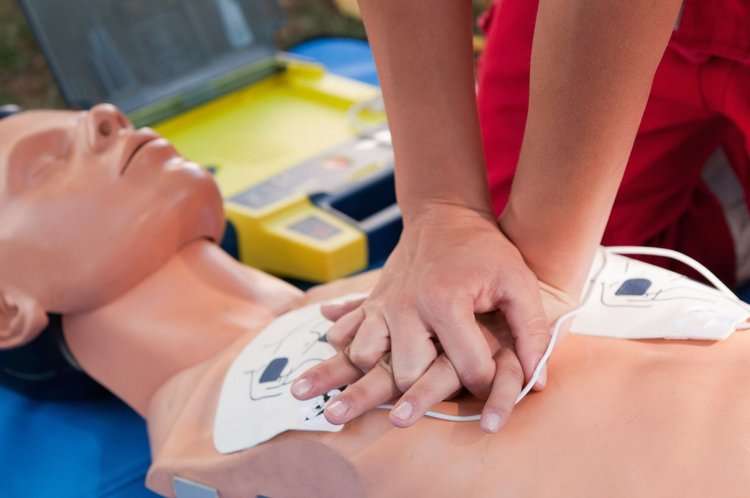
Place the heel of one hand in the centre of the chest, on the lower half of the breastbone. Put the heel of your other hand on top and interlock your fingers, keeping your fingers off the ribs.
3. Lock your elbows and keep your arms straight
Straight arms let you use your body weight, instead of tiring your arm muscles.
4. Get your shoulders over your hands
Lean forward so that your shoulders are directly above your hands. This lets you push straight down, rather than at an angle.
5. Push straight down
Press vertically. Avoid rocking or bouncing, because that wastes energy and affects depth.
6. Release fully
Let the chest come back up completely after every push, without lifting your hands off. Full release lets the heart refill with blood.
7. Keep a steady rhythm
Count aloud, use a song in your head or follow a metronome. An even rhythm helps both speed and depth.
8. Swap when you can
If someone else is available, swap roughly every two minutes, with as little delay as possible. Fatigue makes compressions shallower without you noticing.
Common Mistakes
Trainers see the same mistakes again and again. Knowing them helps you avoid them.
- Pressing too lightly. The most common one. Fear of hurting the person makes people hold back. Research suggests that compression depth is often the first thing to slip.
- Pressing too slowly or too fast. Rhythm can drift, especially when you are nervous.
- Bent arms. Bending your elbows loses force and tires you quickly.
- Hands in the wrong place. Too low, too high or off to one side reduces effectiveness.
- Leaning on the chest. Not letting the chest recoil fully between pushes.
- Bouncing. Using short, jerky movements instead of smooth, firm pushes.
- Long pauses. Stopping too often, or for too long, to check or give breaths.
- Waiting. Hesitating to start because you are unsure. Doing something is better than doing nothing.
- Not swapping. Struggling on alone when someone else could take over.
What If You Are Not Sure You Are Pressing Hard Enough?
If you are unsure, the usual advice is to push harder and faster, within the limits. It is much more common for people to press too lightly than too hard. Studies of CPR skills suggest that shallow compressions are a frequent problem, and that skill quality can start to drop within about three to six months without practice. In a real emergency, a call handler may also encourage you to push harder and keep going.
If you are practising on a manikin with a feedback device, use it. It shows you what the right depth feels like, so you can carry that feeling with you.
What If You Are Worried About Hurting Someone?
This is the biggest fear for many people, so it is worth being clear.
- Broken ribs can happen. They are a known result of effective CPR, and they heal. They are far less serious than cardiac arrest.
- Doing nothing is not safe. More than 30,000 people have an out of hospital cardiac arrest in the UK each year, according to the British Heart Foundation, and fewer than one in ten survive. Every minute without CPR and defibrillation reduces the chance of survival by up to 10 percent.
- You are not expected to be perfect. Imperfect CPR is much better than none.
- The law is generally supportive. The law in England and Wales looks kindly on people who act sensibly and in good faith to help others. The Social Action, Responsibility and Heroism Act 2015 says courts should consider this when they decide on negligence. This is general information, not legal advice.
Does Depth Depend on the Person?
For adults, the guidelines use one range, at least 5 cm but not more than 6 cm, whatever the size of the person. You may find it harder to reach that depth on a larger person, and you may feel less sure about a smaller or older person, but the aim stays the same. Children and babies have different depth guidance, which is why paediatric first aid is taught separately.
What About the Surface and Position?
A firm surface helps, because a soft surface can absorb some of your force. If the person is on a soft bed or sofa, and you can move them to the floor safely without delay, that is usually better, but do not waste precious time. Your trainer can explain how to deal with awkward positions, tight spaces and stairs on a course.
How an EFAW Course Teaches Pressing Depth
An Emergency First Aid at Work course is built around practice, and compression depth is a good example.
- Demonstration. A trainer shows the posture, the hand position and the movement.
- Manikin practice. You kneel at a manikin and practise several times.
- Feedback. Some manikins show depth and rate, and trainers watch and correct your technique.
- Rhythm training. Trainers may use counting, songs or a metronome to help you find 100 to 120 a minute.
- Fatigue practice. You experience how tiring it is, and practise swapping with a partner.
- AED practice. You learn to combine compressions with a training defibrillator.
- Scenarios. For example, a colleague collapsing at their desk, so you practise under mild pressure.
- Assessment. A qualified trainer watches you perform the skills in person.
The course is a one day, regulated Level 3 qualification. HSE guidance says it should include at least six hours of training time, not counting breaks. The certificate is valid for three years. You also learn how to help a choking adult, place someone in the recovery position, control serious bleeding, manage shock and treat minor injuries.
Can You Practise at Home?
You can practise some things, but not everything.
- Hand position and posture. Practise kneeling, locking your elbows and placing your hands on a firm cushion.
- Rhythm. Practise counting to 30 at a steady pace, or use a song or a metronome app.
- Review the steps. Walk through the full sequence in your head.
- What you cannot practise is depth. A cushion does not give realistic resistance, and you must never practise compressions on a real person who is breathing normally. A manikin with a trainer is the best way to learn depth.
Skills can fade quickly without practice, so HSE strongly recommends a short refresher each year, although it is not a legal requirement. A refresher does not renew your certificate, so you still need to retake the full course before your three years end.
What Employers and Workplaces Should Know
The Health and Safety (First Aid) Regulations 1981 require employers to provide adequate and appropriate first aid for their employees. As a starting point for low hazard workplaces, HSE suggests at least one appointed person for fewer than 25 employees, at least one first aider trained in Emergency First Aid at Work for 25 to 50 employees, and at least one first aider trained in First Aid at Work for every 100 employees above that, or part of 100. Higher hazard workplaces need more. A first aid needs assessment gives the best answer. Regular practice, refreshers and knowing where your AED is all help first aiders deliver good compressions when it counts.
Choosing a Course That Teaches It Well
If you want to learn the right force, look for a course with strong practical teaching.
- A regulated Level 3 Award in Emergency First Aid at Work (RQF) from a recognised awarding organisation.
- At least six hours of training time, not counting breaks.
- Plenty of hands on practice with manikins, ideally with feedback, and a training AED.
- Practical assessment in person. HSE guidance expects this for a workplace first aider, so online only courses are generally not suitable.
- Qualified, experienced trainers.
- Small classes. Many awarding organisations set a maximum of around 12 learners per trainer.
- A clear certificate and a clear total price.
HSE stopped approving first aid training providers in 2013, so be cautious of any claim that a course is HSE approved. In London in 2026, public prices for a one day course commonly range from about £65 to £150 per person. One provider page, linked above, lists £89 per person for classroom training and £75 per person for groups of five or more, at the time of writing in October 2026. Prices change, so always confirm. You can review the Emergency First Aid at Work training page to see how one provider presents its course, price and booking options.
Why London Needs Confident Compressions
London workplaces and public places are busy and crowded, and roads and public transport can be congested, so ambulances may take time to reach a patient. In those first minutes, good quality compressions from someone on the spot can make a real difference. There is also a very large number of training providers and dates in London, and many deliver training at your workplace, which is a practical way for a whole team to practise together.
Final Thoughts
So, how hard should you press during CPR? For an adult, at least 5 cm but not more than 6 cm deep, at 100 to 120 compressions a minute, in the centre of the chest, letting the chest recoil fully each time. It takes real effort, and most people press too lightly at first, so do not be afraid to push firmly. Use your body weight, keep your arms straight, swap when you can and keep pauses short.
Reading about it is a good start, but practice on a manikin is what makes it real. When you are ready, take a look at the Emergency First Aid at Work course in London and choose a date that suits you.
Frequently Asked Questions
1. How hard should you press during adult CPR?
According to the 2021 Resuscitation Council UK guidelines, press down at least 5 cm but not more than 6 cm in the centre of the chest, at a rate of 100 to 120 compressions a minute, and allow the chest to recoil fully after each push.
2. How fast should chest compressions be?
About 100 to 120 a minute, which is roughly two compressions every second. Counting aloud, a steady song in your head or a metronome can help you keep the rhythm.
3. Is it better to press too hard or too softly?
Pressing too softly is the more common mistake, and it makes compressions less effective. The aim is to reach at least 5 cm without going beyond 6 cm. If you are unsure, push firmly and keep going.
4. Will CPR break ribs?
It can, and this is common in effective CPR. It is not a reason to stop. Keeping blood and oxygen moving is the priority for a person in cardiac arrest, and ribs heal.
5. Where exactly should I place my hands for CPR?
On the lower half of the breastbone, in the centre of the chest. Place the heel of one hand there, put the other hand on top and interlock your fingers, keeping your fingers off the ribs.
6. How do I stop my arms getting tired during CPR?
Keep your arms straight, lock your elbows, get your shoulders directly above your hands and use your body weight. If someone else is available, swap roughly every two minutes with as little delay as possible.
7. Can I practise CPR depth at home?
You can practise hand position, posture and rhythm on a firm cushion, but not depth, because a cushion does not give realistic resistance. Never practise compressions on a real person who is breathing normally. A manikin with a trainer is the best way to learn depth.
8. Is CPR depth the same for children?
No. This guide covers adults. Children and babies have different depth and technique, so learn them on a paediatric first aid course.
9. How often should I practise to keep my CPR skills?
Research suggests that skill quality can begin to drop within about three to six months. Walk through the steps regularly, and take a short refresher each year, as HSE recommends, although it is not a legal requirement. Retake the full course before your three year certificate expires.
10. Where can I learn CPR properly in London?
You can book an Emergency First Aid at Work course through a training provider that offers the regulated qualification, either as a public course or as training at your workplace. Check the practical content, the class size, the awarding organisation and the total price before you book.