When people think about learning CPR, one question comes up quickly: how long will it take? Is it a quick skill you can pick up in an afternoon, or something that needs weeks of practice? And when you sign up for an Emergency First Aid at Work (EFAW) course in London, how much of that one day is actually spent on CPR?
The honest answer has three parts. You can learn the basic steps in minutes. You can learn to do them properly in a couple of hours of guided practice. And you need regular refreshing to keep the skill. In this guide, we explain how the time is spent on an EFAW course, how that compares with other options and how to get the most out of it. If you want to see a real course page as you read, here is the Emergency First Aid at Work course in London.
The Short Answer
The whole EFAW course is one day, with at least six hours of training time, not counting breaks, according to HSE guidance. CPR and defibrillator practice usually take up one of the biggest blocks of that day, often somewhere around one and a half to two hours, though the exact timetable varies between providers. Most people feel able to perform the basic steps by the end of that block, and feel more confident after repeating them during scenarios later in the day.
So the answer is: about a couple of hours of focused practice within a one day course, followed by a short refresher each year to keep it fresh.
Three Different Meanings of Learn
People use the word learn in different ways, and it helps to separate them.
1. Knowing the steps
This means being able to say what to do: check for danger, check for a response, call for help, check breathing, start compressions and use an AED. The basic sequence is simple, and most people can understand it in a few minutes. Free online awareness tools from charities can teach the basics in minutes.
2. Being able to do it properly
This means placing your hands correctly, pressing to the right depth at the right speed, giving breaths if trained and willing, and using an AED. This takes hands on practice with feedback. For most people, one or two hours of guided practice on a manikin makes a big difference.
3. Keeping the skill
This means still being able to do it months or years later. Research suggests that CPR skill quality can begin to drop within about three to six months without practice. Keeping the skill needs regular refreshers.
An EFAW course mainly focuses on the second one, and gives you a good start on the third.
How the Day Is Spent
The EFAW course is a regulated Level 3 qualification that covers more than CPR. Over the day, you learn how to assess an incident safely, give adult CPR, use an AED, place someone in the recovery position, help a choking adult, control serious bleeding, manage shock and treat minor injuries. CPR and the AED are among the most important parts, so they get a generous share of the time.
Here is a typical shape of the day. This is an illustration only, and every provider sets its own timetable.
- Welcome and introduction: about half an hour.
- Role of a first aider and assessing an incident: about an hour.
- CPR and AED: about one and a half to two hours.
- Recovery position and choking: about an hour.
- Bleeding, shock and minor injuries: about an hour.
- Scenarios, assessment and questions: about an hour.
- Wrap up: about half an hour.
- Breaks and lunch: on top of the training time.
In total, that is at least six hours of training time, not counting breaks.
What Happens During the CPR Block
Here is how the CPR session might break down, again as an illustration.
Demonstration: about 15 to 20 minutes
The trainer explains when CPR is needed and demonstrates the steps on a manikin: checking for danger, checking for a response, opening the airway, checking breathing, calling 999, hand position, depth and rate.
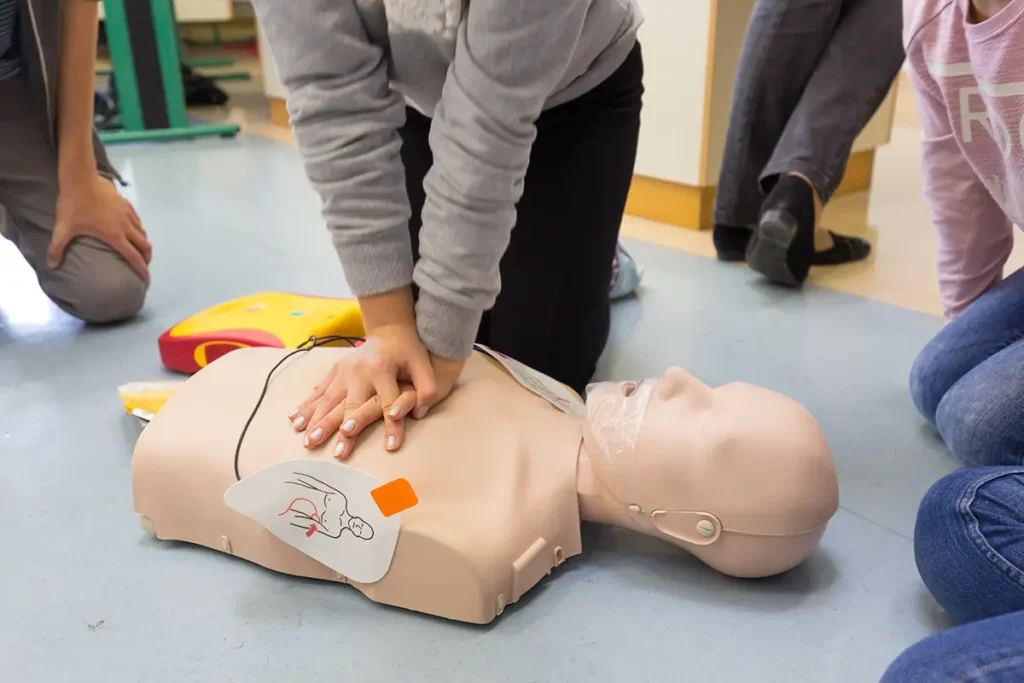
Hands on practice: about 30 to 45 minutes
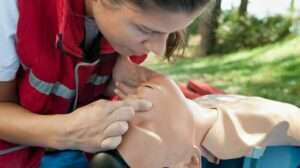
You kneel at a manikin and practise chest compressions several times. The trainer watches and corrects your hand position, posture, depth and rhythm. Many courses use manikins that give feedback. You also practise rescue breaths, if the course includes them, with a face shield.
AED practice: about 15 to 20 minutes
You use a training defibrillator. You switch it on, place the pads on the manikin and follow the spoken prompts, practising how to combine compressions with the machine.
Teamwork and swapping: about 10 to 15 minutes
You practise working with a partner, calling for help, sending someone for an AED and swapping over to avoid fatigue.
Scenarios: about 15 to 20 minutes
You work through a realistic situation, such as a colleague collapsing, putting the steps together under mild pressure.
Added together, that is roughly one and a half to two hours, which matches the rough estimate above. Some courses spend more time, some less.
How Long Until It Feels Natural?
This varies from person to person. Here is what many learners experience.
- First attempt. It feels awkward, and you may be surprised by how hard you need to press.
- After a few repeats. Your hand position and posture start to settle.
- By the end of the CPR block. Many people can carry out the sequence with prompts and feel reasonably confident.
- Later in the day. Scenarios and the final assessment give extra repetitions and help the sequence stick.
- A few days later. Reviewing your notes and walking through the steps in your head helps you remember.
You will probably feel more confident at the end of the day than at the start, but it takes regular practice to feel truly comfortable.
Why Time on a Manikin Matters
You could learn the steps from an article or video in a few minutes, so why spend hours on a course? Because the hard part is not knowing what to do. It is doing it well. Chest compressions need the right depth, speed and position, and these are hard to judge without feedback. A video cannot see your hands or tell you that your compressions are too shallow. Instructor led training with feedback tends to be better for compression depth and hand placement, according to research.
HSE guidance also expects practical teaching and in person assessment for a workplace first aider, which is why online only courses are generally not suitable for that role.
How EFAW Compares With Other Ways to Learn CPR
There are several routes, and they differ in how much time they need.
Free online awareness tools
- A few minutes.
- Good for learning the basic idea.
- No practical feedback.
A short CPR and AED awareness session
- Often one to a few hours, depending on the provider.
- Focused on CPR and defibrillator use only.
- May give a certificate of attendance, not a regulated qualification.
Emergency First Aid at Work
- One day, at least six hours of training time.
- CPR and AED plus choking, the recovery position, bleeding, shock and minor injuries.
- A regulated Level 3 qualification valid for three years.
First Aid at Work
- Three days, at least 18 hours of training time.
- Includes CPR and AED and a much wider range of injuries and illnesses.
- A regulated Level 3 qualification valid for three years.
Yearly refresher
- About half a day, often about three hours.
- Reviews key skills including CPR and AED.
- Recommended by HSE, though not a legal requirement, and does not renew your certificate.
For a workplace first aider, EFAW or FAW is the usual route, because the certificate is accepted by employers.
What Affects How Quickly You Learn?
People learn at different speeds. Several things make a difference.
Things that help
- A good trainer. Clear explanations and quick, friendly feedback.
- Plenty of manikins. Ideally two or three learners per manikin, so you get plenty of turns.
- Small groups. Many awarding organisations set a maximum of around 12 learners per trainer.
- Being willing to try. The more you take part, the faster you learn.
- Comfortable clothes. You will kneel on the floor.
- Some preparation. A short video beforehand can give you a head start.
- Asking questions. Even basic ones.
Things that can slow you down
- Fear of getting it wrong. Everyone makes mistakes at first.
- Physical discomfort. Tell the trainer about any health or access needs so they can adapt.
- Crowded classes with few manikins. Less practice time.
- Feeling rushed. A good trainer will not rush you.
How to Learn Faster and Remember More
You can make the most of the time you have.
Before the course
- Look at a short, reliable video to see the basic sequence.
- Wear comfortable clothes.
- Tell the provider about any access needs.
- Think of questions about your workplace.
During the course
- Take part in every practical task.
- Ask for another turn on the manikin if you want one.
- Practise in pairs and give each other feedback.
- Write the key steps in your own words.
- Pay attention to how the right depth feels.
After the course
- Review your notes within a few days.
- Walk through the steps in your head every month.
- Practise the recovery position with a friend.
- Find your workplace first aid kit and AED.
- Take a yearly refresher.
How Long Does the Skill Last?
Here is the part many people do not expect. The certificate lasts three years, but the skill can fade sooner. Studies suggest that the quality of chest compressions can start to drop within about three to six months if you do not practise, while knowledge of the steps and AED skills tend to hold up better. That is why HSE strongly recommends a short refresher each year, and why renewal means retaking the full one day course before your three year certificate expires. For more detail, see our guide on how quickly first aid skills fade.
So learning CPR is not a one off event. It is a skill you refresh, a bit like learning to drive and then keeping in practice.
Why the Time Is Worth It
More than 30,000 people have an out of hospital cardiac arrest in the UK each year, according to the British Heart Foundation, and fewer than one in ten survive. Every minute without CPR and defibrillation reduces the chance of survival by up to 10 percent. A couple of hours of practice within a one day course is a small investment compared with the difference it can make.
What Employers Should Know
The Health and Safety (First Aid) Regulations 1981 require employers to provide adequate and appropriate first aid for their employees. As a starting point for low hazard workplaces, HSE suggests at least one appointed person for fewer than 25 employees, at least one first aider trained in Emergency First Aid at Work for 25 to 50 employees, and at least one first aider trained in First Aid at Work for every 100 employees above that, or part of 100. Higher hazard workplaces need more. A first aid needs assessment gives the best answer. Employers can help first aiders keep their CPR skills by scheduling yearly refreshers, adding short practice drills and making sure everyone knows where the AED is.
Choosing a Course With Enough CPR Practice
Not every course gives the same amount of practice time. When you compare providers, look for:
- A regulated Level 3 Award in Emergency First Aid at Work (RQF) from a recognised awarding organisation.
- At least six hours of training time, not counting breaks.
- A clear timetable that shows how long is spent on CPR and the AED.
- Plenty of manikins, ideally with feedback, and a training AED.
- Small classes.
- Practical assessment in person.
- Qualified, experienced trainers.
- A clear certificate and a clear total price.
HSE stopped approving first aid training providers in 2013, so be cautious of any claim that a course is HSE approved. In London in 2026, public prices for a one day course commonly range from about £65 to £150 per person. One provider page, linked above, lists £89 per person for classroom training and £75 per person for groups of five or more, at the time of writing in October 2026. Prices change, so always confirm. You can review the Emergency First Aid at Work training page to see how one provider presents its course, price and booking options.
Why London Learners Benefit From Practical Training
London workplaces and public places are busy and crowded, and roads and public transport can be congested, so ambulances may take time to reach a patient. In the first minutes of a cardiac arrest, the people nearby matter. There is also a very large number of training providers and dates in London, and many deliver training at your workplace, which is a practical way for a whole team to learn and practise CPR together.
Final Thoughts
So, how long does it take to learn CPR in an EFAW course? You can understand the basic steps in minutes, and you will usually spend around one and a half to two hours of a one day course practising CPR and AED use on a manikin with a trainer. Most people leave feeling able to carry out the sequence and more confident than when they arrived. Keeping the skill takes regular practice and a yearly refresher.
If you want to learn CPR properly, a practical course is the best way to start. When you are ready, take a look at the Emergency First Aid at Work course in London and choose a date that suits you.
Frequently Asked Questions
1. How long does it take to learn CPR on an EFAW course?
The whole course is one day, with at least six hours of training time. CPR and AED practice usually take around one and a half to two hours of that day, though the exact timetable varies by provider.
2. Can I learn CPR in an hour?
You can learn the basic steps in much less time, and short CPR and AED sessions exist. But learning to do it well, with the right depth, rhythm and hand position, usually takes guided practice on a manikin, which an EFAW course provides.
3. How long is the whole Emergency First Aid at Work course?
It is a one day course. HSE guidance says it should include at least six hours of training time, not counting breaks. Start and finish times vary by provider.
4. Is one day enough to learn CPR properly?
For the skills it is designed to teach, yes. An EFAW course gives you hands on practice and assessment. But skills can fade without practice, so HSE recommends a short refresher each year, although it is not a legal requirement.
5. How long does CPR training last before I need a refresher?
Your EFAW certificate is valid for three years, but research suggests that skill quality can begin to drop within about three to six months without practice. A yearly refresher is recommended, and you must retake the full course before the certificate expires.
6. Do I need experience before learning CPR on the course?
No. The course is designed for beginners. The trainer demonstrates each step and lets you practise at a steady pace with feedback.
7. Is learning CPR online as good as learning it on a course?
Online tools can teach the basic steps quickly, but they cannot give you feedback on your technique. HSE guidance expects practical training and in person assessment for a workplace first aider, so online only courses are generally not suitable for that role.
8. How can I learn CPR faster on the day?
Wear comfortable clothes, take part in every practical task, ask for extra turns on the manikin, practise in pairs, ask questions and make notes in your own words. A short video beforehand can also help.
9. What if I do not feel confident at the end of the course?
That is common at first. Review your notes within a few days, walk through the steps regularly, practise the recovery position and book a refresher. Confidence grows with repetition.
10. Where can I learn CPR in London?
You can book an Emergency First Aid at Work course through a training provider that offers the regulated qualification, either as a public course or as training at your workplace. Check the timetable, the amount of CPR practice, the class size and the total price before you book