If you have ever sat on a first aid course, you have probably heard the phrase chain of survival. A trainer draws a diagram, points to each link and says that survival depends on all of them. It can sound like jargon, but the idea behind it is simple, and it explains why an Emergency First Aid at Work (EFAW) course teaches the skills it does.
In this guide, we explain the chain of survival in plain English. You will see what the links are, how they fit together, where a workplace first aider fits in, what the numbers say and how an EFAW course in London prepares you to be a strong link. If you want to see a real course page as you read, here is the Emergency First Aid at Work course in London.
The Short Answer
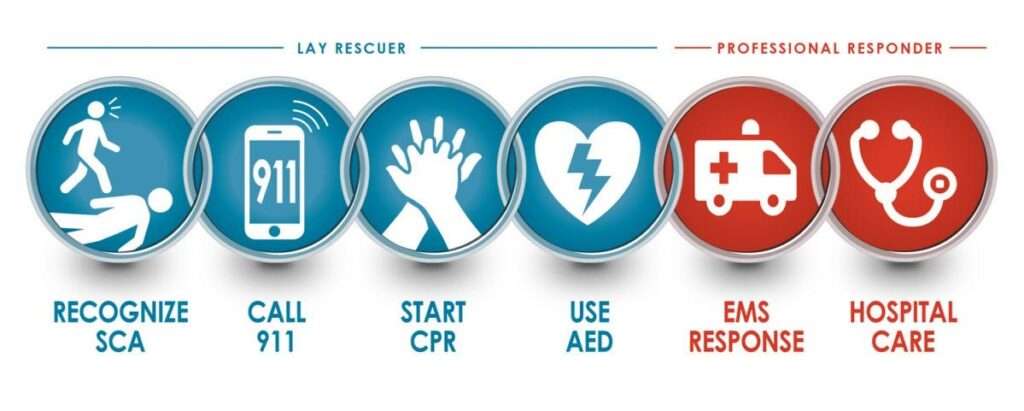
The chain of survival is a sequence of linked actions that give someone the best chance of surviving a cardiac arrest. The Resuscitation Council UK describes four links: early recognition and call for help, early CPR and defibrillation, advanced and post resuscitation care, and survival and recovery. The idea is that the chain is only as strong as its weakest link, so each step needs to happen quickly and well.
EFAW training covers it because the first links depend on ordinary people at the scene, often in a workplace. A trained first aider can strengthen the first two links before the ambulance arrives.
What Is Cardiac Arrest?
To understand the chain, it helps to know what it is about. A cardiac arrest is when the heart suddenly stops pumping blood effectively. The person becomes unresponsive and stops breathing normally. Without help, brain damage can begin within minutes, and death follows soon after.
Cardiac arrest is different from a heart attack. A heart attack is a blockage that stops blood reaching part of the heart, and the person is usually awake and breathing. A cardiac arrest is an electrical problem that stops the heart pumping. A heart attack can lead to a cardiac arrest, but they are not the same.
The Four Links, One by One
The chain of survival has been shown in slightly different ways over the years, and different organisations and countries describe it a little differently. Here is the current UK version from the Resuscitation Council UK, with the older versions noted.
Link 1: Early recognition and call for help
The first link is about spotting that something is seriously wrong and calling for help quickly. In some cases, early recognition of warning signs, such as chest pain, and a call for help can even prevent a cardiac arrest from happening. If a cardiac arrest does happen, recognising it fast and calling 999 sets everything else in motion.
Key points for a first aider:
- Recognise an unresponsive person who is not breathing normally.
- Remember that gasping, noisy breathing can happen straight after a cardiac arrest and is not normal breathing. Mistaking it for a sign of life can delay CPR.
- Call 999 immediately, or ask someone to, and ask for an AED.
- Use the phone on speaker, so the call handler can guide you.
Link 2: Early CPR and defibrillation
The second link is where bystanders can make the biggest difference. In earlier versions of the chain, early CPR and early defibrillation were shown as two separate links, and many training materials still use that version. The current Resuscitation Council UK version combines them, describing early CPR and defibrillation as the way to preserve the brain and restart the heart.
CPR keeps blood and oxygen moving to the brain and heart until the heart can be restarted. An AED, or automated external defibrillator, can deliver an electric shock that may restart a normal rhythm. Together they greatly improve the chance of survival.
Key points for a first aider:
- Start chest compressions straight away, at least 5 cm but not more than 6 cm deep, at 100 to 120 a minute.
- Give rescue breaths if you are trained and willing, or continue compressions only.
- Send someone for the nearest AED, and use it as soon as it arrives.
- Keep going until help takes over.
Link 3: Advanced and post resuscitation care
Once paramedics arrive, they take over with advanced life support, such as airway management and medication, and then move the person to hospital for specialist care. In older versions, this was described as early advanced life support and post resuscitation care. The quality of care after the heart restarts has a big effect on the outcome.
Key points for a first aider:
- Hand over clearly to paramedics: what happened, what you found, what you did and how long.
- Tell them the time of collapse and when CPR and the AED were started.
- Stay available to help, for example by clearing space or guiding the crew.
- Let them take over, and follow their instructions.
Link 4: Survival and recovery
The most recent version of the chain adds a clear final link about recovery. Surviving a cardiac arrest is only the start. Many survivors face physical, emotional and cognitive challenges, and good rehabilitation and follow up help them return to everyday life. Resuscitation Council UK has highlighted recovery as an important and sometimes neglected part of the chain.
Key points for a first aider and a workplace:
- Remember that bystanders and colleagues can be affected too. Seeing a cardiac arrest can be distressing.
- Offer support to anyone who was involved, and encourage them to talk to someone if they need to.
- Employers can offer time, a quiet space and access to employee support.
- If a colleague survives, support their return to work, in line with medical advice.
Why a Chain?
The word chain is deliberate. A chain breaks at its weakest link, so a delay or failure at any step reduces the chance of survival.
- If nobody recognises the cardiac arrest, or the call for help is late, the rest of the chain starts late.
- If nobody starts CPR, the brain is deprived of oxygen while waiting for help.
- If no AED is used, the heart may never restart on its own.
- If hospital care is poor, the early efforts may not lead to survival.
- If recovery support is missing, survivors may struggle to rebuild their lives.
Resuscitation Council UK says that all the links in the chain are equally important. That is why training does not only teach CPR. It teaches the whole sequence.
What the Numbers Say
The figures show why each link matters.
- More than 30,000 people have an out of hospital cardiac arrest in the UK each year, according to the British Heart Foundation, and fewer than one in ten survive.
- Every minute without CPR and defibrillation reduces the chance of survival by up to 10 percent.
- The Resuscitation Council UK has stated that immediate bystander CPR can double or quadruple survival from out of hospital cardiac arrest.
- It has also stated that defibrillation within three to five minutes of collapse can produce survival rates as high as 50 to 70 percent.
- In the past, the Resuscitation Council UK noted that in the UK, fewer than 2 percent of victims had an AED deployed before the ambulance arrived. Efforts since then have focused on making defibrillators easier to find and use.
These figures come from different years and studies, and rates continue to be updated, but they point in the same direction. Fast action by people on the scene saves lives.
Where a Workplace First Aider Fits
In a workplace, the first aider is often the first person to act, which puts them in the first and second links.
Link 1: Recognition and calling for help. You spot that someone is unresponsive and not breathing normally, and you or a colleague calls 999.
Link 2: CPR and defibrillation. You start compressions, send for the AED and use it.
Link 3: Handover. You pass clear information to paramedics when they arrive.
Link 4: Recovery. You help colleagues cope, and support the person’s return if they survive.
So the chain of survival is not an abstract diagram. It is a map of what you may be asked to do.
Why EFAW Training Covers the Chain
There are several reasons why the chain sits at the heart of the course.
It explains the why
People remember steps better when they understand the reasons. The chain shows why you call 999 first, why you start compressions quickly, why the AED matters and why handover is important.
It matches the skills taught
The course teaches how to assess an incident safely, give adult CPR, use an AED, place someone in the recovery position, help a choking adult, control serious bleeding, manage shock and treat minor injuries. The first two links map directly onto the CPR and AED parts.
It builds confidence
Knowing that you are one link in a chain, not the whole chain, makes the task less daunting. You do not have to save the person alone. You have to do your part well, and others take over.
It supports the employer’s duty
The Health and Safety (First Aid) Regulations 1981 require employers to provide adequate and appropriate first aid for their employees. Trained first aiders who understand the chain help employers meet that duty in the most serious emergencies.
It reflects national guidance
HSE guidance for first aid training and national resuscitation guidance both emphasise early recognition, early CPR and early defibrillation. EFAW courses are regulated Level 3 qualifications, and HSE guidance says the course should include at least six hours of training time, not counting breaks.
How an EFAW Course Teaches the Chain
On the day, you meet the chain in several ways.
- The trainer explains it. Usually early in the CPR session, with a diagram of the links.
- You practise the first links. Checking for danger, checking for a response, calling for help and starting CPR.
- You use a training AED. You switch it on, place pads and follow prompts.
- You rehearse handover. You practise describing what happened and what you did.
- You work through scenarios. For example, a colleague collapsing at their desk, so you put the links together.
- You discuss recovery and support. Trainers often mention how to look after yourself and others after an incident.
- You are assessed in person. A qualified trainer watches your practical skills.
A Worked Example: A Collapse in an Office
This is an illustration only, with made up details, to show the links in action.
- Minute 0. A colleague slumps at their desk. You check for danger, shake their shoulders and shout. They do not respond. Link 1.
- Minute 1. You check their breathing for no more than 10 seconds. It is not normal. You ask a colleague to call 999 and fetch the AED. Link 1.
- Minute 2. You start chest compressions. Link 2.
- Minute 4. The AED arrives. You switch it on and follow the prompts. Link 2.
- Minute 8. Paramedics arrive. You hand over clearly and step back. Link 3.
- Later. Your employer arranges support for the team. If the colleague survives, there is a plan for their recovery and return. Link 4.
Every link depended on someone acting promptly. That is the chain in practice.
Common Gaps in the Chain, and How to Close Them
Workplaces can look for weak links in advance.
- Weak link: slow recognition. Make sure staff know the signs of cardiac arrest and that gasping is not normal breathing.
- Weak link: slow call. Put 999 instructions where people can see them, and encourage staff to call early.
- Weak link: no trained people. Train enough first aiders to cover every shift and area.
- Weak link: no AED, or unknown location. If you have an AED, make sure everyone knows where it is. Public access defibrillators can be registered on The Circuit, the national defibrillator network, so ambulance services can direct callers to them.
- Weak link: skills have faded. Provide yearly refreshers. HSE strongly recommends them, although they are not a legal requirement.
- Weak link: poor handover. Practise handovers in drills.
- Weak link: no support afterwards. Plan how you will look after staff after an incident.
As a starting point for low hazard workplaces, HSE suggests at least one appointed person for fewer than 25 employees, at least one first aider trained in Emergency First Aid at Work for 25 to 50 employees, and at least one first aider trained in First Aid at Work for every 100 employees above that, or part of 100. Higher hazard workplaces need more. A first aid needs assessment gives the best answer.
Other Versions of the Chain
You may see the chain drawn in different ways. Some versions show three links, some four, and some six or more, depending on the organisation and the year. Some separate early CPR and early defibrillation into two links, and some add a link for activating the emergency response or for recovery. The core idea is the same in every version: early recognition and a call for help, early CPR, early defibrillation, good advanced care and support for recovery. If your trainer uses a slightly different diagram from the one here, that is normal.
Choosing a Course That Teaches It Well
If you want to understand and practise the chain, choose a course with strong practical content.
- A regulated Level 3 Award in Emergency First Aid at Work (RQF) from a recognised awarding organisation.
- At least six hours of training time, not counting breaks.
- Hands on practice with manikins and a training AED.
- Scenarios that link the steps together.
- Practical assessment in person. HSE guidance expects this for a workplace first aider, so online only courses are generally not suitable.
- Qualified, experienced trainers.
- Small classes. Many awarding organisations set a maximum of around 12 learners per trainer.
- A clear certificate and a clear total price.
HSE stopped approving first aid training providers in 2013, so be cautious of any claim that a course is HSE approved. In London in 2026, public prices for a one day course commonly range from about £65 to £150 per person. One provider page, linked above, lists £89 per person for classroom training and £75 per person for groups of five or more, at the time of writing in October 2026. Prices change, so always confirm. You can review the Emergency First Aid at Work training page to see how one provider presents its course, price and booking options.
Why London Needs Strong Links
London workplaces and public places are busy and crowded, and roads and public transport can be congested, so ambulances may take time to reach a patient. That makes the first links, recognition, calling for help, CPR and defibrillation, especially important. There is also a very large number of training providers and dates in London, and many deliver training at your workplace, which is a practical way for a whole team to learn the chain together.
Final Thoughts
So, what is the chain of survival, and why does EFAW training cover it? It is a sequence of linked actions that give someone the best chance of surviving a cardiac arrest: early recognition and call for help, early CPR and defibrillation, advanced and post resuscitation care, and survival and recovery. It is a chain because every link matters, and the first links often depend on ordinary people at the scene. EFAW training covers it because a workplace first aider is often one of those people.
When you understand the chain, the steps you learn make more sense, and it is easier to act. When you are ready, take a look at the Emergency First Aid at Work course in London and choose a date that suits you.
Frequently Asked Questions
1. What is the chain of survival?
It is a sequence of linked actions that give someone the best chance of surviving a cardiac arrest. The Resuscitation Council UK describes four links: early recognition and call for help, early CPR and defibrillation, advanced and post resuscitation care, and survival and recovery.
2. What are the links in the chain of survival?
Early recognition and call for help, early CPR and defibrillation, advanced and post resuscitation care, and survival and recovery. Older versions show early CPR and early defibrillation as two separate links, and other organisations use different numbers of links.
3. Why is it called a chain?
Because a chain is only as strong as its weakest link. A delay or failure at any step, such as a late call for help, no CPR, no AED or poor recovery support, reduces the chance of survival.
4. Which links can a workplace first aider help with?
Mainly the first two: recognising a cardiac arrest and calling for help, and giving early CPR and using an AED. A first aider also helps with handover to paramedics and with supporting colleagues afterwards.
5. Why does EFAW training cover the chain of survival?
It explains why each step matters, matches the CPR and AED skills taught, builds confidence and supports the employer’s duty to provide adequate and appropriate first aid. HSE guidance says the course should include at least six hours of training time.
6. How much does early CPR improve survival?
The Resuscitation Council UK has stated that immediate bystander CPR can double or quadruple survival from out of hospital cardiac arrest. Every minute without CPR and defibrillation reduces the chance of survival by up to 10 percent.
7. Why is early defibrillation so important?
An AED can restart a normal heart rhythm in some cardiac arrests. The Resuscitation Council UK has stated that defibrillation within three to five minutes of collapse can produce survival rates as high as 50 to 70 percent, so using an AED quickly matters.
8. What is the difference between a heart attack and a cardiac arrest?
A heart attack is a blockage that stops blood reaching part of the heart, and the person is usually awake and breathing. A cardiac arrest is when the heart stops pumping effectively, and the person is unresponsive and not breathing normally. A heart attack can lead to a cardiac arrest.
9. Is the chain of survival the same everywhere?
The core idea is the same, but diagrams differ between organisations and years. Some show three or four links, and some show more, for example separating CPR and defibrillation or adding a link for recovery. Your trainer may use a slightly different version.
10. Where can I learn the chain of survival in London?
You can book an Emergency First Aid at Work course through a training provider that offers the regulated qualification, either as a public course or as training at your workplace. Check the practical content, the awarding organisation, the class size and the total price before you book.