It can happen at a lunch meeting, in a staff canteen, at a desk or at a work event. A colleague is eating, then suddenly stops. Their hand goes to their throat. They cannot speak, and their face changes colour. Everyone freezes. Choking is one of the few first aid emergencies where the right action in the first minute can make all the difference, and where most people do not know what to do.
The good news is that the steps are simple and easy to learn. In this guide, we explain in plain English how to help an adult who is choking, how back blows and abdominal thrusts work, when to call 999 and what to do if the person becomes unresponsive. We follow UK advice from the NHS and St John Ambulance, and show how it connects to what you learn on an Emergency First Aid at Work (EFAW) course in London. If you want to see a real course page as you read, here is the Emergency First Aid at Work course in London.
Important Notes First
- This guide is for adults. Choking in babies and children needs different techniques, so learn them on a paediatric first aid course. Do not use abdominal thrusts on babies.
- This is general information, not training. Back blows and abdominal thrusts are physical skills that a trainer can demonstrate and check.
- Never practise abdominal thrusts or back blows with force on a real person who is not choking. Use a manikin on a course, or practise the hand positions gently.
- If you are unsure, call 999.
The Short Answer
If an adult is choking but can still speak, cough or breathe, encourage them to keep coughing. If they cannot speak, cough or breathe, lean them forward and give up to five sharp back blows between the shoulder blades with the heel of your hand, checking their mouth after each blow. If that does not work, give up to five abdominal thrusts, standing behind them with a fist just above the belly button and pulling sharply inwards and upwards. If the blockage does not clear, call 999, and keep alternating five back blows with five abdominal thrusts until help arrives. If they become unresponsive, start CPR.
What Is Choking?
Choking happens when something blocks the airway, usually food, but also small objects, sweets, vomit or other items. The blockage stops air reaching the lungs. If it is not cleared, the person can become unconscious and their heart can stop.
Choking is different from a cough that goes down the wrong way. A person who can cough strongly, speak and breathe has a mild blockage, and usually clears it themselves. A person who cannot is in danger.
Mild or Severe? How to Tell
As a first aider, the key question is whether the person can cough effectively and speak.
Mild obstruction
The person:
- Can speak, cry or answer when you ask whether they are choking.
- Can cough, and the cough is strong.
- Can breathe in, even if noisily.
- Is conscious and responsive.
Severe obstruction
The person:
- Cannot speak, or can only make a faint noise.
- Cannot cough, or the cough is weak and silent.
- Cannot breathe, or has noisy, wheezing or no breathing at all.
- May clutch their throat or neck, or point to it.
- Looks frightened and distressed.
- Has a face that turns red, then pale or blue.
- May become unresponsive if the blockage is not cleared.
If you are not sure, ask the person: Are you choking? A person who can answer aloud is not completely blocked.
For Mild Choking: Cough It Out
- Encourage them to keep coughing. Coughing is the best way to clear an airway.
- Stay with them, and watch carefully.
- Do not slap them on the back while they are coughing effectively, and do not put your fingers in their mouth, as they may bite you or push the object further in.
- Do not give them anything to drink while they are choking.
- If it does not clear, or if they become unable to cough, speak or breathe, treat it as severe choking and move to the steps below.
- If you are worried, call 999 or NHS 111 for advice.
For Severe Choking: Step by Step
The sequence taught in the UK is often summed up in a few simple words: cough it out, slap it out, squeeze it out, check the mouth, call 999.
Step 1: Recognise it and act fast
If the person cannot speak, cough or breathe, act immediately. Tell them that you are going to help. Do not waste time.
Step 2: Give up to five back blows
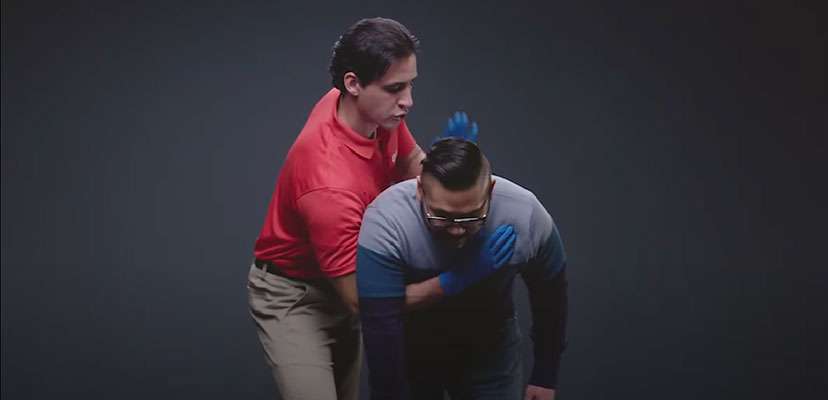
Back blows are sharp blows between the shoulder blades that create vibrations and pressure in the airway which can dislodge the blockage.
- Stand to the side and slightly behind the person.
- Support their chest with one hand.
- Lean them well forward, so that when the blockage comes out, it comes out of the mouth rather than moving further down the airway.
- Give up to five sharp blows between the shoulder blades with the heel of your other hand. The heel of the hand is the part between your palm and your wrist.
- Check their mouth after each blow. Stop if the blockage has cleared.
Each blow should be separate and firm, intended to clear the blockage, but not so heavy that you risk injury.
Step 3: Check the mouth
After the back blows, look inside the mouth. If you can see the object, and can easily remove it with your fingers, do so, taking care not to push it further in. Do not sweep blindly with your fingers, because you may push the blockage deeper or cause damage. If you cannot see it, carry on.
Step 4: Give up to five abdominal thrusts
If back blows do not clear the blockage, move to abdominal thrusts. These squeeze the air out of the lungs and may force the object out.
- Stand behind the person, and put both arms around their waist.
- Lean them forward.
- Make a fist with one hand, and place it just above the belly button, below the breastbone, with the thumb side of the fist against their abdomen.
- Grasp your fist with your other hand.
- Pull sharply inwards and upwards, up to five times, as though trying to lift them.
- Check the mouth after each thrust. Stop if the blockage clears.
Step 5: Call 999 if the blockage has not cleared
If the blockage has not cleared after the back blows and abdominal thrusts, call 999 immediately, or ask someone to, and say that the person is choking. Put the phone on speaker so you can follow the call handler’s advice. If someone else is with you, they should call 999 as soon as you realise the person is struggling, rather than waiting.
Step 6: Keep alternating
Continue with cycles of five back blows and five abdominal thrusts, checking the mouth each time, until the blockage clears, the person becomes unresponsive, or help arrives. Do not interrupt the cycle while they are still conscious.
Step 7: If the person becomes unresponsive
If they stop responding, support them carefully to the ground, and call 999 if you have not already. Start CPR immediately, beginning with chest compressions. Chest compressions can help dislodge the object, and the steps are the same as for any adult in cardiac arrest, with one addition: each time you open the airway for breaths, look inside the mouth, and remove any object you can see. See our guide to adult CPR step by step. Send someone for an AED if one is available.
Step 8: After the blockage clears
If the object comes out and the person can breathe, speak and cough again:
- Stay with them. They may be shaken, upset or short of breath.
- Encourage them to sit and rest.
- Give them a drink of water in small sips only once they are breathing normally and feel better, if they want one.
- Make sure they are checked by a doctor. Anyone who has been given abdominal thrusts or back blows should have a medical check, even if they feel fine, because thrusts can cause internal injury, and small pieces of the object may remain in the airway. The NHS and St John Ambulance advise this.
- If they cannot breathe properly, have a cough that does not stop, difficulty swallowing, or pain, seek urgent medical help.
A Quick Summary
- Cough it out. Encourage coughing for a mild blockage.
- Slap it out. Up to five back blows between the shoulder blades, leaning them forward.
- Squeeze it out. Up to five abdominal thrusts, fist above the belly button, inwards and upwards.
- Check the mouth. After each blow or thrust.
- Call 999. If it has not cleared, and keep repeating.
- CPR. If they become unresponsive.
Special Situations
Someone who is pregnant or very overweight
Abdominal thrusts are not recommended for people who are visibly pregnant. NHS advice says that abdominal thrusts should not be given to pregnant women or babies under one year. Back blows can still be used, and many guidelines teach chest thrusts, a similar technique performed on the lower half of the breastbone, for people who are pregnant or whose size makes abdominal thrusts hard to perform. A trainer can show you how. If you are not trained, give back blows and call 999.
Someone in a wheelchair
Lean the person forward as much as safely possible, and give back blows. For abdominal thrusts, reach around the person from behind the chair, if it is safe and you can do so effectively. Call 999 early.
Someone on the floor or lying down
If a person is unresponsive, start CPR. If they are conscious and choking, help them sit or stand if you can, because the techniques work best upright and leaning forward.
If you are alone and choking
Call 999 if you can, though you may not be able to speak. Try to cough forcefully. If that does not work, you can try to give yourself abdominal thrusts, by making a fist above the belly button and pressing hard inwards and upwards, or by pressing your upper abdomen firmly against the back of a chair, a counter or a rail. If you can, tell someone nearby, or unlock your door.
Someone with dentures
If dentures are loose and causing choking, remove them if you can easily see and reach them. Do not force anything.
Someone who has been drinking alcohol
Intoxicated people are at higher risk of choking, including on vomit. Treat it the same way, and call 999.
Someone with a known swallowing difficulty or a medical condition
People with swallowing problems, stroke, dementia, some neurological conditions or disability may have a higher risk. Follow the same first aid, and any specific plan they have.
What Not to Do
- Do not slap the back of someone who is coughing effectively.
- Do not put your fingers blindly into the mouth. Only remove an object you can see and easily reach.
- Do not give water or food while the person is choking.
- Do not hold the person upside down, or lift them off the ground.
- Do not use abdominal thrusts on babies, or on someone who is pregnant, unless trained in the right technique.
- Do not give up until help takes over, or the blockage clears.
- Do not let the person leave without being checked, after back blows or abdominal thrusts.
- Do not delay calling 999 if the blockage has not cleared.
Choking or Something Else?
Sudden difficulty breathing at work could have other causes. A first aider does not need to be certain, but it helps to know.
- Choking: often happens while eating or with an object in the mouth. The person cannot speak or cough, and clutches their throat.
- Asthma attack: wheeze, cough and tight chest, often in someone with asthma. Needs a blue inhaler. See our guide on how to help someone with an asthma attack.
- Anaphylaxis: swelling of the lips, tongue or throat, hives, wheeze, dizziness. Needs adrenaline and 999. See our guide on anaphylaxis at work.
- Heart attack or cardiac arrest: chest pain, sweating, collapse. Needs 999, and CPR if unresponsive and not breathing normally.
- Panic attack: fast breathing and fear, with a person who can speak. If unsure, call 999.
If you are unsure, call 999, and follow the call handler’s advice.
Preventing Choking at Work
- Encourage people to eat sitting down, and not while walking, working at machinery or in a rush.
- Chew food thoroughly, and avoid talking and laughing with a full mouth.
- Take care with alcohol and meals.
- Cut up food for people who have trouble swallowing, or follow guidance from their care team.
- Make sure dentures fit.
- Take care at events and buffets, where people eat and talk at the same time.
- Keep small objects out of mouths, such as pens, pins and screws, especially in workshops.
- Train staff. A short briefing on what to do helps everyone feel more confident.
After the Incident
Once the person has been seen by a medical professional, there are more things to do.
- Record what happened. Date, time, place, what the person was eating or doing, what you did, how many cycles you gave, what help arrived.
- Report to your employer. Incidents should be recorded.
- Make sure the person gets a medical check, even if they seem well.
- Replace anything used, and review the first aid kit.
- Look after yourself and others. A choking emergency can be very frightening. Talk to someone you trust, and use any support your employer offers.
- Review. Employers should look at whether anything can be done to reduce the risk.
How an EFAW Course Teaches Choking
An Emergency First Aid at Work course covers helping a choking adult as a core skill. On the day, you can expect to:
- Learn how to tell mild and severe choking.
- Watch a demonstration. Of back blows and abdominal thrusts.
- Practise the techniques safely, usually with a partner using light, gentle contact, or with a training aid, never real force.
- Learn the hand positions. Where to place the heel of the hand and the fist.
- Practise the sequence. Back blows, check the mouth, abdominal thrusts, call 999, repeat.
- Learn what to do if the person becomes unresponsive. Moving straight to CPR.
- Learn about special situations. For example, pregnancy.
- Work through scenarios. For example, a colleague choking in the canteen.
- Be assessed in person. A qualified trainer watches your skills.
The course is a one day, regulated Level 3 qualification, and HSE guidance says it should include at least six hours of training time, not counting breaks. You also learn how to assess an incident safely, give adult CPR, use an AED, place someone in the recovery position, control serious bleeding, manage shock and treat minor injuries. The certificate is valid for three years. HSE strongly recommends a short refresher each year, although it is not a legal requirement.
What Workplaces Should Do
The Health and Safety (First Aid) Regulations 1981 require employers to provide adequate and appropriate first aid for their employees. As a starting point for low hazard workplaces, HSE suggests at least one appointed person for fewer than 25 employees, at least one first aider trained in Emergency First Aid at Work for 25 to 50 employees, and at least one first aider trained in First Aid at Work for every 100 employees above that, or part of 100. Higher hazard workplaces need more. A first aid needs assessment gives the best answer. Workplaces with canteens, restaurants, cafes, care settings or events have more reason to make sure trained people are on hand at mealtimes. Make sure that:
- Staff know who the first aiders are.
- Notices show how to call 999 and where the AED and first aid kit are.
- A clear emergency procedure is in place. Who calls 999, who gives first aid, who meets the ambulance.
- First aiders take regular refreshers. Choking is rare, so skills fade.
- There is support after an incident.
Choosing a Good Course in London
Look for:
- A regulated Level 3 Award in Emergency First Aid at Work (RQF) from a recognised awarding organisation.
- At least six hours of training time, not counting breaks.
- Hands on practice, including choking techniques and CPR.
- Practical assessment in person. HSE guidance expects this for a workplace first aider, so online only courses are generally not suitable.
- Qualified, experienced trainers.
- Small classes. Many awarding organisations set a maximum of around 12 learners per trainer.
- A clear certificate and a clear total price.
HSE stopped approving first aid training providers in 2013, so be cautious of any claim that a course is HSE approved. In London in 2026, public prices for a one day course commonly range from about £65 to £150 per person. One provider page, linked above, lists £89 per person for classroom training and £75 per person for groups of five or more, at the time of writing in October 2026. Prices change, so always confirm. You can review the Emergency First Aid at Work training page to see how one provider presents its course, price and booking options.
Why London Workplaces Should Be Ready
London has a huge number of restaurants, cafes, canteens, hotels, events and busy offices where people eat at work. Roads and public transport can be congested, so ambulances may take time to arrive, and a trained colleague acting in the first minute can be the difference between a frightening moment and a tragedy. There is also a very large number of training providers and dates in London, and many deliver training at your workplace, which is a practical way to prepare a whole team.
Final Thoughts
So, how do you help an adult who is choking? If they can speak, cough or breathe, encourage coughing. If they cannot, lean them forward and give up to five sharp back blows between the shoulder blades with the heel of your hand, then up to five abdominal thrusts, with a fist above the belly button, pulling inwards and upwards, checking the mouth each time. Call 999 if the blockage does not clear, and keep alternating until help arrives. If they become unresponsive, start CPR. Anyone who has had thrusts should be checked by a doctor.
The steps are simple, and practice makes them natural. When you are ready to learn with a trainer, take a look at the Emergency First Aid at Work course in London and choose a date that suits you.
Frequently Asked Questions
1. What should you do if an adult is choking?
If they can cough, encourage them to keep coughing. If they cannot speak, cough or breathe, lean them forward and give up to five back blows between the shoulder blades, then up to five abdominal thrusts, checking the mouth each time. Call 999 if it does not clear, and keep alternating until help arrives.
2. How do you give back blows to an adult?
Stand to the side and slightly behind them, support their chest, lean them well forward and give up to five sharp blows between the shoulder blades with the heel of your other hand. Check the mouth after each blow, and stop if the blockage clears.
3. How do you give abdominal thrusts to an adult?
Stand behind them with your arms around their waist, make a fist and place it above the belly button, below the breastbone, grasp it with your other hand and pull sharply inwards and upwards, up to five times, checking the mouth each time.
4. When should I call 999 for a choking adult?
If the blockage has not cleared after the back blows and abdominal thrusts, call 999 and say that the person is choking. If someone else is with you, ask them to call as soon as you realise the person is struggling.
5. What if the choking person becomes unresponsive?
Support them to the ground, call 999 if you have not already, send for an AED and start CPR, beginning with chest compressions. Look in the mouth when you open the airway, and remove any object you can see.
6. Why must someone see a doctor after abdominal thrusts?
Abdominal thrusts and back blows can cause internal injury, and parts of the object may remain in the airway. NHS and St John Ambulance advice is that anyone who has been given abdominal thrusts should be checked by a medical professional, even if they feel fine.
7. Can I use abdominal thrusts on someone who is pregnant?
NHS advice is not to give abdominal thrusts to pregnant women or babies under one. Back blows can still be used, and trained people may use chest thrusts. If you are not trained, give back blows and call 999.
8. Should I put my fingers in the person’s mouth?
Only to remove an object that you can see and easily reach. Do not sweep blindly with your fingers, because you may push the blockage further in or be bitten.
9. Does an EFAW course teach choking first aid?
Yes. An Emergency First Aid at Work course teaches how to help a choking adult, including back blows, abdominal thrusts and what to do if the person becomes unresponsive. It is a one day regulated Level 3 qualification with at least six hours of training time.
10. Where can I learn choking first aid in London?
You can book an Emergency First Aid at Work course through a training provider that offers the regulated qualification, either as a public course or as training at your workplace. Check the practical content, the awarding organisation, the class size and the total price before you book.