A ladder slips. A pallet falls. A colleague trips on a wet floor and cannot get up, holding their arm or leg and gasping with pain. Everyone looks at you. Is it broken? Should you move them? What do you do while you wait for help?
Broken bones are common in workplaces, from falls and slips to manual handling accidents and machinery injuries. Good first aid in the first few minutes can reduce pain, prevent further damage and help the person get the right care quickly. In this guide, we explain in plain English how to treat a suspected fracture before the ambulance arrives, and how it connects to what you learn on an Emergency First Aid at Work (EFAW) course in London. If you want to see a real course page as you read, here is the Emergency First Aid at Work course in London.
Important Notes First
- This guide is general information, not medical advice or training. A trainer can show you how to support a limb, apply bandages and slings and check your technique.
- A first aider cannot tell for certain whether a bone is broken. If in doubt, treat the injury as a fracture.
- Call 999 for serious injuries. The call handler can advise you.
- Do not put yourself at risk. Make sure the area is safe before you help.
- This guide is mainly for adults. Children’s bones can bend and crack in different ways, so any suspected fracture in a child needs medical assessment.
The Short Answer
If you suspect a broken bone, tell the person to keep still, and support the injured part in the position you found it, using your hands and soft padding. Call 999 if the injury is serious. Do not move the person unless they are in immediate danger. If there is a wound with bone showing, cover it with a clean, non fluffy dressing and press around the wound, not on the bone. Treat for shock, and watch their breathing and responsiveness until help arrives.
What Is a Fracture?
A fracture is a break or crack in a bone. There are two main kinds.
- A closed fracture. The skin over the break is intact. Most fractures are closed.
- An open fracture. The broken bone has pierced the skin, or there is an open wound near the break. This is more serious, because of the risk of heavy bleeding and infection.
Broken bones can be unstable. They may cause internal bleeding, and the person may develop shock, particularly with fractures of the thigh bone, hip or pelvis.
Fractures are different from dislocations, where a joint is pulled out of position, and from sprains and strains, which affect ligaments and muscles. It can be hard for a first aider to tell which is which, and you do not need to. The first aid is much the same, and the safe approach is to treat any doubtful injury as a fracture.
Signs of a Suspected Fracture
St John Ambulance lists these signs. A person may have one or several.
- Pain at or near the injury, often severe.
- Swelling, bruising or deformity. The limb may look shorter, twisted, bent or crooked compared to the other side.
- Difficulty or inability to move the limb normally. Or loss of power.
- A grating noise or feeling from the ends of the broken bones.
- A wound with bone showing, which is an open fracture.
- Signs of shock, such as pale, cold, clammy skin, a fast pulse, dizziness and nausea.
- Numbness, tingling or a pale, cold or blue limb below the injury, which may mean that blood flow or nerves are affected.
- The person heard or felt a crack or snap at the time of the injury.
Common Causes at Work
In London workplaces, suspected fractures can follow:
- Slips, trips and falls. On wet floors, stairs, kerbs and uneven ground.
- Falls from height. Ladders, scaffolding, platforms and roofs.
- Manual handling accidents. Heavy loads dropped or lifted wrongly.
- Crush injuries. Equipment, vehicles, doors and falling objects.
- Machinery accidents.
- Vehicle incidents. In yards, car parks and on the road.
- Sports and activity injuries. In gyms, schools and activity centres.
- Violence or assault. In some roles.
Falls from height and heavy impacts are higher risk, because there may be injuries to the head, neck, back or pelvis that are not obvious at first.
Step by Step: First Aid for a Suspected Fracture
Step 1: Make the scene safe
Look for dangers, such as moving vehicles, unstable structures, machinery, fumes or live electricity. Do not put yourself at risk. If the person is in immediate danger, for example near traffic or a fire, move them only as far as needed to make them safe.
Step 2: Check the person and treat life threatening problems first
Check for a response and normal breathing. If they are unresponsive and not breathing normally, call 999 and start CPR. If they are unresponsive but breathing, protect the airway. If there is severe bleeding, control it straight away. These come before the fracture. See our guides on first aid for severe bleeding and on what to do if someone is unresponsive but breathing.
Step 3: Tell the person to keep still
Explain what you are doing, and ask them not to move the injured part. Moving a broken bone can cause more pain, more bleeding and more damage to nerves and blood vessels.
Step 4: Support the injured part
Support the injury exactly in the position you found it, using your hands. Hold the joints above and below the injury, until it is secured. Place soft padding around it for extra support, such as folded clothing, towels, cushions or rolled blankets. Do not try to straighten a deformed limb.
Step 5: Call 999 for serious injuries
Call 999 if you suspect any of the following.
- An open fracture, with bone showing or a wound near the break.
- A fractured thigh bone, or other long bone.
- A suspected injury to the back, neck, head or pelvis.
- Severe pain, or signs of shock.
- Severe bleeding that will not stop.
- A limb that is pale, blue, cold or has lost feeling.
- A fall from height or a heavy impact.
- A person who is elderly, frail or has other health problems.
- You are unsure.
Put the phone on speaker, so you can follow advice while your hands are busy. Send someone to meet the ambulance. For some less serious injuries, such as a suspected broken wrist or forearm, the person may be taken to hospital by car or taxi, and the call handler or NHS 111 can advise, but a leg injury needs an ambulance.
Step 6: Do not move the person, unless they are in danger
Wait for the ambulance if possible. Moving someone with a broken bone, especially in the leg, hip, pelvis, back or neck, can make the injury worse.
Step 7: Secure the injury if you are trained and need to
If help will be delayed, or the person must be moved, you may need to immobilise the injured part. This is where practical training helps, because the technique matters.
Upper limb fractures
- Support the arm in a sling, placing the forearm across the chest, with the hand slightly higher than the elbow.
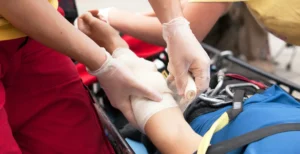
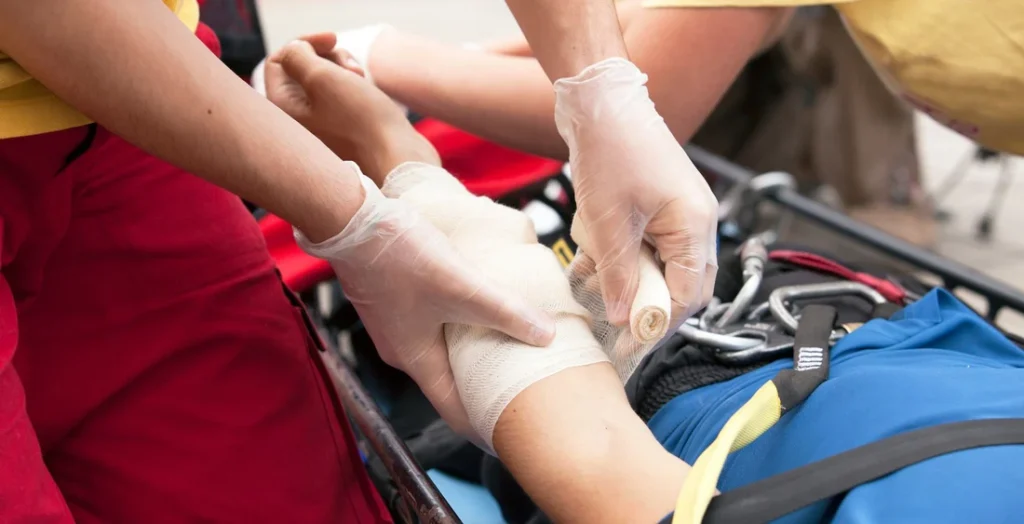
- A triangular bandage can be used to make an arm sling. A trainer will show you how, and how to tie the knot at the side of the neck, not on the neck.
- Place padding between the arm and the body for comfort.
- A collarbone fracture can be supported with a sling on the injured side.
Lower limb fractures
- Place padding between the legs, and move the uninjured leg gently next to the injured leg.
- Secure the legs together with broad bandages, passing them through the natural hollows of the body, for example under the knees and ankles.
- Tie the knots on the side of the uninjured leg, so they do not press on the injury.
- Do not move the injured leg more than you need to.
Ribs
- Help the person into the position that is most comfortable, usually leaning towards the injured side, supporting the injured side with their arm or a pad.
- Do not bind the chest tightly.
- Call 999 if there is difficulty breathing.
Hands and fingers
- Support the hand in a raised position on a soft pad, and remove rings before swelling begins, if you can do it easily.
If you are not trained in splinting, keep the person still, support the injury with padding and wait for the ambulance. Poor splinting can do more harm than good.
Step 8: Check circulation after bandaging
After securing the injury, check below the bandage, at the fingers or toes, for colour, warmth, feeling and movement. If they become pale, blue, cold, numb or tingly, loosen the bandages slightly, and tell the call handler. Check again regularly, for example every 10 to 15 minutes.
Step 9: Reduce swelling and pain
If you have a cold pack, you can place it over the injury, wrapped in a cloth, to help reduce swelling and ease pain. Never place ice or a cold pack directly on the skin. Do not use it on an open wound.
Step 10: Treat for shock
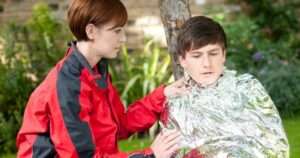
Fractures, especially of the thigh, hip or pelvis, can cause shock. Keep the person warm with a coat or blanket, reassure them and loosen tight clothing. Do not give food or drink, because they may need an operation. Do not raise an injured leg, or the legs if either is suspected to be broken or if the pelvis or hip is injured. St John Ambulance advises treating shock if necessary, but not raising an injured leg. See our guide on shock in first aid.
Step 11: Watch and reassure
Stay with the person. Talk calmly, and tell them help is coming. Monitor their breathing, level of response and colour. Be ready to change your approach if they become unresponsive or stop breathing normally.
Step 12: Hand over to the ambulance crew
Tell them how the injury happened, where it hurts, what you found, what you did and when, any bleeding or open wound, any numbness or colour changes, and what you know about medical conditions, medication or allergies. Then let them take over.
Open Fractures: Bone Showing Through the Skin
An open fracture is an emergency.
- Call 999.
- Do not push the bone back, and do not touch it.
- Cover the wound with a sterile dressing or a clean, non fluffy cloth.
- Control bleeding by pressing around the wound, not on the protruding bone. Build up padding around the bone so you can bandage without pressing on it.
- Secure the dressing with a bandage, without tying it too tightly.
- Keep the limb supported and still.
- Treat for shock, and monitor the person.
- Do not wash the wound, and do not give food or drink.
Suspected Head, Neck, Back or Pelvis Injuries
These injuries can be life threatening, and may be caused by falls from height, heavy impacts or vehicle collisions. Signs can include pain in the neck or back, numbness or tingling, weakness or loss of movement, loss of bladder or bowel control, deformity of the spine, severe headache, confusion or drowsiness, or a pelvis that hurts when touched.
- Call 999 immediately.
- Keep the person as still as possible. Tell them not to move their head, neck or back.
- Support the head and neck in the position found, using your hands or by placing rolled towels or jackets on either side, if you are able and it is safe to do so.
- Do not move them unless there is immediate danger, such as a fire.
- Do not remove a motorcycle or cycle helmet unless you must do so to clear the airway or breathing, and then only as advised by the call handler.
- Protect the airway. If they are unresponsive but breathing, airway protection is the priority, and the call handler will advise on how to roll them with as little twisting as possible.
- Treat for shock, and keep them warm and calm.
- Do not give food or drink.
St John Ambulance advises that suspected broken back, neck or pelvis injuries need immediate transfer to A&E by calling 999.
What Not to Do
- Do not move the person unless they are in immediate danger.
- Do not try to straighten a deformed limb or push a bone back.
- Do not press on a bone sticking out of the skin.
- Do not remove an embedded object.
- Do not apply a bandage so tightly that it cuts off blood flow.
- Do not give food or drink, in case they need an operation.
- Do not give medicines. A workplace first aider should not give painkillers.
- Do not raise an injured leg, or the legs if the hip, pelvis or either leg is injured.
- Do not let the person walk on a suspected broken leg or put weight on it.
- Do not massage the injury.
- Do not apply ice directly to the skin.
- Do not leave them alone.
- Do not take chances with the neck and back. If in doubt, keep them still.
Fracture, Sprain or Dislocation: Does It Matter?
For a first aider, it does not need to matter. The signs overlap, and even doctors need an X ray to be sure. The sensible rule is: if in doubt, treat it as a fracture. Support the injury, keep the person still, call for help if needed and make sure they are checked by a medical professional.
When Can the Person Go to Hospital Without an Ambulance?
For a less serious injury, such as a suspected broken finger, wrist or forearm, with no other injuries, no deformity that looks severe and no signs of shock, the person may be able to be taken to A&E or an urgent treatment centre by car or taxi, with someone accompanying them. The injured part should be supported and secured, and the person should not drive. If you are unsure, call 999 or NHS 111 for advice. A leg injury, a hip or pelvis injury, a back or neck injury or anything severe needs an ambulance.
After the Incident
Once the ambulance has gone, there is more to do.
- Record what happened. Date, time, place, cause, injuries, what you did and what help arrived.
- Report to your employer. Some serious injuries must be reported to the authorities under the Reporting of Injuries, Diseases and Dangerous Occurrences Regulations, often called RIDDOR. Fractures other than to fingers, thumbs and toes are among the injuries that are reportable, and your employer decides what is needed.
- Make the area safe. Deal with the hazard that caused the injury, such as a wet floor or damaged equipment.
- Restock the first aid kit.
- Look after yourself and others. Seeing a serious injury can be upsetting. Talk to someone you trust, and use any support your employer offers.
- Review and prevent. Employers should look at what caused the accident and how to prevent it happening again.
Preventing Fractures at Work
Many workplace fractures can be prevented.
- Keep floors clean, dry and clear. Clear spills quickly, and keep walkways free from clutter.
- Maintain stairs, handrails and lighting.
- Use equipment safely. Ladders, steps and platforms should be in good condition and used correctly.
- Provide manual handling training and aids.
- Use guards and safe systems on machinery.
- Wear suitable footwear and protective equipment.
- Plan work at height carefully.
- Report hazards and near misses.
What You Learn on an EFAW Course
It helps to be clear about what an Emergency First Aid at Work course covers. It is a one day, regulated Level 3 qualification, and HSE guidance says it should include at least six hours of training time, not counting breaks. The course teaches how to assess an incident safely, give adult CPR, use an AED, place someone in the recovery position, help a choking adult, control serious bleeding, manage shock and treat minor injuries.
Those skills are the foundation for dealing with a suspected fracture. You learn how to check a casualty safely, call for help, control bleeding from an open wound, recognise and manage shock, keep a person still and warm and hand over to paramedics. The longer First Aid at Work course, which takes three days and has at least 18 hours of training time, covers a wider range of injuries, including fractures, dislocations and spinal injuries, in more detail, with practice in applying slings and bandages. Exact content varies by awarding organisation, so check the course outline if you want to know what is included.
The EFAW certificate is valid for three years. HSE strongly recommends a short refresher each year, although it is not a legal requirement.
Which Course Does Your Workplace Need?
The Health and Safety (First Aid) Regulations 1981 require employers to provide adequate and appropriate first aid for their employees. Workplaces with a higher risk of fractures, such as construction, warehousing and light industry, often need first aiders trained in First Aid at Work. As a starting point for low hazard workplaces, HSE suggests at least one appointed person for fewer than 25 employees, at least one first aider trained in Emergency First Aid at Work for 25 to 50 employees, and at least one first aider trained in First Aid at Work for every 100 employees above that, or part of 100. For higher hazard workplaces, HSE suggests at least one first aider trained in EFAW or FAW for 5 to 50 employees, depending on the injuries that could happen, and at least one first aider trained in First Aid at Work for every 50 employees above that, or part of 50. A first aid needs assessment gives the best answer.
What Workplaces Should Have Ready
- Trained first aiders on every shift.
- A well stocked first aid kit. With triangular bandages, dressings, gloves, padding and blankets, depending on your needs assessment.
- Clear procedures. Who calls 999, who stays with the casualty, who meets the ambulance.
- Clear access for ambulances. And a named person to guide them.
- Regular refreshers.
- Support after incidents.
Choosing a Good Course in London
Look for:
- A regulated Level 3 Award in Emergency First Aid at Work (RQF) or First Aid at Work from a recognised awarding organisation.
- The right training time: at least six hours for EFAW, and at least 18 hours for FAW, not counting breaks.
- Hands on practice with bandages, slings and positioning, as far as the course covers it.
- Practical assessment in person. HSE guidance expects this for a workplace first aider, so online only courses are generally not suitable.
- Qualified, experienced trainers.
- Small classes. Many awarding organisations set a maximum of around 12 learners per trainer.
- A clear course outline, showing what is covered about fractures.
- A clear certificate and a clear total price.
HSE stopped approving first aid training providers in 2013, so be cautious of any claim that a course is HSE approved. In London in 2026, public prices for a one day EFAW course commonly range from about £65 to £150 per person. One provider page, linked above, lists £89 per person for classroom training and £75 per person for groups of five or more, at the time of writing in October 2026, and First Aid at Work at around £200 to £300 per person. Prices change, so always confirm. You can review the Emergency First Aid at Work training page to see how one provider presents its courses, prices and booking options.
Why London Workplaces Should Be Ready
London has busy building sites, warehouses, kitchens, shops and offices, many spread over several floors, with stairs, ladders and heavy loads. Roads and public transport can be congested, so ambulances may take time to arrive, and what you do in those first minutes can reduce pain and prevent further injury. There is also a very large number of training providers and dates in London, and many deliver training at your workplace, which is a practical way to prepare a whole team.
Final Thoughts
So, how do you treat a suspected fracture before the ambulance arrives? Make the scene safe, deal with life threatening problems first, tell the person to keep still and support the injured part in the position found, with padding. Call 999 for serious injuries, and do not move the person unless they are in danger. Cover and press around an open wound, never on the bone, treat for shock, check circulation if you have bandaged the injury and hand over clearly to the ambulance crew. If in doubt, treat it as a fracture.
Calm, simple actions make a real difference. When you are ready to learn with a trainer, take a look at the Emergency First Aid at Work course in London and choose a date that suits you.
Frequently Asked Questions
1. What should you do for a suspected broken bone?
Tell the person to keep still, support the injured part in the position found with your hands and soft padding, call 999 if the injury is serious and do not move them unless they are in danger. Treat for shock, and watch their breathing and responsiveness until help arrives.
2. What are the signs of a broken bone?
Pain, swelling, bruising, deformity, difficulty moving the limb, a limb that looks shorter, twisted or bent, a grating sensation, sometimes a wound with bone showing and signs of shock. Numbness or a pale, cold or blue limb below the injury needs urgent help.
3. When should I call 999 for a suspected fracture?
Call 999 for open fractures, fractures of the thigh bone or other long bones, suspected back, neck, head or pelvis injuries, severe pain or shock, severe bleeding, a limb that is pale, blue, cold or numb, falls from height or if you are unsure.
4. Should I move someone with a suspected broken bone?
No, unless they are in immediate danger. Moving them can cause more pain, bleeding and damage. Support the injury, keep them still and wait for the ambulance.
5. What do I do if bone is sticking out of the skin?
Call 999. Do not touch or push the bone. Cover the wound with a sterile or clean, non fluffy dressing, press around the wound but not on the bone, build up padding and bandage without pressing on the bone.
6. Should I give painkillers, food or drink?
No. A workplace first aider should not give medicines, and food or drink should be avoided in case the person needs an operation.
7. Can I put ice on a suspected fracture?
A cold pack, wrapped in a cloth, can help reduce swelling and ease pain, if you have one. Never place ice or a cold pack directly on the skin, and do not use it on an open wound.
8. Should I raise the legs of someone in shock from a fracture?
Not if a leg, hip or pelvis is injured. St John Ambulance advises treating shock if necessary, but not raising an injured leg, or the legs if either is suspected to be broken or the pelvis or hip is injured.
9. Does an EFAW course cover fractures?
An Emergency First Aid at Work course covers assessing an incident, calling for help, controlling serious bleeding, managing shock and treating minor injuries, which are the foundation for dealing with a suspected fracture. The longer First Aid at Work course covers fractures, dislocations and spinal injuries in more detail. Check the course outline.
10. Where can I learn first aid in London?
You can book an Emergency First Aid at Work or First Aid at Work course through a training provider that offers the regulated qualification, either as a public course or as training at your workplace. Check the practical content, the awarding organisation, the class size and the total price before you book