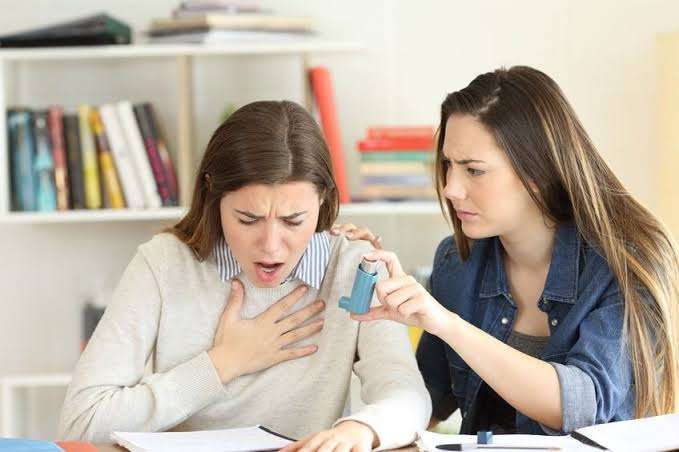
It starts with a cough, or a wheeze, or a colleague who suddenly cannot finish a sentence. They reach for their bag, or they cannot find their inhaler. Their chest is tight, and they look frightened. Asthma attacks can happen to anyone with asthma, at any time, and they can become life threatening quickly. Many people say they would not know how to help.
The good news is that the first aid is clear and simple, and following it can make a real difference. In this guide, we explain in plain English how to help someone with an asthma attack at work, using the advice from Asthma + Lung UK and the NHS, and how it connects to what you learn on an Emergency First Aid at Work (EFAW) course in London. If you want to see a real course page as you read, here is the Emergency First Aid at Work course in London.
Important Notes First
- This guide is general information, not medical advice or training. A trainer can show you how to help someone use an inhaler and spacer.
- If you are worried at any point, call 999. Do not wait to see if it gets better.
- A first aider does not give medicine. You can help someone use their own prescribed inhaler.
- This guide is mainly for adults. Asthma attacks in children follow a similar pattern, but children need extra care, so learn about them on a paediatric first aid course.
- Follow the person’s own asthma action plan, if they have one and share it.
The Short Answer
Help the person sit up, in a comfortable position, and keep them calm. Help them take one puff of their blue reliever inhaler every 30 to 60 seconds, up to 10 puffs, using a spacer if they have one. If they feel worse at any point, do not feel better after 10 puffs, or you are worried at any time, call 999 for an ambulance. If the ambulance has not arrived after 10 minutes and they are not improving, repeat the puffs, and call 999 again if there is still no help. If they do not have a reliever inhaler, call 999 straight away.
What Is an Asthma Attack?
Asthma is a common long term condition that affects the airways, the small tubes that carry air in and out of the lungs. In an asthma attack, the airways become inflamed, tighten and fill with mucus, making it hard to breathe out. An attack can come on suddenly, or build up over hours or days.
Asthma + Lung UK says that asthma attacks can be life threatening, and that sadly around three people in the UK die from an asthma attack each day, but many of these deaths could be avoided. Early, correct action matters.
Signs of an Asthma Attack
Signs that someone may be having an asthma attack include:
- Their usual symptoms are getting worse, such as a cough, wheezing, breathlessness or a tight chest.
- Their reliever inhaler is not helping, or not lasting as long as usual.
- They are finding it hard to breathe.
- They are wheezing or coughing a lot, and cannot stop.
- Their chest feels tight, as if a band is squeezing it.
- They are breathing faster than usual.
- They are struggling to speak in full sentences.
- They look anxious, and may hold on to a chair or desk.
Signs That the Attack Is Becoming Dangerous
Call 999 straight away if you see:
- They cannot speak, or can only say a word or two at a time.
- Blue or grey lips, face or fingertips.
- They look exhausted, or very pale and sweaty.
- They are getting drowsy, confused or hard to wake.
- Their breathing is very fast, very slow, or they are using their shoulders and neck muscles to breathe.
- The wheezing stops, but they are still struggling, which can mean very little air is moving. A quiet chest in a person who is struggling is dangerous.
- They become unresponsive.
If they are unresponsive and not breathing normally, call 999 and start CPR.
Step by Step: First Aid for an Asthma Attack
Step 1: Help them sit up and stay calm
Help the person sit upright in a comfortable position, for example on a chair, leaning slightly forward. Do not let them lie down. Lying down makes breathing harder. Stay calm yourself, speak slowly and reassuringly, and encourage them to take slow, steady breaths. Panic makes breathing harder.
Step 2: Find their reliever inhaler
A reliever inhaler is usually blue, though it can be a different colour. It is the inhaler they use when they have symptoms. Ask them where it is, or look in their bag or desk, if they are happy for you to do so. If a colleague has told you in advance where it is kept, fetch it.
Step 3: Help them take their reliever
Advice from Asthma + Lung UK is to take one puff of the reliever inhaler every 30 to 60 seconds, up to 10 puffs. Here is how to help.
- Shake the inhaler well.
- If they have a spacer, fit the inhaler into it. A spacer is a plastic tube that makes the medicine easier to inhale.
- Help them put the mouthpiece in their mouth, with their lips sealed round it.
- Press the inhaler once to release one puff, as they breathe in slowly and steadily. With a spacer, they may breathe in and out slowly a few times.
- Wait 30 to 60 seconds, shake the inhaler again and give the next puff.
- Carry on, one puff at a time, up to 10 puffs in total, watching how they respond.
A trainer can show you the correct technique, and it is worth practising with a spare inhaler device if your workplace has a training one.
Step 4: Call 999 when you need to
Call 999 for an ambulance if:
- They feel worse at any point.
- They do not feel better after 10 puffs.
- They do not have their reliever inhaler, or it is empty or not working.
- You are worried at any time.
- You see any of the danger signs above.
Asthma + Lung UK says to call 999 straight away if the person does not have their blue reliever inhaler. Tell the call handler that the person is having an asthma attack, what you have done and how many puffs they have taken. Put the phone on speaker, and follow their instructions.
Step 5: If the ambulance has not arrived after 10 minutes
If the ambulance has not arrived after 10 minutes and the person is not improving, repeat the puffs: one puff every 30 to 60 seconds, up to another 10 puffs. If they are still no better and the ambulance has still not arrived, call 999 again immediately.
Step 6: Stay with them and keep them comfortable
Stay with the person until the ambulance arrives or they have fully recovered. Keep them sitting upright and calm. Loosen tight clothing around the neck and chest. Open a window for fresh air, if it helps, though cold air can trigger symptoms in some people, so avoid a draught directly on them.
Step 7: Be ready for the worst
If the person becomes unresponsive, place them on their back and check their breathing. If they are not breathing normally, call 999 if you have not already, send for an AED and start CPR straight away. See our guide to adult CPR step by step. If they are unresponsive but breathing, place them in the recovery position, as in our guide on what to do if someone is unresponsive but breathing.
Step 8: Hand over to the ambulance crew
Tell the paramedics what happened, when the attack began, what the person has taken and when, how many puffs, how they have responded, any known triggers and anything you know about their medical history. Hand over their inhaler and any action plan.
If the Person Uses a MART or AIR Inhaler
Some people with asthma use a different kind of inhaler called a MART or AIR inhaler, which is used both daily and during an attack. The advice for these is different. Asthma + Lung UK and the NHS say that for a MART or AIR inhaler, the person should take one puff every 1 to 3 minutes, up to a maximum of six puffs, then call 999 if they do not feel better or feel worse. If you are not sure which type of inhaler a person has, ask them or look at their action plan. If it is not clear, call 999 and follow the call handler’s advice.
What If They Do Not Have Their Inhaler?
Asthma + Lung UK advice is clear: if the person does not have their reliever inhaler, call 999 straight away. While you wait, help them sit upright, keep them calm and tell them help is on its way. Ask the call handler whether it is appropriate to use another person’s reliever inhaler in the circumstances, and follow their advice. Do not give any other medicine.
What Not to Do
- Do not let them lie down.
- Do not tell them to calm down in a sharp way. Calm reassurance helps, but panic or dismissal does not.
- Do not wait to see if it gets better when they are struggling.
- Do not leave them alone.
- Do not give food, hot drinks, tablets or other medicines. Only help them use their own prescribed inhaler.
- Do not ask them to hold their breath or breathe into a paper bag.
- Do not block the airway or press on the chest.
- Do not delay calling 999 if you are worried at any point.
- Do not assume it is a panic attack. The two can feel similar, but an asthma attack is a medical emergency.
Asthma Attack, Panic Attack or Something Else?
Because breathlessness has many causes, it can be hard to tell. You do not need to be certain.
- Asthma attack: wheeze, cough, tight chest, symptoms that follow a trigger or a history of asthma, relief from the blue inhaler.
- Panic attack: fast breathing, tingling, dizziness and fear, often without wheeze. Calm reassurance helps, but if you are unsure, treat it as a medical problem.
- Allergic reaction: swelling of the lips, face or tongue, a rash, difficulty breathing. This can be life threatening anaphylaxis, which needs 999 and an adrenaline auto injector if the person has one.
- Heart problem: chest pain, sweating, breathlessness. Call 999.
- Choking: sudden difficulty breathing while eating, with an inability to speak or cough.
If you are unsure, call 999, and follow the call handler’s advice.
Common Triggers at Work
A person with asthma may have attacks triggered by things at work or on the way to work.
- Dust and mould.
- Cleaning products, chemicals and fumes. Including sprays, paints and solvents.
- Cold air or sudden changes in temperature.
- Exercise, especially in cold weather.
- Smoke and vapour, including tobacco and cooking fumes.
- Air pollution, including busy London roads.
- Pollen and hay fever.
- Animals and fur.
- Colds and infections.
- Stress and strong emotion.
- Some medicines.
- Workplace substances, which can cause occupational asthma. Employers have duties to control exposure to hazardous substances.
Asthma attacks often follow a trigger, but not always.
After the Attack
Once the attack has settled, there is more to do.
- Let them rest. They may feel tired, shaky and anxious.
- Encourage a medical review. Asthma + Lung UK advises anyone who has had an asthma attack to call their GP surgery and ask for a follow up appointment, because an attack is a sign that their asthma may need reviewing. If they were taken to hospital, they should be seen by their GP or asthma nurse soon afterwards.
- Do not let them go back to hazardous tasks or exposure to triggers until they feel well.
- Record what happened. Date, time, place, signs, what you did, how many puffs, what help arrived.
- Report to your employer. Accidents and incidents should be recorded.
- Replace the inhaler if needed. The person may need a new one.
- Respect confidentiality. Health information belongs to the person.
- Support the team. Colleagues who witnessed it may be shaken.
What Employers Can Do
The Health and Safety (First Aid) Regulations 1981 require employers to provide adequate and appropriate first aid for their employees. Employers can go further to support staff with asthma.
- Train first aiders. As a starting point for low hazard workplaces, HSE suggests at least one appointed person for fewer than 25 employees, at least one first aider trained in Emergency First Aid at Work for 25 to 50 employees, and at least one first aider trained in First Aid at Work for every 100 employees above that, or part of 100. Higher hazard workplaces need more. A first aid needs assessment gives the best answer.
- Encourage staff to keep their inhalers with them, and accessible, not locked away.
- Support personal asthma action plans. If an employee chooses to share one, make sure the right people know where it is and what it says, with confidentiality.
- Control triggers. Good ventilation, safe handling of chemicals and dust, cleaning schedules and smoke free areas help. Employers have duties to control exposure to hazardous substances.
- Make reasonable adjustments. Asthma may count as a disability under the Equality Act 2010, depending on its effects, and employers may need to consider reasonable adjustments. This is general information, not legal advice. If you are unsure, check with Acas or a legal adviser.
- Raise awareness. A short briefing on what to do reduces fear and delay.
- Have a clear emergency procedure. Who calls 999, who stays with the person, who meets the ambulance.
- Offer support afterwards.
Where an EFAW Course Fits
An Emergency First Aid at Work course teaches the core skills that matter in an asthma emergency: assessing an incident safely, checking a casualty, calling for help clearly, managing an unresponsive casualty, using the recovery position, giving CPR and using an AED if needed, and handing over to the ambulance crew. You practise with a trainer and work through scenarios.
Asthma itself is a medical condition, and the longer First Aid at Work course covers a wider range of medical conditions, including asthma, in more detail. Exact content varies by awarding organisation, so check the course outline to see how asthma is covered.
EFAW is a one day, regulated Level 3 qualification, and HSE guidance says it should include at least six hours of training time, not counting breaks. The certificate is valid for three years. HSE strongly recommends a short refresher each year, although it is not a legal requirement.
Choosing a Good Course in London
Look for:
- A regulated Level 3 Award in Emergency First Aid at Work (RQF) or First Aid at Work from a recognised awarding organisation.
- The right training time: at least six hours for EFAW, and at least 18 hours for FAW, not counting breaks.
- Hands on practice, including calling for help, the recovery position and CPR.
- A clear course outline, so you can see how asthma and other medical conditions are covered.
- Practical assessment in person. HSE guidance expects this for a workplace first aider, so online only courses are generally not suitable.
- Qualified, experienced trainers.
- Small classes. Many awarding organisations set a maximum of around 12 learners per trainer.
- A clear certificate and a clear total price.
HSE stopped approving first aid training providers in 2013, so be cautious of any claim that a course is HSE approved. In London in 2026, public prices for a one day EFAW course commonly range from about £65 to £150 per person. One provider page, linked above, lists £89 per person for classroom training and £75 per person for groups of five or more, at the time of writing in October 2026, and First Aid at Work at around £200 to £300 per person. Prices change, so always confirm. You can review the Emergency First Aid at Work training page to see how one provider presents its courses, prices and booking options.
Why London Workplaces Should Be Ready
London has busy offices, kitchens, shops and building sites, with air pollution on many roads, cleaning chemicals, dust and crowded indoor spaces, all of which can trigger asthma. Roads and public transport can be congested, so ambulances may take time to arrive, and what you do in those first minutes matters. There is also a very large number of training providers and dates in London, and many deliver training at your workplace, which is a practical way to prepare a whole team to respond calmly.
Final Thoughts
So, how do you help someone with an asthma attack at work? Help them sit up and stay calm, and do not let them lie down. Help them take one puff of their blue reliever inhaler every 30 to 60 seconds, up to 10 puffs, with a spacer if they have one. Call 999 if they feel worse, if they do not feel better after 10 puffs, if you are worried at any point, or straight away if they have no inhaler. If the ambulance has not come after 10 minutes and they are not improving, repeat the puffs, and call 999 again. Stay with them, and be ready to start CPR if they become unresponsive and stop breathing normally.
The steps are simple, and knowing them can save a life. When you are ready to learn with a trainer, take a look at the Emergency First Aid at Work course in London and choose a date that suits you.
Frequently Asked Questions
1. What should you do if someone is having an asthma attack?
Help them sit up and stay calm, and help them take one puff of their blue reliever inhaler every 30 to 60 seconds, up to 10 puffs. Call 999 if they feel worse, do not feel better after 10 puffs or you are worried at any time. If they have no inhaler, call 999 straight away.
2. How many puffs of a reliever inhaler should someone take during an attack?
One puff every 30 to 60 seconds, up to a maximum of 10 puffs, for a standard blue reliever inhaler. For a MART or AIR inhaler, one puff every 1 to 3 minutes, up to a maximum of six puffs. Use a spacer if they have one.
3. When should I call 999 for an asthma attack?
Call 999 if they feel worse at any point, do not feel better after 10 puffs, cannot speak, have blue or grey lips, look exhausted or drowsy, do not have their reliever inhaler or if you are worried at any time.
4. Should someone lie down during an asthma attack?
No. Help them sit upright in a comfortable position, leaning slightly forward if that helps. Lying down makes breathing harder.
5. What if the ambulance has not arrived after 10 minutes?
If the person is not improving, repeat the puffs, up to the same maximum. If they are still no better and the ambulance has not arrived, call 999 again immediately.
6. Can I use someone else’s inhaler?
If the person does not have their own reliever, call 999 straight away and ask the call handler whether it is appropriate to use another person’s reliever inhaler. Follow their advice. Do not give any other medicine.
7. What is the difference between an asthma attack and a panic attack?
An asthma attack usually involves wheezing, coughing and a tight chest, often after a trigger or in someone with asthma, and responds to a blue inhaler. A panic attack involves fast breathing, tingling and fear. They can feel similar, so if you are unsure, treat it as a medical emergency and call 999.
8. What should happen after an asthma attack?
The person should rest and see their GP or asthma nurse for a review, because an attack is a sign that their asthma may need attention. Record what happened, report it to your employer and replace the inhaler if needed.
9. Does an EFAW course cover asthma attacks?
An Emergency First Aid at Work course covers assessing an incident, calling for help, the recovery position, CPR and AED use. The longer First Aid at Work course covers medical conditions, including asthma, in more detail. Check the course outline to see how asthma is covered.
10. Where can I learn first aid in London?
You can book an Emergency First Aid at Work or First Aid at Work course through a training provider that offers the regulated qualification, either as a public course or as training at your workplace. Check the practical content, the awarding organisation, the class size and the total price before you book.