A colleague slumps at their desk. Someone is found on the floor of the stockroom. A visitor collapses in reception. You speak to them, you shake their shoulder, and they do not respond. But when you check, they are breathing. What now?
This is one of the most common serious situations a workplace first aider meets, and it is very different from a cardiac arrest. The person needs help, and fast, but not CPR. In this guide, we explain in plain English what to do when someone is unresponsive but breathing at work, following the same steps taught on an Emergency First Aid at Work (EFAW) course in London. If you want to see a real course page as you read, here is the Emergency First Aid at Work course in London.
Important Notes First
- This guide is for adults. Babies and children need different advice, so learn it on a paediatric first aid course.
- Call 999 in a real emergency. An unresponsive person always needs urgent medical help.
- This is general information, not training. A trainer can show you the recovery position on a real person and check your technique.
- First aiders do not diagnose. Your job is to keep the person safe, protect the airway and get professional help.
The Short Answer
If someone is unresponsive but breathing normally, call 999, place them in the recovery position so that their airway stays open and clear, stay with them and keep checking their breathing until help arrives. If their breathing stops or becomes abnormal at any point, start CPR straight away.
Why This Is Different From Cardiac Arrest
It helps to be clear about the difference.
Cardiac arrest
- The person is unresponsive and not breathing normally.
- The heart has stopped pumping effectively.
- You need CPR and an AED.
Unresponsive but breathing
- The person is unresponsive, but is breathing normally.
- The heart is still pumping.
- The main danger is that the airway may become blocked, for example by the tongue falling back or by vomit.
- You need to protect the airway, call for help and monitor.
Giving chest compressions to someone who is breathing normally is not what you want. That is why checking breathing properly is such an important step.
Why the Airway Is the Main Danger
When a person is unresponsive, their muscles relax. If they are lying on their back, the tongue can fall to the back of the throat and block the airway. Vomit or fluid can also enter the airway, because the person cannot cough or swallow properly. A blocked airway can stop breathing, which can turn a serious situation into a life threatening one.
The recovery position helps by turning the person onto their side, so the tongue falls forward, and any fluid drains out of the mouth rather than into the airway.
Step by Step: What to Do
Step 1: Check for danger
Before you approach, look around. Check for hazards such as spilt liquids, electrical equipment, machinery, fumes, traffic or anything else that could harm you or others. If it is not safe, call 999 and wait for help. If the cause could be a hazard, such as a gas leak or fumes, do not become a second casualty.
Step 2: Check for a response
Kneel beside the person. Speak loudly and clearly, for example: Can you hear me? Open your eyes. Gently shake their shoulders. If they respond, they are not unresponsive. Ask what happened, find out if they are hurt and get help as needed.
Step 3: Shout for help
If they do not respond, call out for help. If someone is nearby, give clear instructions: You, call 999. You, fetch the first aid kit. You, find the AED. Send someone to meet the ambulance at the entrance.
Step 4: Open the airway
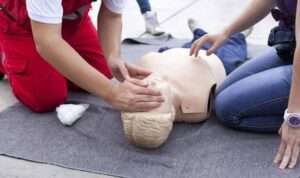
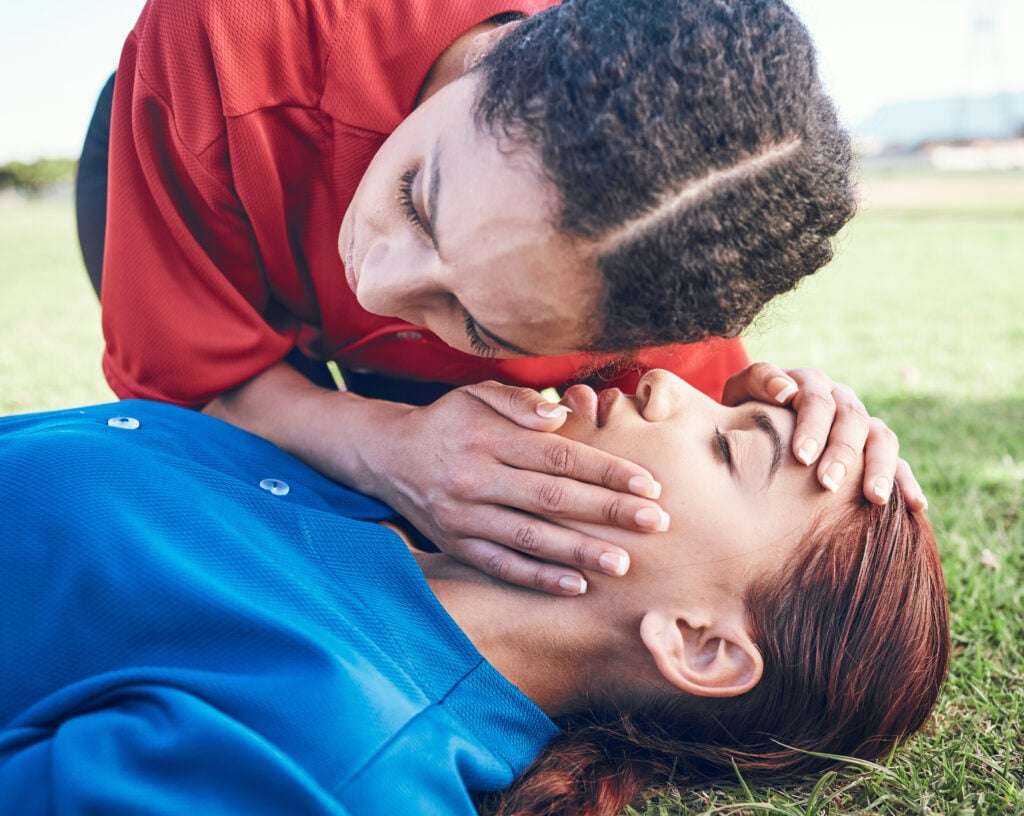
Tilt the head back gently and lift the chin, using two fingers under the point of the chin and a hand on the forehead. This opens the airway.
Step 5: Check for normal breathing
While you keep the airway open, look, listen and feel for normal breathing, for no more than 10 seconds. Look for chest movement, listen for breath sounds and feel for breath on your cheek.
- If breathing is normal, carry on with this guide.
- If it is not normal, or you are unsure, treat it as cardiac arrest: call 999, send for an AED and start chest compressions. Gasping or noisy breathing that is not regular and normal is not safe to rely on.
Step 6: Call 999
If you have not already done so, call 999, or ask someone to, and put the phone on speaker. Tell the call handler that the person is unresponsive but breathing. They may give you advice and ask you to check breathing again.
Step 7: Place the person in the recovery position
The recovery position is taught in detail on an EFAW course, because it is a practical skill. Here is a typical method for an adult who is lying on their back.
- Kneel beside the person. Remove their glasses, and any bulky items from their pockets if you can do so quickly.
- Make sure both legs are straight.
- Place the arm nearest to you at a right angle to their body, with the elbow bent and the palm facing up.
- Bring the far arm across their chest, and hold the back of that hand against their cheek nearest to you. Keep holding it there.
- With your other hand, grasp the far leg just above the knee and pull it up, keeping the foot flat on the floor.
- Keeping their hand pressed against their cheek, pull on the bent knee and roll the person towards you, onto their side.
- Adjust the upper leg so that the hip and knee are bent at right angles, which keeps them stable and stops them rolling forward.
- Tilt the head back gently to keep the airway open, and adjust the hand under the cheek to keep the head tilted.
- Check that the person cannot roll onto their front or back.
Step 8: Keep checking
Stay with the person. Keep checking their breathing regularly, and watch for changes. If they are in the recovery position for a long time, some guidance suggests turning them to the other side about every 30 minutes, but the ambulance may arrive before this matters. Follow the call handler’s advice.
Step 9: Be ready to start CPR
If the person stops breathing normally at any point, roll them onto their back, call 999 again if needed, send for an AED and start chest compressions straight away.
Step 10: Keep them warm and comfortable
Cover them with a coat or blanket, if available. Loosen tight clothing around the neck, such as a tie or collar, if you can do it easily. Do not give food or drink, because they cannot swallow safely.
Step 11: Hand over to the ambulance crew
When paramedics arrive, tell them what happened, what you found and what you did. Include:
- What you saw or were told happened.
- When you found the person, and how long they have been unresponsive.
- Whether they have any known medical conditions, medication, allergies or injuries, if you know.
- What you did, and when you placed them in the recovery position.
- Any changes in breathing or colour.
- Anything unusual at the scene, such as spilt liquids, fumes or an object nearby.
Then step back and let them take over.
Possible Reasons at Work
A first aider does not need to diagnose, but it helps to know that there are many possible reasons for being unresponsive but breathing, and some are very serious. At work, they might include:
- Fainting. Usually the person recovers within a minute or two, though they still need to be checked.
- Low blood sugar. For example, in someone with diabetes.
- Epileptic seizure. The person may be unresponsive after a seizure.
- Stroke. The person may have weakness or a drooping face, and may be unresponsive.
- Head injury. After a fall or a blow.
- Heat exhaustion or heat stroke. Especially in hot environments.
- Fumes, gases or chemicals. In a workplace with hazards.
- Alcohol or drugs. In some situations.
- Medical conditions. Such as heart problems or low blood pressure.
- A new or worsening illness.
Because the cause is often unclear, the safest approach is always the same: protect the airway, call 999 and monitor.
What If They Wake Up?
If the person regains consciousness:
- Stay with them, and keep them calm and still.
- Ask what happened, and how they feel.
- Do not let them get up quickly.
- Keep the ambulance on the way, unless the call handler tells you otherwise. Even if they seem better, they should still be checked by a medical professional, because they were unresponsive.
- Keep watching them, because they could become unresponsive again.
If someone has fainted and recovers within a minute or two, they may sit up slowly, drink water and rest, but they should still seek medical advice. If you are unsure, call 999 or 111 for advice.
Special Situations
Suspected head, neck or spinal injury
If you suspect a serious head or neck injury, for example after a fall from height, take extra care. But if the person is unresponsive, their airway is the priority, and a blocked airway is life threatening. Follow the call handler’s advice, and keep the head, neck and back in line as much as you can when you roll them. If you are not sure, call 999 and ask for guidance.
Pregnancy
If the person is visibly pregnant, the same steps apply. Roll them onto their left side if you can, and call 999.
Serious bleeding
If there is severe bleeding, control it with firm pressure at the same time as you protect the airway, and ask someone to help. Bleeding and airway are both priorities, so use helpers.
A seizure
If the person has had a seizure and is now unresponsive but breathing, place them in the recovery position once the seizure has stopped, and call 999 if it is their first seizure, if it lasts more than five minutes or if you are unsure.
A tight space or an awkward position
If the person is in a toilet cubicle, under a desk or in a tight space, move them only as far as you need to in order to open the airway and check breathing. Call 999 and ask for advice.
Unsafe scene
If there is a risk from fumes, machinery or other hazards, make the scene safe first, or wait for the emergency services.
Common Worries, Answered
What if I put them in the wrong position?
A slightly imperfect recovery position is much better than leaving the person on their back with an unprotected airway. The key points are that they are on their side, their head is tilted back and they cannot roll over. Your trainer can help you improve your technique on a course.
What if I am not sure whether they are breathing normally?
If you are unsure, treat it as cardiac arrest, call 999 and start CPR. It is safer to start CPR than to wait.
Should I move them at all?
If they are breathing and the airway is at risk, turning them into the recovery position is usually the right choice. Only avoid moving them if there is danger, or if a call handler advises it for a specific reason.
Can I give them water or something sweet?
Not when they are unresponsive. They cannot swallow safely, and there is a risk of choking. Wait for medical help.
What if I am on my own?
Call 999 first, put the phone on speaker and follow the call handler’s advice. Place the person in the recovery position, and stay with them. If you must leave them to get help, put them in the recovery position first.
Could I be blamed for helping?
The law in England and Wales looks kindly on people who act sensibly and in good faith to help others. The Social Action, Responsibility and Heroism Act 2015 says courts should consider this when they decide on negligence. This is general information, not legal advice.
After the Incident
Once the ambulance has gone, there is still work to do.
- Write down what happened. Date, time, place, what you saw, what you did and what you handed over. Keep it factual.
- Report it to your employer. Accidents and incidents should be recorded. Some serious work related injuries and illnesses must be reported to the authorities, and your employer decides what is needed.
- Check the first aid kit. Replace anything used.
- Look after yourself and others. Seeing a colleague collapse can be upsetting. Talk to someone you trust, and use any support your employer offers.
- Review. Your employer may review how well the response worked.
How an EFAW Course Teaches This
On an Emergency First Aid at Work course, you practise this situation in a hands on way.
- A trainer demonstrates. You see the checks and the recovery position.
- You practise with a partner. You take turns being the casualty, so you feel what the position is like from both sides.
- You learn the decision point. You practise checking breathing and deciding between the recovery position and CPR.
- You rehearse the handover. You practise describing what you found and did.
- You work through scenarios. For example, finding a colleague on the floor.
- You are assessed in person. A qualified trainer watches your skills.
The course is a one day, regulated Level 3 qualification. HSE guidance says it should include at least six hours of training time, not counting breaks. You also learn adult CPR, how to use an AED, how to help a choking adult, how to control serious bleeding, how to manage shock and how to treat minor injuries. The certificate is valid for three years. For more on CPR, see our guide to adult CPR step by step.
What Workplaces Should Do
The Health and Safety (First Aid) Regulations 1981 require employers to provide adequate and appropriate first aid for their employees. For an unresponsive person, workplaces should have:
- Trained first aiders on every shift. As a starting point for low hazard workplaces, HSE suggests at least one appointed person for fewer than 25 employees, at least one first aider trained in Emergency First Aid at Work for 25 to 50 employees, and at least one first aider trained in First Aid at Work for every 100 employees above that, or part of 100. Higher hazard workplaces need more. A first aid needs assessment gives the best answer.
- A clear emergency procedure. Who calls 999, who fetches the first aid kit and AED, who meets the ambulance.
- A well stocked first aid kit. Easy to find and checked regularly.
- A way to direct the ambulance. A clear address, entrance details and a named person to meet the crew.
- Regular refreshers. HSE strongly recommends them, although they are not a legal requirement, because skills such as the recovery position can fade.
- Support after an incident. Time, a quiet space and access to employee support.
Choosing a Good Course
If you want to practise this properly, look for:
- A regulated Level 3 Award in Emergency First Aid at Work (RQF) from a recognised awarding organisation.
- At least six hours of training time, not counting breaks.
- Hands on practice, including the recovery position with a partner.
- Practical assessment in person. HSE guidance expects this for a workplace first aider, so online only courses are generally not suitable.
- Qualified, experienced trainers.
- Small classes. Many awarding organisations set a maximum of around 12 learners per trainer.
- A clear certificate and a clear total price.
HSE stopped approving first aid training providers in 2013, so be cautious of any claim that a course is HSE approved. In London in 2026, public prices for a one day course commonly range from about £65 to £150 per person. One provider page, linked above, lists £89 per person for classroom training and £75 per person for groups of five or more, at the time of writing in October 2026. Prices change, so always confirm. You can review the Emergency First Aid at Work training page to see how one provider presents its course, price and booking options.
Why London Workplaces Should Be Ready
London workplaces are busy, often spread over several floors, and full of visitors and contractors. Roads and public transport can be congested, so ambulances may take time to reach a patient, and the people on site are often the first help available. There is also a very large number of training providers and dates in London, and many deliver training at your workplace, which is a practical way to teach a whole team how to respond.
Final Thoughts
So, what do you do if someone is unresponsive but breathing at work? Check for danger, check for a response, shout for help, open the airway and check breathing for no more than 10 seconds. If breathing is normal, call 999, place the person in the recovery position, keep checking their breathing, keep them warm and hand over clearly to the ambulance crew. If breathing stops or becomes abnormal at any time, start CPR straight away.
The skill is simple, but it needs practice. When you are ready to learn it with a trainer, take a look at the Emergency First Aid at Work course in London and choose a date that suits you.
Frequently Asked Questions
1. What should you do if someone is unresponsive but breathing?
Call 999, place them in the recovery position so the airway stays open and clear, stay with them and keep checking their breathing until help arrives. If breathing stops or becomes abnormal, start CPR straight away.
2. What is the recovery position?
It is a way of laying an unresponsive but breathing person on their side, with the head tilted back and the upper leg bent, so that the airway stays open and any fluid can drain from the mouth. It stops the tongue or vomit blocking the airway.
3. How long should I check for breathing?
No more than 10 seconds. Look for chest movement, listen for breath sounds and feel for breath on your cheek. If breathing is not normal, or you are unsure, treat it as cardiac arrest and start CPR.
4. Should I call 999 if the person is breathing?
Yes. An unresponsive person always needs urgent medical help, even if they are breathing. Put the phone on speaker so the call handler can guide you.
5. Can I give an unresponsive person water or food?
No. They cannot swallow safely, and there is a risk of choking. Wait for medical help.
6. What if the person wakes up?
Stay with them, keep them calm and still, and do not let them get up quickly. They should still be checked by a medical professional, so keep the ambulance on the way unless the call handler advises otherwise, and keep watching them.
7. What if I think they have a spinal injury?
The airway is the priority, because a blocked airway is life threatening. Follow the call handler’s advice, and keep the head, neck and back in line as much as you can when you roll them. If you are unsure, call 999 and ask for guidance.
8. What should I tell the ambulance crew?
What happened, when you found the person, what you found, what you did and when, any changes in breathing or colour, and anything you know about medical conditions, medication or allergies. Then step back and let them take over.
9. Does an EFAW course teach the recovery position?
Yes. You practise it with a partner, learn how to check breathing and decide between the recovery position and CPR, and rehearse the handover. The course is a one day regulated Level 3 qualification with at least six hours of training time.
10. Where can I learn first aid for unresponsive casualties in London?
You can book an Emergency First Aid at Work course through a training provider that offers the regulated qualification, either as a public course or as training at your workplace. Check the practical content, the class size, the awarding organisation and the total price before you book.