A clear list of the things you will be able to do on the day you walk out with your certificate.
A first aid certificate is a piece of paper. What really matters is what you can do when someone needs help. So before you book an Emergency First Aid at Work course in London, it makes sense to ask: what practical skills will I actually leave with?
In this guide, we answer that question in plain English. We go through each skill, explain what you will be able to do, and also cover the softer skills that make a first aider calm and confident. We also say honestly what the course does not cover. If you want to see a real course page as you read, here is the Emergency First Aid at Work course in London.
The Short Answer
After an Emergency First Aid at Work (EFAW) course, you will be able to:
- Take charge of an emergency scene safely.
- Check a casualty and decide when to call 999.
- Give CPR to an adult.
- Use an automated external defibrillator (AED).
- Place an unresponsive, breathing person in the recovery position.
- Help an adult who is choking.
- Control serious bleeding.
- Recognise and manage shock.
- Treat minor injuries such as small cuts, grazes and burns.
- Record what happened and hand over to professionals.
These are the core skills of a first aider in a low risk workplace. The course is a one day, regulated Level 3 qualification. HSE guidance says it should include at least six hours of training time, not counting breaks.
Skill 1: Taking Charge Safely
The first skill is not about the casualty at all. It is about you and the scene.
What you will be able to do:
- Look around quickly for dangers, such as traffic, fire, electrical hazards or broken glass.
- Protect yourself, for example by using gloves.
- Keep bystanders safe and ask them for help.
- Decide whether it is safe to approach the casualty.
Why it matters: if you become a casualty too, you cannot help anyone. Good first aiders stay safe first.
Skill 2: Checking a Casualty and Calling for Help
Next, you learn a simple, step by step way to check a person who is hurt or unwell.
What you will be able to do:
- Check whether the person responds to your voice and touch.
- Open their airway and check their breathing.
- Decide what kind of emergency you are dealing with.
- Call 999, or ask someone else to call, and give clear information to the call handler.
- Send someone to fetch the first aid kit and the AED.
Why it matters: this method is the backbone of the whole course. It helps you stay calm and avoid missing something important.
Skill 3: Giving CPR to an Adult
CPR, or cardiopulmonary resuscitation, is one of the most valuable skills you will learn.
What you will be able to do:
- Recognise when an adult is not breathing normally.
- Place your hands in the correct position on the chest.
- Give chest compressions at the right depth and speed.
- Give rescue breaths, where you are trained and able.
- Keep going until help arrives, and swap with another rescuer when you are tired.
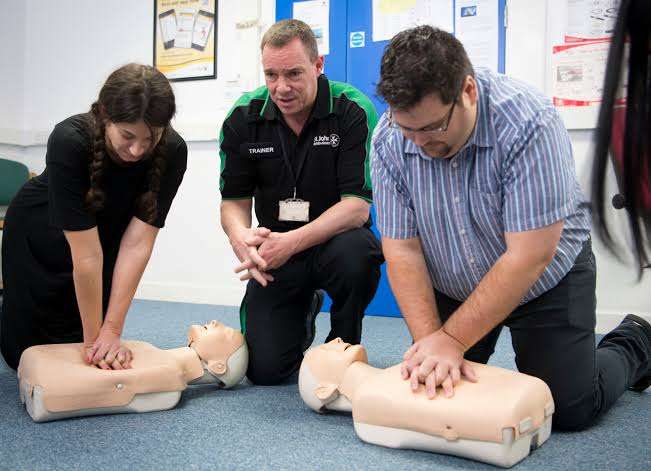
How you practise: you kneel beside a training manikin and practise several times, while the trainer watches and gives feedback. Chest compressions need real effort, so you will feel it in your arms.
Why it matters: quick CPR can keep blood and oxygen moving to the brain and heart until an ambulance arrives.
Skill 4: Using an AED
An AED is a machine that can give an electric shock to help restart a heart. It is built for ordinary people to use, and it gives spoken instructions.
What you will be able to do:
- Switch on the AED and follow its prompts.
- Place the pads on the casualty’s chest correctly.
- Make sure nobody is touching the casualty when the machine asks.
- Carry on with CPR when the machine tells you to.
How you practise: you use a training AED with practice pads on a manikin, so you get used to the steps.
Why it matters: early use of an AED, together with CPR, greatly improves the chance of survival after a cardiac arrest. Many people feel much less afraid of these machines once they have used one.
Skill 5: The Recovery Position
Not everyone who is unresponsive needs CPR. Some are unresponsive but still breathing.
What you will be able to do:
- Check that the person is breathing normally.
- Roll them safely onto their side in the recovery position.
- Keep their airway open and clear.
- Monitor their breathing until help arrives, and be ready to start CPR if it stops.
How you practise: you work in pairs and take turns being the casualty. This gives you a feel for what the position looks like and how it feels.
Why it matters: the position helps prevent the airway from becoming blocked, for example by the tongue or by vomit.
Skill 6: Helping a Choking Adult
Choking can happen in any canteen, café or office kitchen.
What you will be able to do:
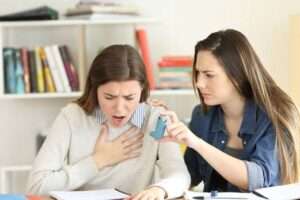
- Tell the difference between mild and severe choking.
- Encourage a person with mild choking to keep coughing.
- Give back blows and abdominal thrusts for severe choking.
- Call 999 when needed, and start CPR if the person becomes unresponsive.
How you practise: the trainer demonstrates the movements, and you practise the technique safely without real force.
Why it matters: quick, correct action can clear a blockage and prevent a tragedy.
Skill 7: Controlling Serious Bleeding
Bleeding can look frightening, but you can learn to manage it calmly.
What you will be able to do:
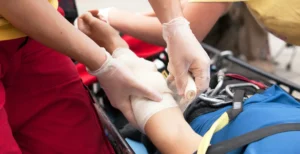
- Apply firm, direct pressure to a bleeding wound.
- Use a dressing or clean pad and bandage it in place.
- Raise or support the injured part where appropriate.
- Decide when to call an ambulance.
- Watch for signs of shock.
How you practise: you use real dressings and bandages on a partner or a training model.
Why it matters: serious bleeding can become life-threatening quickly. Early control gives the person a better chance.
Skill 8: Recognising and Managing Shock
In first aid, shock means a serious condition where the body is not getting enough blood flow, often after severe bleeding or injury.
What you will be able to do:
- Spot signs such as pale, cold, clammy skin and a fast pulse.
- Help the person lie down and stay warm and calm.
- Treat the cause, such as bleeding, where you can.
- Call for professional help quickly.
Why it matters: shock can worsen fast. Knowing the signs helps you act early.
Skill 9: Treating Minor Injuries
Most workplace incidents are small. Your training helps you deal with them properly.
What you will be able to do:
- Clean and dress small cuts and grazes.
- Cool minor burns and scalds correctly and cover them.
- Care for minor head bumps and know what warning signs to look for.
- Decide whether a person needs further medical care.
Why it matters: correct early care helps healing and prevents small problems from becoming bigger ones.
Skill 10: Recording and Handing Over
First aid does not end when the ambulance arrives.
What you will be able to do:
- Pass clear information to paramedics, such as what happened, what you found and what you did.
- Keep a simple record of the incident and the first aid given.
- Report accidents to your employer as required.
Why it matters: good records help medical staff, protect you and help your employer improve safety.
The Soft Skills You Will Also Gain
The course is not only about techniques. You also build skills that help you stay effective under pressure.
- Staying calm. Following a clear method gives your mind a plan to hold on to.
- Clear communication. You learn how to speak to casualties, bystanders and the 999 call handler.
- Leading and delegating. You learn to give simple, firm instructions, such as asking one person to call 999 and another to fetch the AED.
- Confidence. Practising each skill several times makes it feel less scary.
- Awareness. You start to notice hazards and think about prevention.
- Knowing your limits. You understand what a first aider should and should not do.
What You Will Not Leave With
To be fair, it helps to know the limits of a one-day course.
- You will not become a medical professional. First aiders do not diagnose or treat as doctors and nurses do.
- You will not be trained in every illness or injury. The three-day First Aid at Work course covers a wider range.
- You will not be trained in baby and child first aid. EFAW mainly focuses on adults. Early years settings in England need paediatric first aid.
- You will not keep your skills forever without practice. Skills like CPR can fade within months. HSE recommends a short yearly refresher, although it is not a legal rule.
How You Learn These Skills
The course uses a simple, proven method.
- Watch. The trainer shows you each skill.
- Try. You practise with real equipment, such as manikins, training AEDs and dressings.
- Get feedback. The trainer corrects small mistakes straight away.
- Repeat. Key skills such as CPR are practised several times.
- Show. You demonstrate your skills so the trainer can assess you.
This is why practical training matters so much. You cannot learn CPR well from a video alone.
How to Keep Your Skills Sharp
A few easy habits help you remember what you learned.
- Review your notes a few days after the course.
- Walk through the steps in your head, for example CPR, when you have a quiet moment.
- Practise the recovery position with a friend or family member.
- Find out where your workplace first aid kit and AED are.
- Plan a yearly refresher.
- Put your three-year expiry date in your diary and book your renewal early.
Who Needs These Skills?
The Health and Safety (First Aid) Regulations 1981 say employers must provide adequate and appropriate first aid for their employees. For low risk workplaces, HSE suggests as a starting point:
- Fewer than 25 employees: at least one appointed person. Training someone in EFAW is a smart upgrade.
- 25 to 50 employees: at least one trained first aider.
- More than 50 employees: at least one first aider for every 50 people.
Higher risk workplaces usually need the three day First Aid at Work course. A first aid needs assessment gives the best answer for your workplace. Many other people take EFAW too, including teachers, gym staff, volunteers and self-employed workers.
What Makes a Good Course in London?
To come away with real skills, you need a good course. Look for:
- A regulated Level 3 qualification from a recognised awarding organisation.
- Experienced trainers with real emergency, medical or teaching backgrounds.
- Plenty of hands on practice, with enough manikins and AED trainers.
- Small groups, so the trainer can give you feedback.
- A clear timetable and honest pricing.
You can review the Emergency First Aid at Work training page to see how a course is described and what to compare.
Why Train in London?
London has thousands of workplaces and a busy, crowded transport network. In an emergency, the people nearby are often the first help available. There are many training venues, and many providers can deliver on-site training for teams. With so much choice, it is easy to find a course close to home or work.
Final Thoughts
After an Emergency First Aid at Work course in London, you will leave with real, practical abilities: taking charge safely, checking a casualty, giving CPR, using an AED, using the recovery position, helping a choking adult, controlling bleeding, managing shock, treating minor injuries and handing over to professionals. You will also gain calm, clear communication and the confidence to act.
These skills are valuable at work and at home. When you are ready to build them, take a look at the Emergency First Aid at Work course in London and choose a date that suits you.
Frequently Asked Questions
1. What practical skills do you learn on an Emergency First Aid at Work course?
You learn how to assess an emergency safely, give adult CPR, use an AED, place someone in the recovery position, help a choking adult, control serious bleeding, manage shock and treat minor injuries.
2. Will I learn how to use a defibrillator?
Yes. You practise using a training AED on a manikin, following the machine’s spoken prompts. These machines are designed for ordinary people to use.
3. Will I practise CPR on a manikin?
Yes. Most courses use training manikins so you can practise chest compressions and rescue breaths safely. The trainer watches your technique and gives feedback.
4. Does the EFAW course teach CPR for children and babies?
The course mainly teaches adult first aid. If you work with babies or young children, you will usually need a separate paediatric first aid course.
5. Can I treat any injury after the course?
No. You learn to deal with emergencies and common minor injuries, but first aid is not medical treatment. The three-day First Aid at Work course covers a wider range of injuries and illnesses.
6. Will I feel confident after one day?
Most people feel much more confident, because they have practised each skill with real equipment. Confidence grows further if you review your notes and take a yearly refresher.
7. How long do my skills last?
Your certificate is valid for three years, but skills such as CPR can fade sooner without practice. HSE recommends a short yearly refresher, although it is not a legal requirement.
8. Do I need any experience before the course?
No. The course is designed for beginners. Your trainer explains each skill step by step and lets you practise at a steady pace.
9. Is the course assessed?
Yes, but it is not a hard written exam. Trainers usually watch your practical skills during the day and may ask a few short questions. If you need extra support, tell your provider beforehand.
10. Where can I book an Emergency First Aid at Work course in London?
You can book through a training provider that offers the regulated qualification, either as a public course or as on site training for your team. Check the trainer’s experience, the equipment and what the price includes before you book.