Online vs In-Person Training: Which Suits You Best?
Choosing the right way to study is just as important as choosing the right course. If you’re planning to start a career in the UK security industry, you’ll likely come across both online and in-person training options. While each has its own benefits, the best choice depends on your learning style, schedule, and the type of qualification you need.
Many aspiring security professionals wonder whether online learning is enough or if attending classes in person is the better option. The answer is not always straightforward. Some security courses include online learning for theory, while others require face-to-face training because they involve practical assessments.
This guide compares online and in-person security training to help you decide which option suits you best.
Understanding Security Training in the UK
Before comparing learning methods, it is important to understand that many SIA-related qualifications include practical elements. Courses such as the Door Supervisor qualification involve physical intervention training, conflict management exercises, and practical assessments that must usually be completed in person.
Some providers offer blended learning, where students complete theory modules online before attending a training centre for practical sessions and examinations.
Always check the course requirements before booking.
What Is Online Security Training?
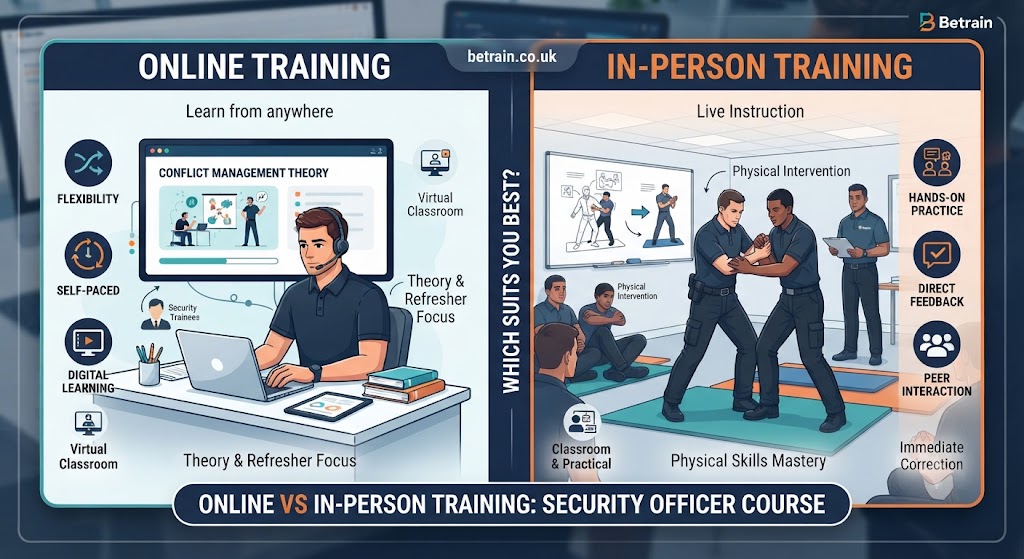
Online training allows students to complete parts of their course using a computer, tablet, or smartphone. Lessons are usually delivered through videos, presentations, reading materials, quizzes, and online assessments.
Depending on the provider, students may study:
- Health and safety
- Customer service
- Communication skills
- Basic security principles
- Legal responsibilities
- Conflict management theory
Some courses also include live virtual classes where instructors answer questions in real time.
Advantages of Online Training
Study From Anywhere
One of the biggest benefits is convenience. You can study from home, at work during breaks, or while travelling.
There is no daily commute, helping you save both time and money.
Flexible Learning Schedule
Online learning allows you to study when it suits you.
This is especially useful if you:
- Work full-time
- Have family responsibilities
- Work night shifts
- Live far from training centres
Many students appreciate being able to pause lessons and continue later.
Learn at Your Own Speed
Everyone learns differently.
With online training, you can:
- Replay videos
- Review lessons multiple times
- Take additional notes
- Spend more time on difficult topics
This flexibility often improves understanding.
Lower Travel Costs
Studying from home reduces expenses such as:
- Fuel
- Train fares
- Parking
- Meals while travelling
For students living outside major cities, this can result in significant savings.
Disadvantages of Online Training
Online learning is not perfect for everyone.
Some common challenges include:
Less Face-to-Face Interaction
Students cannot always ask questions immediately.
Although many providers offer tutor support, it may not feel the same as learning in a classroom.
Requires Self-Discipline
Online learners need motivation.
Without fixed class times, some students delay studying until the last minute.
Good time management becomes very important.
Practical Skills Are Limited
Security work involves real-world situations.
Topics like:
- Physical intervention
- Searching procedures
- Emergency response
- Team exercises
are much easier to practise in person.
What Is In-Person Training?
In-person training takes place at an approved training centre.
Students attend scheduled classes where qualified instructors teach theory and practical lessons face to face.
This remains the most common method for many SIA courses.
Advantages of In-Person Training
Direct Support From Trainers
One of the biggest advantages is immediate access to instructors.
If you do not understand something, you can ask questions straight away and receive detailed explanations.
Practical Experience
Security professionals often deal with real people and real situations.
Classroom exercises help students practise:
- Conflict management
- Customer service
- Communication
- Emergency procedures
- Physical intervention techniques
These activities build confidence before entering the workplace.
Better Focus
Many students find it easier to concentrate in a classroom than at home.
Being away from household distractions helps maintain focus throughout the day.
Learn With Other Students
Studying alongside classmates creates opportunities to:
- Share experiences
- Work in teams
- Build communication skills
- Make professional connections
Networking can sometimes help when looking for future job opportunities.
Disadvantages of In-Person Training
Like online learning, classroom training also has drawbacks.
Fixed Schedule
Students must attend classes at specific times.
This may be difficult for people working full-time or with changing work schedules.
Travel Required
Attending a training centre means paying for transport and spending time travelling.
Those living outside London or major cities may need to travel long distances.
Higher Overall Costs
Although course fees are often similar, additional expenses can include:
- Fuel
- Public transport
- Parking
- Food
- Accommodation for distant learners
These costs should be considered when comparing options.
Blended Learning: The Best of Both Worlds
Many training providers now offer blended learning.
This combines online theory with classroom practical sessions.
For example:
- Study theory online.
- Attend practical training at the centre.
- Complete physical intervention assessments.
- Sit final examinations.
This approach gives students flexibility while ensuring they gain essential practical experience.
For many aspiring security officers, blended learning offers an excellent balance between convenience and hands-on learning.
Which Learning Style Suits You?
Online training may suit you if you:
- Prefer studying independently
- Have strong self-discipline
- Work full-time
- Need flexible study hours
- Live far from training centres
In-person training may suit you if you:
- Learn better through classroom teaching
- Prefer asking questions directly
- Enjoy practical activities
- Stay motivated by structured schedules
- Value face-to-face interaction
There is no single option that works for everyone.
Questions to Ask Before Choosing
Before enrolling, ask yourself:
- Do I have enough time for classroom sessions?
- Am I comfortable studying independently?
- How far is the training centre?
- Will I need practical instruction?
- Can I stay motivated without regular classes?
- Does the provider offer tutor support?
Answering these questions honestly will help you choose the right learning method.
What Do Employers Prefer?
Most employers care more about your qualifications, licence, attitude, communication skills, and professionalism than whether you completed theory online or in person.
As long as your qualification meets SIA requirements and has been completed through an approved training provider, employers generally focus on your ability to perform the job safely and professionally.
Practical experience, confidence, reliability, and good customer service often make a stronger impression during interviews than the method you used to study.
Tips for Success Regardless of Your Choice
Whichever learning method you choose, you can improve your chances of success by:
- Attending every session.
- Completing all assignments on time.
- Asking questions whenever needed.
- Reviewing study materials regularly.
- Practising communication skills.
- Preparing well for assessments.
- Staying organised throughout the course.
Consistent effort is often more important than the learning format itself.
Final Thoughts
Both online and in-person security training offer valuable benefits. Online learning provides flexibility, convenience, and the freedom to study at your own pace, making it ideal for busy professionals and independent learners. In-person training offers hands-on practice, direct interaction with experienced instructors, and a structured learning environment that many students find motivating.
For many SIA qualifications, a blended approach that combines online theory with classroom practical sessions provides the best balance. It allows students to enjoy flexible learning while still developing the practical skills required for a successful career in the security industry.
Before making your decision, consider your schedule, learning style, travel requirements, and the course’s practical components. Choosing the training method that fits your needs will help you gain confidence, complete your qualification successfully, and take the first step towards a rewarding career in security.