You are about to book a first aid course. You have found the date, the venue and the price. But one question is still floating around in your head: how many other people will be there?
It is a fair thing to wonder about. Some people picture a small, friendly circle. Others worry about a packed room where they will be lost in the crowd. In this guide, we look at what a normal Emergency First Aid at Work course in London really looks like, what group sizes you can expect, and how to make sure the class suits you. You can see a real course listing here: Emergency First Aid at Work course in London.
Quick Answer
Most Emergency First Aid at Work (EFAW) classes in London have between 6 and 12 learners and one trainer. Many awarding organisations cap the number at about 12 per trainer, and plenty of providers prefer to keep groups a little smaller. Private sessions for one team can be smaller still.
If a provider tells you the course will be much bigger than 12 with a single trainer, ask how they manage practice time and what the awarding organisation allows.
First, a Quick Reminder of the Course
EFAW is a one day, regulated Level 3 first aid qualification. HSE guidance says it should include at least six hours of training time, not counting breaks. During that time, you learn to:
- Check an incident and a casualty safely.
- Give adult CPR and use an AED.
- Place an unresponsive, breathing person in the recovery position.
- Help a choking adult.
- Control serious bleeding.
- Spot and manage shock.
- Treat minor injuries such as small cuts and burns.
Six hours is not long. So how that time is shared between people is important.
Why the Number of People Changes Your Day
Think of the trainer as the most valuable thing in the room. Every learner needs a bit of their attention. Let us do a simple sum.
Suppose the trainer spends about two hours of the day watching people practise hands on skills. With four learners, each person might get around thirty minutes of close attention. With twelve learners, it is closer to ten minutes. The more people there are, the more you rely on practising with a partner and on the trainer’s quick checks.
That does not mean big groups are bad. It means that equipment, planning and a good trainer become even more important.
Three Typical Class Types in London
1. The open public course
This is where people from different companies and backgrounds join the same class. You might sit next to a teacher, a gym instructor, a shop manager and a freelancer. Groups are often around 6 to 12 people. Some providers set a minimum number to run the course, so ask what happens if the date has few bookings.
2. The private team course
Here, the trainer teaches one organisation. Everyone knows each other, so the atmosphere is relaxed. Team courses are often 6 to 12 people too. If you have a smaller team, the group may be only two or three learners. If your team is bigger than the limit, the provider can usually run two sessions or send more than one trainer.
3. The tiny or one to one session
Some providers offer sessions for just one or two learners. These are handy if you need extra support, have a tight schedule or prefer a quiet setting.
Who Decides the Maximum Class Size?
The Health and Safety (First Aid) Regulations 1981 require employers to provide adequate and appropriate first aid. They do not give a fixed class size. The limits usually come from the awarding organisation that issues the Level 3 Award in Emergency First Aid at Work (RQF). It sets rules for how the course must be taught and assessed, and many include a maximum number of learners per trainer.
Since HSE stopped approving first aid training providers in 2013, employers need to check for themselves that their provider is competent. A sensible class size, enough equipment and a qualified trainer are all part of that check.
Class Size Is Only Half the Story
Here is something many people miss. Two classes with the same number of people can feel very different. What matters is how much practice time each person gets. Look at these three factors together.
- People per trainer. Fewer is better for feedback.
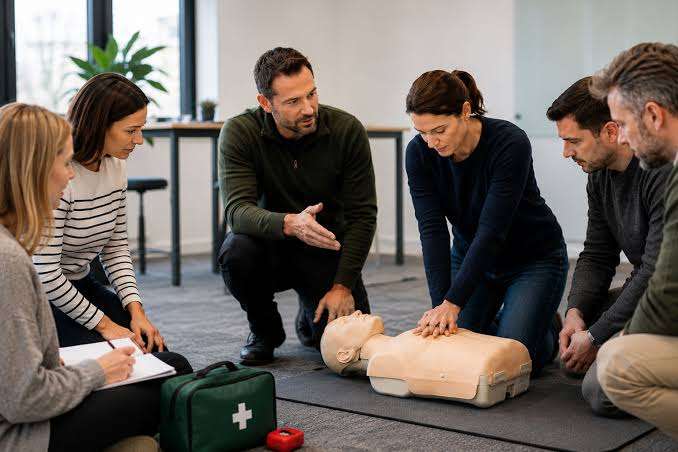
- People per manikin. Ideally only two or three people share one.
- People per AED trainer. Everyone should get a go at placing the pads and following the prompts.
A class of ten with five manikins can beat a class of six with one manikin. So when you ask about size, also ask about equipment.
A Day in a Small Class vs a Larger Class
Let us imagine two versions of the same day.
Small class: five learners
The trainer demonstrates CPR once, then each person tries it while the trainer stands beside them. Mistakes get corrected straight away. When you practise the recovery position, you have time to do it three or four times. If you have a question about your own workplace, there is time to talk it through.
Larger class: twelve learners
The trainer demonstrates, then splits the group into pairs or threes. While one person practises, the others watch and give feedback. The trainer moves around the room. You may get slightly less one-to-one time, but you see more people try the skill, which can also help you learn. A good trainer keeps the energy up and makes sure nobody is left out.
Both versions can work well. The key is how the trainer organises the day.
How Group Size Can Affect the Price
Price and class size are linked. Here is the simple picture.
- Public courses are usually priced per person. A fuller class shares the cost of the trainer, venue and equipment, which can keep the price per person lower.
- Private team courses may be priced per person or per group. Larger groups often bring the price per learner down.
- Very small sessions can cost more per person, because the same trainer and equipment serve fewer people.
Always ask for the full price and what it includes, such as the certificate, materials and refreshments.
How Many Staff Should You Train?
This is a separate question from class size, but it often comes up at the same time. The right number of first aiders depends on your first aid needs assessment. As a starting point for low-risk workplaces, HSE suggests:
- Fewer than 25 employees: at least one appointed person. Training someone in EFAW is a smart upgrade.
- 25 to 50 employees: at least one trained first aider.
- More than 50 employees: at least one first aider for every 50 people.
Higher-risk workplaces usually need the three-day First Aid at Work course and more first aiders. Many employers also train an extra person to cover holidays, sickness and shift patterns.
Is a Smaller Class Always Better?
Not always. Here are the honest pros and cons.
Small class
- Pros: more feedback, more practice, easier to ask questions, calmer feel.
- Cons: fewer people to practise with, and sometimes a higher price per person.
Larger class
- Pros: lively atmosphere, more partners to practise with, often lower price per person.
- Cons: less one to one time, and a poor setup can leave people waiting for equipment.
Choose based on how you like to learn. If you are nervous, have access needs or want lots of attention, a small group may suit you. If you enjoy a busy room, a bigger group is fine, as long as the equipment is good.
Smart Questions to Ask the Provider
A few quick questions can tell you a lot.
- What is the largest class you run for this course?
- How many trainers will be in the room?
- How many manikins and AED trainers will we have?
- What is the minimum number needed for the course to go ahead?
- Is the qualification a regulated Level 3 Award in Emergency First Aid at Work (RQF)?
- How much of the day is hands-on practice?
- Can you adapt the session for access needs?
- What is included in the price?
A good provider answers these clearly and quickly.
Warning Signs
Most providers run good classes. Still, be careful if you notice any of these.
- The provider cannot tell you the maximum class size.
- Many learners are expected to share a single manikin.
- The course is advertised as much shorter than six hours of training time.
- There is no named awarding organisation.
- The price is far lower than similar courses, with few details about what is included.
Tips for Getting the Most From Any Class
Whatever the size, you can help yourself learn more.
- Arrive on time and ready to take part.
- Wear comfortable clothes for kneeling on the floor.
- Tell the trainer about any health or access needs before the day.
- Ask for another go if you want one.
- Practise in pairs and give each other feedback.
- Write down the key steps in your own words.
- Review your notes a few days later.
After the Class
When you pass, you receive a certificate valid for three years. Put the expiry date in your diary. HSE recommends a short yearly refresher, although it is not a legal rule. CPR skills can fade within months if you do not practise, so a regular top-up helps you stay confident.
Why London Offers So Many Choices
London is a huge city with thousands of workplaces, so training providers run classes at many venues. You can usually find a public course near home or work. Many providers also come to your workplace for on site training, which is handy for teams. With so many options, you can compare class sizes, dates and prices and pick what fits.
It also matters because London is busy. Roads and transport can be crowded, so trained people nearby are often the first help someone gets. You can review the Emergency First Aid at Work training page to see how a course is described and what questions to ask.
Final Thoughts
A typical Emergency First Aid at Work class in London has around 6 to 12 people and one trainer, with many awarding organisations setting a limit of about 12. Smaller private sessions are also common.
The number matters because first aid is a skill you learn by doing. But the real measure of a good class is how much hands-on practice you get. Ask about class size, trainers and equipment together, and choose the option that fits you or your team.
When you are ready, take a look at the Emergency First Aid at Work course in London and choose a date that suits you.
Frequently Asked Questions
1. How many people are usually in an EFAW class in London?
Most classes have around 6 to 12 learners with one trainer. Some providers run smaller groups, and private sessions for one team can be even smaller.
2. What is the maximum number of learners for an Emergency First Aid at Work course?
The law does not set a number, but many awarding organisations limit classes to about 12 learners per trainer. Ask your provider what applies to your course.
3. Will I get enough practice in a bigger class?
You can, as long as there is enough equipment and the trainer organises the day well. Ask how many manikins and AED trainers will be used and how learners share them.
4. Can I take the course with just my own team?
Yes. Many providers offer private or on site courses for one organisation. The trainer comes to your workplace, and your team learns together.
5. Is there a minimum number of people for a course to run?
Some public courses need a minimum number of bookings to go ahead. This depends on the provider, so ask when you book and check what happens if the date changes.
6. Does class size change the price of the course?
It can. Public courses are usually priced per person, and fuller classes help share costs. Private groups may be priced per person or per group. Always ask for a clear final price.
7. Is a small class better for nervous learners?
Often, yes. A small group gives you more time with the trainer and a calmer setting. But a good trainer can also make a bigger group feel friendly and safe.
8. How many manikins should there be?
The fewer people per manikin, the more practice time each person gets. Ideally, only two or three learners share one. Ask your provider how many they bring.
9. How long is the Emergency First Aid at Work course?
It is a one day course. HSE guidance says it should include at least six hours of training time, not counting breaks. The certificate is valid for three years.
10. Where can I book an Emergency First Aid at Work course in London?
You can book through a training provider that offers the regulated qualification, either as a public course or as on-site training for your team. Check the class size, trainer experience, equipment and what the price includes before you book.