The hardest part of any new course is not knowing what will happen. Will you be put on the spot? Will there be a test? When do you eat lunch? When will you finally get your hands on the practice dummy?
This guide takes away the mystery. We walk through a typical Emergency First Aid at Work course in London, hour by hour. Every provider has its own timetable, so treat this as a realistic example rather than a fixed rule. If you want to see a real course page as you read, here is the Emergency First Aid at Work course in London.
Before We Begin: The Basics
The Emergency First Aid at Work (EFAW) course is a one day, regulated Level 3 qualification. HSE guidance says it should include at least six hours of training time, not counting breaks. Most providers run the day from around 9:00 in the morning to around 4:00 or 4:30 in the afternoon, with a lunch break and a couple of short breaks.
You do not need any medical background. Most learners are complete beginners. By the end of the day, you will know how to give adult CPR, use a defibrillator, help a choking person, control bleeding and look after an unwell casualty until help arrives.
Here is the example day at a glance:
- 9:00 to 9:30: Arrival and welcome
- 9:30 to 10:30: Your role and assessing an emergency
- 10:30 to 10:45: Short break
- 10:45 to 12:15: CPR and using an AED
- 12:15 to 1:00: Lunch
- 1:00 to 2:00: Unresponsive casualty, recovery position and choking
- 2:00 to 3:00: Bleeding, shock and minor injuries
- 3:00 to 3:15: Short break
- 3:15 to 4:00: Practice, assessment and questions
- 4:00 to 4:30: Wrap-up and certificate details
Now let us look at each part more closely.
9:00 to 9:30: Arrival and Welcome
You arrive at the venue, sign in and find a seat. If you have any health or access needs, now is a good moment to remind the trainer quietly. Many people arrive a little nervous. That is completely normal.
The trainer then welcomes the group and explains how the day will work. You will hear about:
- Fire exits and venue rules.
- Break and lunch times.
- How you will be assessed.
- The friendly ground rules: take part, ask questions, respect each other.
Often there is a quick round of introductions. You say your name and why you are doing the course. You will find that others have the same worries as you.
What you are doing: listening, meeting the group, getting settled.
How it feels: a little nervous, but friendly.
9:30 to 10:30: Your Role and Assessing an Emergency
The first teaching hour sets the foundation. The trainer explains what a first aider does, and just as importantly, what a first aider does not do. You learn about:
- Your responsibilities at work and under the Health and Safety (First Aid) Regulations 1981.
- Staying safe, including using gloves and avoiding danger.
- Why accurate records matter.
- A simple method for dealing with an emergency: check for danger, check the person, call for help, check breathing, then give care.
This step-by-step pattern is the backbone of the whole day. Every skill you learn later fits inside it.
The trainer usually demonstrates first. Then you practise in pairs, acting out simple scenarios such as finding a colleague on the floor.
What you are doing: listening, asking questions, trying your first practical task.
How it feels: gentle and clear. No one expects you to be perfect.
10:30 to 10:45: Short Break
Tea, coffee and a chance to chat. Many people use this time to compare notes and ask the trainer questions on the side. Stretch your legs. The next session is more physical.
10:45 to 12:15: CPR and Using an AED
This is usually the longest block and the heart of the course. You learn how to help an adult whose heart has stopped. The trainer covers:
- How to recognise that someone is not breathing normally.
- When and how to call 999, and how to ask for an AED.
- Where to place your hands and how deep and fast to push on the chest.
- How to give rescue breaths.
- How to use an automated external defibrillator (AED), following its spoken instructions.
- How to work with another rescuer and swap over when tired.
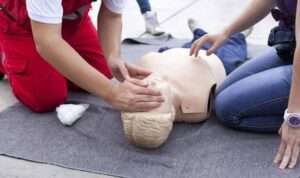
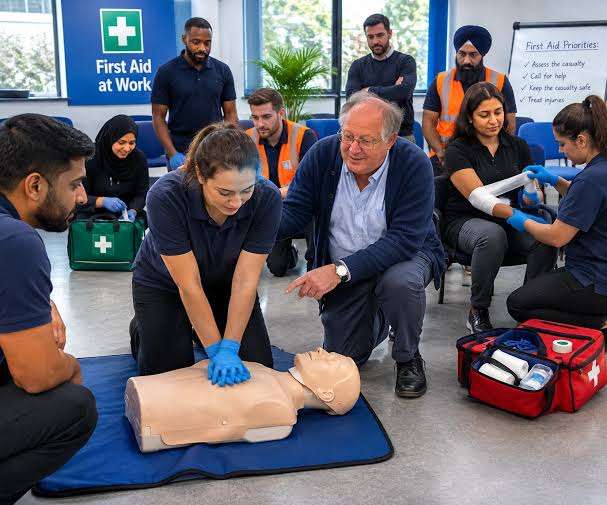
You kneel on the floor beside a manikin and practise several times. The trainer watches your hand position and rhythm, and gives friendly feedback. Chest compressions are tiring, so you will probably feel your arms working by the end.
You also use a training AED. You stick the practice pads on the manikin and follow the machine’s prompts. Many people are surprised by how simple and calm the process is.
What you are doing: kneeling, pushing, listening to the AED, swapping with a partner.
How it feels: physical and focused. This is where the course starts to feel real.
Tip: wear comfortable clothes. Trousers or loose clothing make kneeling easier.
12:15 to 1:00: Lunch
Lunch is a proper break. Some providers include refreshments, others ask you to bring your own food or buy nearby. Check this when you book. It is wise to eat something sensible so your energy holds up in the afternoon.
1:00 to 2:00: Unresponsive Casualty, Recovery Position and Choking
After lunch, the trainer moves on to two more urgent topics.
The unresponsive but breathing casualty
You learn what to do if someone is unresponsive but still breathing. You open the airway, check breathing and place them in the recovery position. This keeps the airway clear while you wait for help. You practise on a partner, swapping roles, which gives you a feel for how it looks and feels from both sides. You also learn to watch for changes, so you can switch to CPR if needed.
Choking
Next comes choking. You learn to spot the difference between mild and severe choking and what to do for each one. For a severe case, you learn to give back blows and abdominal thrusts. The trainer shows the movements safely, and you practise the technique without real force.
What you are doing: practising in pairs, moving between floor and standing work.
How it feels: busy and varied. The afternoon dip is easy to beat when you are moving around.
2:00 to 3:00: Bleeding, Shock and Minor Injuries
This hour covers the injuries you are most likely to see at work.
Serious bleeding
You learn how to control bleeding using firm pressure and a dressing, and when to call an ambulance. You practise applying dressings and bandages on a partner.
Shock
You learn to spot signs such as pale, cold, clammy skin and a fast pulse. You also learn how to help the casualty stay as safe and comfortable as possible until help arrives.
Minor injuries
The trainer covers small cuts, grazes, minor burns and scalds, and minor head bumps. You learn what you can safely treat yourself and when to ask for more help.
What you are doing: handling real dressings, working with a partner, asking about situations from your own workplace.
How it feels: practical and reassuring. Most of this feels like common sense once you have seen it done.
3:00 to 3:15: Short Break
Another quick break to refresh. By now the group usually feels relaxed, and people are chatting more freely.
3:15 to 4:00: Practice, Assessment and Questions
The final teaching hour pulls everything together. Your trainer may run through scenarios that mix several skills, such as a collapsed colleague who is not breathing, or someone who is bleeding heavily and feeling faint. You work through them with your partner or group.
Assessment on EFAW is usually ongoing during the day. The trainer watches your practical skills as you work and may also ask a few short questions. They are looking to see that you can:
- Check for danger and assess a casualty safely.
- Give CPR and use an AED correctly.
- Place an unresponsive, breathing casualty in the recovery position.
- Help a choking adult.
- Control bleeding and recognise shock.
This is not a scary written exam. If something does not go well the first time, a good trainer gives feedback and lets you try again.
What you are doing: putting it all together, answering questions, getting feedback.
How it feels: confident. Most people are surprised by how much they now know.
4:00 to 4:30: Wrap Up and Certificate Details
To finish, the trainer reviews the key points and answers last questions. You are told how and when you will receive your certificate. It is valid for three years, so make a note of the expiry date. The trainer may also remind you of some simple next steps:
- Find your workplace first aid box and AED, if you have one.
- Let your colleagues know who the first aiders are.
- Plan a yearly refresher. HSE recommends this, although it is not a legal rule.
Then you pack up, say goodbye and head home with a new skill set.
What the Day Teaches You to Do, at a Glance
By the end, you have covered:
- Your role and how to stay safe.
- A clear method for assessing an emergency.
- Adult CPR and using an AED.
- The recovery position.
- Helping a choking adult.
- Controlling bleeding.
- Spotting and managing shock.
- Treating minor injuries.
The course focuses on adults. If you work with babies or young children, for example in a nursery, you will normally need a separate paediatric first aid course.
Common Questions About the Timetable
Will I be put on the spot?
Good trainers do not embarrass anyone. You may be asked to try a skill, but you will have seen it demonstrated first and you will have support.
What if I am slower than others?
That is fine. Everyone learns at their own pace. Trainers can repeat skills and give extra help.
Is the day physically hard?
CPR practice takes some effort, and you will kneel on the floor. If you have a health condition or mobility issue, tell the provider beforehand so they can suggest a comfortable way to take part.
What if I miss part of the day?
The course is short, and each part builds on the last. Missing a section can mean you cannot complete the qualification, so check with the provider about their policy before booking.
Tips for Getting the Most From Your Day
- Get a good night’s sleep and eat breakfast.
- Wear comfortable clothes you can kneel in.
- Arrive a few minutes early.
- Tell the trainer about any access needs in advance.
- Take part in every practical activity.
- Ask questions, even ones that feel basic.
- Write down the key steps in your own words.
- Review your notes a few days later.
How This Fits Your Workplace
For low risk workplaces, HSE suggests that employers with fewer than 25 employees may need only an appointed person, those with 25 to 50 employees need at least one trained first aider, and larger ones need one per 50 people. Higher risk workplaces usually need the three day First Aid at Work course. A first aid needs assessment gives the best answer for your own setting.
Why Train in London?
London has a huge range of workplaces and a lot of travel and traffic. In an emergency, people nearby are often the first help. There are many venues across the city, and many providers also offer on-site training, where the trainer comes to your workplace. You can review the Emergency First Aid at Work training page to see how a course is described and what to check before you book.
Final Thoughts
An Emergency First Aid at Work course in London is a simple, friendly day. You start with the basics, move through the most urgent emergencies, practise each skill with your own hands and finish with confidence and a certificate. Knowing the timetable in advance helps you walk in relaxed and ready to learn.
When you are ready, take a look at the Emergency First Aid at Work course in London and choose a date that suits you.
Frequently Asked Questions
1. What happens at an Emergency First Aid at Work course?
You spend one day learning and practising emergency skills. These include assessing an incident, adult CPR, using a defibrillator, the recovery position, choking, bleeding control, shock and minor injuries. You are assessed during the day and receive a certificate at the end.
2. How long is the course?
It is a one-day course. HSE guidance says it should include at least six hours of training time, not counting breaks. Most providers run it from morning to late afternoon.
3. What time does an EFAW course usually start and finish?
Many courses start around 9:00 and finish around 4:00 or 4:30, but times differ by provider. Check your booking details.
4. Will I have to do CPR on the floor?
CPR practice is usually done kneeling on the floor or on a mat beside a manikin. If you have a mobility or health need, tell your provider beforehand so they can help you find a comfortable way to take part.
5. Is there an exam at the end?
There is a simple assessment, but it is not a hard written exam. Trainers usually watch your practical skills during the day and may ask a few short questions.
6. Do I need to bring anything?
Usually you only need yourself, comfortable clothes and sometimes photo ID. Check whether lunch and refreshments are included, and bring food if they are not.
7. What is the most important part of the day?
Most people find CPR and AED practice the most valuable part. These skills can help in a cardiac arrest, where quick action matters.
8. What if I do not feel confident at the end of the day?
That is common at first. Practise with a friend, review your notes and consider a refresher. HSE recommends a short yearly update, although it is not a legal requirement.
9. How long does the certificate last?
The certificate is valid for three years. After that, you need to retake the course to stay qualified.
10. Where can I book an Emergency First Aid at Work course in London?
You can book through a training provider that offers the regulated qualification, either as a public course or as on-site training for your team. Check the timetable, trainer experience and what the price includes before you book.