Maybe your manager asked you to become a first aider. Maybe you run a small business and want to do the right thing. Or maybe you just want to feel ready if someone gets hurt. Whatever your reason, you have probably typed something like Emergency First Aid at Work course London into Google, and now you are wondering where to begin.
Good news: you are in the right place. This guide explains the EFAW course in simple words, from the first question to the day you collect your certificate. You will find out what the course is, what happens on the day, what you will learn, and what worries most beginners have. If you would like to see course details as you read, here is the Emergency First Aid at Work course in London.
What Does EFAW Mean?
EFAW stands for Emergency First Aid at Work. Let us break the name down.
- Emergency first aid means the quick help you give when someone is badly hurt or suddenly very ill, before an ambulance or doctor arrives.
- At work means the course is designed around workplaces such as offices, shops, schools and small businesses.
So EFAW is a short, practical course that teaches you how to handle the most serious problems that can happen at work. It is a regulated Level 3 qualification, which simply means it follows a national standard, so employers and insurers can trust it.
Who Is the Course For?
The short answer: almost anyone aged 16 or over who wants to learn. You do not need to be fit, young, strong or medical. People of all ages, jobs and backgrounds attend. Typical learners include:
- Office staff and receptionists.
- Shop, café and restaurant workers.
- Teachers and teaching assistants.
- Gym instructors and personal trainers.
- Small business owners and managers.
- Volunteers and charity workers.
- Freelancers and self-employed people.
If you can follow simple instructions and are willing to try, you can pass.
Why Do Workplaces Need First Aiders?
In the UK, employers have a legal duty to provide adequate and appropriate first aid for their staff. This comes from the Health and Safety (First Aid) Regulations 1981. The law does not say exactly who must be trained. Instead, each employer looks at their own risks and decides what is needed. This is called a first aid needs assessment.
For many low risk workplaces, an EFAW-trained person is the sensible answer. HSE guidance gives a simple starting point:
- Fewer than 25 employees: at least one appointed person.
- 25 to 50 employees: at least one trained first aider.
- More than 50 employees: at least one first aider for every 50 people.
Higher risk workplaces usually need the longer three day course. Your employer should be able to tell you which one fits.
A Quick Glossary for Beginners
First aid can sound scary because of the words. Here is what they mean.
- HSE: The Health and Safety Executive, the UK body that gives workplace safety guidance.
- First aider: A person trained to give first aid at work.
- Appointed person: Someone who takes charge in an emergency and calls an ambulance, but who has not had first aid training.
- CPR: Cardiopulmonary resuscitation. Pushing on the chest, and sometimes giving breaths, to keep blood moving when someone’s heart has stopped.
- AED: An automated external defibrillator. A machine that gives an electric shock to restart a heart, with spoken instructions.
- Recovery position: A safe way to lay someone on their side when they are unresponsive but breathing.
- Casualty: The person who is hurt or ill.
- Needs assessment: A check of your workplace to decide what first aid you need.
So when your trainer uses these words, you will already know what they mean.
What Happens on the Day?
Most beginners worry about the unknown. So here is a typical day, step by step. Exact times differ between providers.
Morning: welcome and basics
You arrive, sign in and meet your trainer and the other learners. The trainer explains the plan for the day. You then start with the basics: what a first aider does, how to stay safe, and how to check a scene for danger.
Mid-morning: the first practical skills
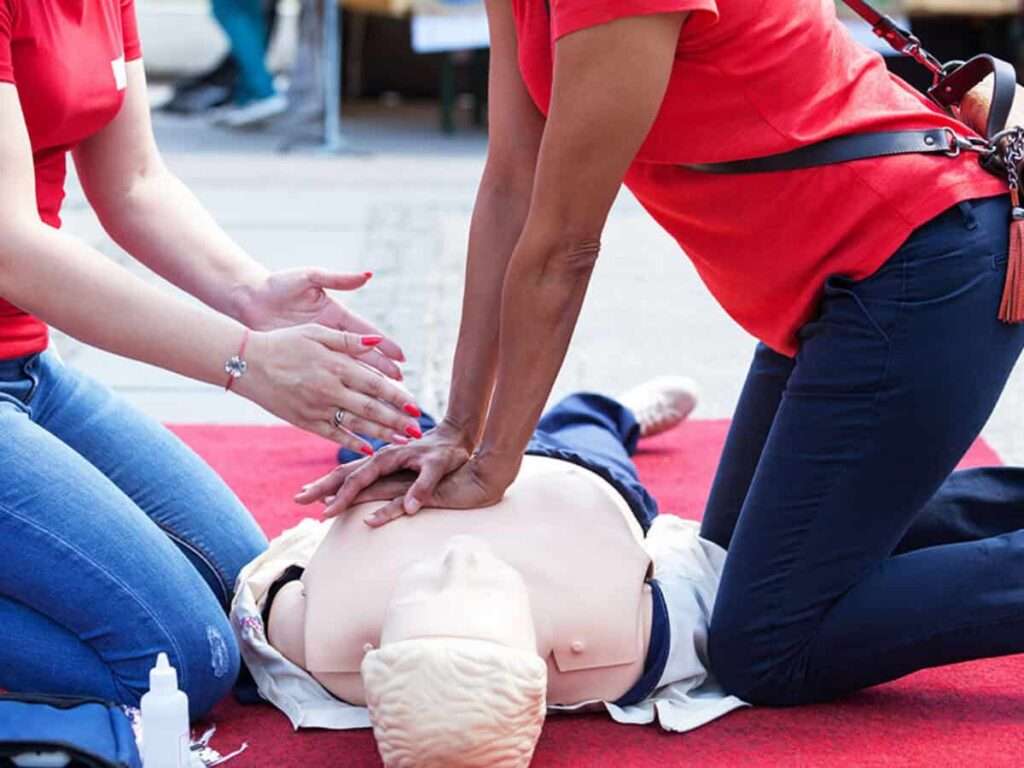
Next, you learn how to check a casualty and decide what to do. You then start on one of the biggest topics, CPR. You practise on a training manikin, so nobody is hurt. The trainer shows you, then you try it yourself.
Midday: AED and the recovery position
You learn how to use an AED. These machines are made for ordinary people, and they talk you through each step. You also learn the recovery position, practising with a partner.
Afternoon: choking, bleeding and common injuries
After a break, you move on to choking, serious bleeding, shock and minor injuries such as small burns and cuts. You practise with real dressings and bandages.
End of the day: review and certificate
Your trainer checks your skills, answers questions and wraps up. When you pass, you receive your certificate, which is valid for three years.
The whole day is around six hours, plus breaks.
What Will You Actually Learn?
Here is the full list in simple terms.
- Your role as a first aider. What you should do and when to ask for more help.
- How to stay safe. Protecting yourself and others at the scene.
- How to check a casualty. A step by step way to see what is wrong.
- CPR for adults. How to help when someone is not breathing normally.
- Using an AED. How to follow the machine’s instructions.
- The recovery position. How to keep an unresponsive, breathing person safe.
- Choking. Back blows and abdominal thrusts.
- Bleeding. How to control it and when to call for help.
- Shock. How to spot it and what to do.
- Minor injuries. Small cuts, burns and grazes.
The course focuses on adults. If you work with babies or young children, you may need a separate paediatric first aid course. Ask your provider if you are unsure.
Common Worries Beginners Have
Almost every beginner has some fear before the course. Here are the most common ones, with honest answers.
I have no medical knowledge. Will I be lost?
No. The course is built for people who know nothing. Your trainer starts from the beginning and explains everything slowly.
I might freeze in a real emergency.
This is normal, and it is exactly why practice matters. When you have done something several times with your hands, your body remembers it better when your mind is stressed. The course gives you that practice.
What if I do it wrong and make things worse?
First aid is about keeping people safe until professionals arrive. The law in England and Wales looks kindly on people who act sensibly and in good faith to help others. Doing something is usually far better than doing nothing, especially in cases like cardiac arrest. This is general information, not legal advice.
I am not good at exams.
There is a simple assessment, but it is not a tough written test. Trainers usually watch your practical skills during the day and may ask a few short questions. If you need extra support, tell the provider before you book.
I am afraid of blood.
You do not use real blood. You practise on manikins with dressings and bandages. Many people find that learning what to do makes them feel less afraid.
I am worried about kneeling on the floor.
CPR practice is usually done on the floor, or on a mat. If you have a health condition or a mobility issue, tell your provider in advance. Good trainers will help you find a comfortable way to take part.
EFAW vs First Aid at Work: Which One Is Right?
Beginners often get confused here, so here is the simplest way to think about it.
- EFAW is a one day course. It focuses on emergencies and suits many low risk workplaces.
- First Aid at Work (FAW) is a three day course. It covers everything in EFAW plus more about injuries and illnesses, and it suits higher-risk or larger workplaces.
If you are not sure which one you need, ask your manager or your provider. A first aid needs assessment gives the best answer.
How Much Does It Cost?
Prices differ between providers, so it is better to know what changes the price than to guess. The main factors are:
- Whether you attend a public course or arrange a private session for your team.
- The venue and its location in London.
- The size of your group.
- What is included, such as the certificate and materials.
Always ask for a clear final price. If you have six or more people to train, on-site training may be good value, because the trainer comes to you.
How to Prepare for Your Course
You do not need to study. But a few simple steps help you enjoy the day.
- Wear comfortable clothes you can move in.
- Have a good breakfast and bring water.
- Bring photo ID if your provider asks for it.
- Tell the trainer about any health needs or accessibility needs beforehand.
- Bring questions about your own workplace.
Most of all, take part. Everyone is learning, so there is no need to feel embarrassed.
What Happens After You Pass?
Once you pass, you will receive your certificate. Keep a copy and give another to your employer. Write the expiry date in your diary, because it lasts three years.
Then, take a few small steps at work:
- Find out where the first aid box is and check it is stocked.
- Find out where the nearest AED is, if there is one.
- Tell colleagues who the first aiders are.
- Plan a yearly refresher. HSE recommends this, although it is not a legal rule.
Skills like CPR can fade within months if you do not practise, so a short refresher helps you stay confident.
How to Choose a Good Provider in London
Not all courses are the same. Look for these things:
- A regulated Level 3 qualification from a recognised awarding body.
- Trainers with real emergency, medical or teaching experience.
- Lots of hands on practice, with enough equipment for everyone.
- Small groups, so you get time with the trainer.
- Clear information about the content, the timing and the price.
- Friendly support before and after the course.
You can look at the Emergency First Aid at Work training page to compare these points when you are ready.
Myths About First Aid Training
A few false ideas stop people from signing up. Here are the facts.
- Myth: You need to be a medical person. Fact: The course is for beginners.
- Myth: It takes many days. Fact: EFAW is one day.
- Myth: It is only for big companies. Fact: Small businesses, volunteers and self-employed people take it too.
- Myth: Once you pass, you are set for life. Fact: The certificate lasts three years, and skills fade without practice.
- Myth: You can replace a paramedic. Fact: You help until professional help arrives.
Why Train in London?
London is busy and full of workplaces of every size. Many people travel long distances to work, and roads are often crowded. In an emergency, the people who are already there make a difference in those first minutes.
There are also plenty of training venues across the city, so you can choose one close to home or work. On site training is another popular choice for teams.
Final Thoughts
The Emergency First Aid at Work course in London is one of the most useful single days of training you can take. You do not need any experience. You learn clear, simple steps for the most serious emergencies, practise them with your own hands, and leave with a respected certificate and real confidence.
If you have been putting it off because it feels complicated, now you know it is not. When you are ready, take a look at the Emergency First Aid at Work course in London and choose a date that suits you.
Frequently Asked Questions
1. What is an EFAW course?
EFAW stands for Emergency First Aid at Work. It is a one day, regulated first aid course designed for workplaces. It teaches you how to help in serious emergencies such as cardiac arrest, choking and heavy bleeding.
2. Is the EFAW course suitable for complete beginners?
Yes. You do not need any medical or first aid experience. Your trainer explains each skill step by step and lets you practise with training equipment.
3. How long does the EFAW course take?
The course takes one day, which is about six hours of learning time. Start and finish times vary between providers, so check your booking.
4. What will I learn on an EFAW course?
You will learn how to assess an emergency, give CPR to an adult, use a defibrillator, place someone in the recovery position, help a choking person, control bleeding, manage shock and treat minor injuries.
5. Is there an exam on the EFAW course?
There is a simple assessment, but it is not a hard written exam. Trainers usually watch your practical skills during the day and may ask a few short questions.
6. How long does the EFAW certificate last?
The certificate is valid for three years. HSE recommends a yearly refresher to keep your skills fresh, but this is not required by law.
7. What is the difference between EFAW and First Aid at Work?
EFAW is a one-day course for low risk workplaces. First Aid at Work is a three day course that covers more injuries and illnesses and suits higher risk or larger workplaces.
8. Do I need to be fit or strong to do CPR practice?
You do not need to be an athlete. Chest compressions take some effort, but trainers show you the best technique. If you have a health or mobility need, tell your provider beforehand so they can support you.
9. Can my whole team do the course together?
Yes. Many providers offer on site training, where the trainer visits your workplace. This is a convenient choice for groups and uses your real working environment.
10. Where can I book an Emergency First Aid at Work course in London?
You can book with a regulated training provider, either on a public course or as private on-site training. Check that the course is a regulated Level 3 qualification with experienced trainers