Life-saving skills in a single day. It sounds almost too good to be true. When people first hear that an Emergency First Aid at Work course in London takes only about six hours, many of them ask the same thing: can I really learn enough in one day to help in a real emergency?
The honest answer is yes, for what the course is designed to do, as long as you understand its limits and keep your skills fresh. In this guide, we look at why one day works, where it falls short, and how to get the most out of it. If you want to see the course itself, here is the Emergency First Aid at Work course in London.
The Short Answer
Yes, one day is enough to learn the core emergency skills that a first aider in a low-risk workplace needs. These include CPR, using a defibrillator, helping a choking person and controlling serious bleeding.
But one day is not enough to turn you into a medical expert. It also will not cover every illness or injury, and it will not stay fresh in your memory forever without practice. Think of the course as a strong foundation, not a finished building.
Why a One-Day Course Exists
In the UK, employers must provide adequate and appropriate first aid under the Health and Safety (First Aid) Regulations 1981. The right level of training depends on the workplace. HSE guidance sets out two main options for first aiders:
- Emergency First Aid at Work (EFAW): a one day course, usually around six hours.
- First Aid at Work (FAW): a three-day course for more complex needs.
The one day course was made for low-risk workplaces, where the biggest dangers are sudden emergencies rather than a wide range of injuries and illnesses. Because the focus is narrow, the training can be short and still be effective.
What Can You Learn in One Day?
A lot, when the training is well planned. A good EFAW course covers:
- The first aider’s role. What you should and should not do.
- Scene safety. How to protect yourself and others.
- Checking a casualty. A simple step-by-step method.
- Adult CPR. Chest compressions and rescue breaths.
- Using an AED. Following the machine’s spoken instructions.
- The recovery position. Keeping an unresponsive, breathing person safe.
- Choking. Back blows and abdominal thrusts.
- Bleeding. Controlling it with pressure and dressings.
- Shock. Spotting it and giving basic help.
- Minor injuries. Small burns, cuts and grazes.
These are the situations where fast action matters most. Cardiac arrest, choking and severe bleeding can become life-threatening in minutes. So the course puts them first.
Why One Day Can Work Well
The course is focused
The syllabus is short and targeted. There is no long list of rare conditions to memorise. You spend your time on the skills you are most likely to need.
Learning by doing
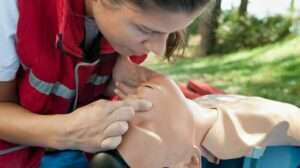
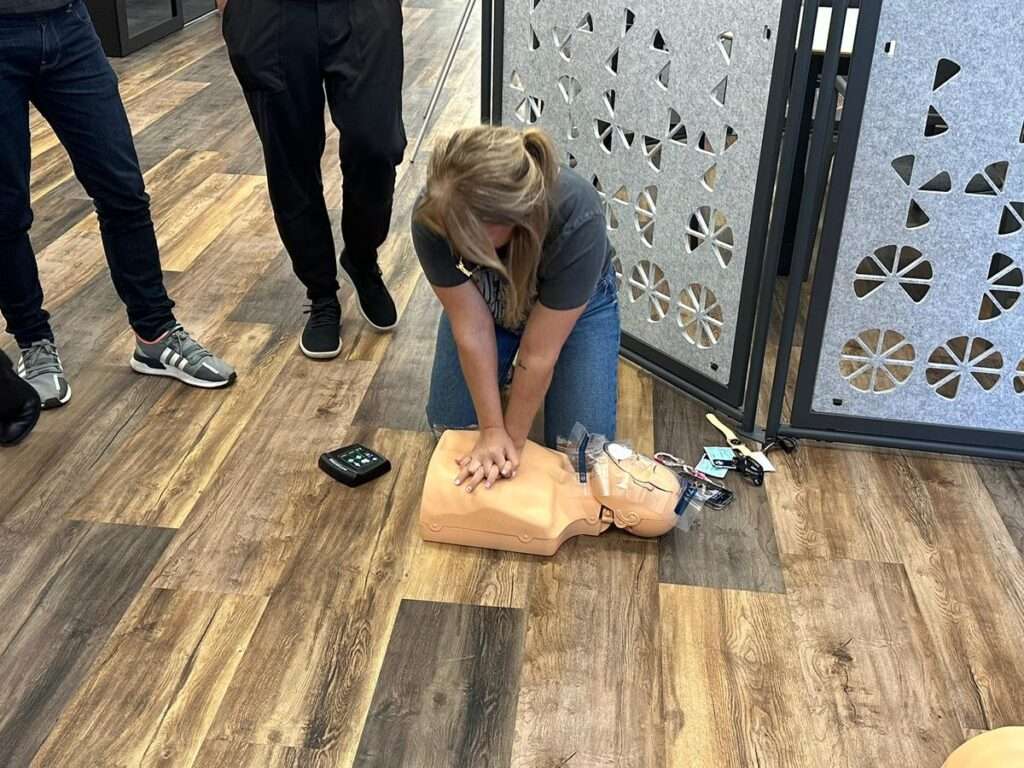
Good first aid training is hands-on. You practise CPR on a manikin, use a training defibrillator, and apply bandages yourself. Most people remember what they do far better than what they only hear. So six hours of practice can teach more than a long lecture.
Small steps, clear order
Trainers teach in a simple order: check for danger, check the person, call for help, then give care. Having a clear pattern helps you stay calm. You do not need to remember hundreds of facts, just a handful of key steps.
It fits real life
Busy businesses find it hard to release staff for three days. A one-day course is easier to schedule, so more people get trained. And more trained people means better cover.
Where One Day Has Limits
To be fair, one day cannot do everything. Here is where you should be realistic.
It does not cover every illness or injury
The three-day FAW course goes into more detail about things like a wider range of injuries and illnesses. If your workplace has more complex needs, one day may not be enough on its own.
It does not suit higher-risk workplaces by itself
If your work involves heavy machinery, dangerous tools, chemicals or other serious hazards, your employer will probably need first aiders with the full FAW qualification. EFAW can still be useful for extra cover in these places, but it should not be the only level of training.
It mainly focuses on adults
The course concentrates on adult first aid. If you work in a nursery or with young children, you will usually need a separate paediatric first aid qualification. Early years settings in England have their own rules about this.
It does not replace practice
This one matters most. Skills such as CPR can fade quickly if you never use them. Experts often point out that confidence and accuracy fall within months without refreshers. A single day gives you the base, but you have to keep it alive.
It does not make you a medical professional
You are trained to give first aid, not diagnose or treat in the way a doctor or paramedic would. Your role is to help until professional care arrives.
One Day vs Three Days: A Simple Comparison
Emergency First Aid at Work (one day)
- Around six hours of training.
- Focus on emergencies.
- Suits many low risk workplaces.
- Certificate valid for three years.
First Aid at Work (three days)
- Longer, more detailed training.
- Covers a wider range of injuries and illnesses.
- Suits higher-risk or larger workplaces.
- Certificate valid for three years.
Neither course is better in every case. The right one depends on your workplace and the risks you face.
How to Know Whether One Day Is Enough for Your Workplace
The best way to decide is a first aid needs assessment. This is a simple review of your workplace. It looks at things such as:
- Hazards. What could go wrong, and how serious could it be?
- Number of people. How many staff, visitors and customers are on site?
- Type of work. Is it mostly desk based or physical?
- Location. How far is the nearest hospital, and how long might an ambulance take?
- Shifts and absences. Will a first aider always be available?
- Past incidents. What accidents or illnesses have happened before?
As a starting point for low-risk workplaces, HSE suggests at least one appointed person for fewer than 25 employees, at least one trained first aider for 25 to 50 employees, and at least one first aider per 50 people above that. If your risks are higher, you will probably need more first aiders and a higher level of training.
How to Get the Most from One Day of Training
The quality of your learning depends partly on you. Here are simple ways to make the day count.
Before the course
- Get a good night’s sleep and eat breakfast.
- Wear comfortable clothes. You will practise on the floor.
- Tell the provider about any health or access needs in advance.
- Think of questions about your own workplace.
During the course
- Take part in every practical activity.
- Ask questions, even if they feel basic.
- Practise CPR until the rhythm feels natural.
- Make notes of the key steps in your own words.
After the course
- Find your workplace first aid box and AED, if you have one.
- Tell colleagues who the first aiders are.
- Practise the recovery position with a friend or family member.
- Put your certificate expiry date in your diary.
Keeping Your Skills Fresh After the Day Ends
Your certificate lasts three years. Skills last a different amount of time. To bridge the gap, try this simple plan:
- Every few months: read through your notes and walk through the steps in your head.
- Every year: take a short refresher. HSE recommends this, though it is not a legal requirement.
- Every three years: retake the full course before your certificate expires.
Small habits make a big difference. For example, when you walk past an AED, remind yourself how it works. When you see a first aid poster, quickly recall the steps for choking.
What Makes a Good One Day Course?
Since the course is short, quality matters even more. Look for these signs:
- A regulated Level 3 qualification from a recognised awarding body.
- Experienced trainers with real emergency, medical or teaching backgrounds.
- Lots of hands-on time, with enough equipment for everyone.
- Small groups, so you get enough time with the trainer.
- A clear timetable showing what is covered and when.
- Friendly support before and after the course.
You can review the Emergency First Aid at Work training page to see how a course is described and compare it with these points.
Is One Day Worth It Compared With Not Training at All?
Absolutely. Think about the choice honestly. Without training, many people freeze, or they are unsure what to do first. In a cardiac arrest, every minute without help reduces the chance of survival. A person with even one day of practical training can start CPR, send someone for an AED and call for an ambulance.
So the real comparison is not one day versus three days. It is trained versus untrained. Even a short course puts you far ahead of someone who has never tried.
Why Train in London?
London has a huge number of workplaces, from small studios to large offices. People also commute long distances, and roads and transport can be crowded. When something goes wrong, the people nearby are the first line of help.
The city also offers plenty of training choices. You can pick a public course close to home or work, or arrange on-site training for your team. Many organisations like the on-site option, because it saves travel time and uses their real working space.
Final Thoughts
Is a single day really enough? For the purpose it was designed for, yes. The one-day Emergency First Aid at Work course gives you the key skills to act in the most serious workplace emergencies: CPR, using an AED, helping a choking person, controlling bleeding and keeping a casualty safe until help arrives.
But be realistic. It is a foundation, not the whole house. Choose the right level for your workplace risks, practise your skills, and refresh them every year.
Ready to start? Take a look at the Emergency First Aid at Work course in London and choose a date that suits you.
Frequently Asked Questions
1. How long is an Emergency First Aid at Work course?
The course takes one day, which is about six hours of training. Exact start and finish times vary between providers, so check your booking.
2. Is a one day first aid course enough?
For many low risk workplaces, yes. It teaches the core emergency skills, including CPR, defibrillator use, choking and bleeding control. Higher risk workplaces may need the three-day First Aid at Work course instead.
3. What is the difference between a one day and a three-day first aid course?
The one day Emergency First Aid at Work course focuses on emergencies in low risk workplaces. The three day First Aid at Work course covers more injuries and illnesses and suits higher risk or larger workplaces.
4. Will I forget what I learn after one day?
Some skills, such as CPR, can fade if you do not practise. HSE recommends a short yearly refresher, and you can keep your memory strong by reviewing your notes and practising with a friend.
5. How long is an EFAW certificate valid?
The certificate is valid for three years. After that, you need to retake the course to stay qualified.
6. Do I need experience before taking the course?
No. The course is designed for beginners. Your trainer explains each skill step by step and lets you practise with training equipment.
7. Does the one day course teach CPR and how to use a defibrillator?
Yes. You will learn adult CPR and how to use an automated external defibrillator (AED), two of the most important skills in a cardiac emergency.
8. Is the one day course suitable for childcare workers?
Not on its own. Early years settings usually need a paediatric first aid qualification. The EFAW course mainly focuses on adults, so check the rules for your setting.
9. How do I know if my workplace needs more than one day of training?
Carry out a first aid needs assessment. It looks at your hazards, staff numbers, location and past incidents. Higher risk or larger workplaces often need the three day First Aid at Work course.
10. Where can I book a one-day first aid course in London?
You can book with a regulated training provider, either on a public course or as private on site training for your team. Check that the course is a regulated Level 3 qualification with experienced trainers