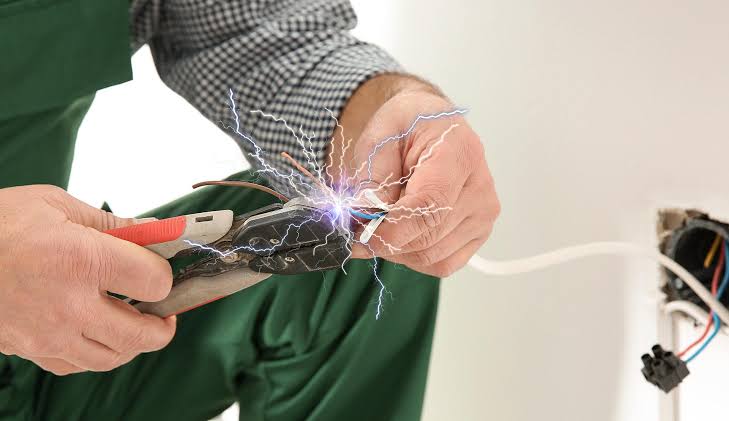
A colleague grabs a faulty power tool and cannot let go. A cleaner touches a damaged cable with wet hands. A contractor brushes against a live wire in the ceiling void. In seconds, a normal working day becomes an emergency. Electric shocks can cause burns, heart problems, injuries from falls and, in the worst cases, death. And there is a second danger that catches out would be rescuers: touching a person who is still in contact with live electricity can pass the current through you.
That is why the first aid for an electric shock starts with an unusual rule: do not touch the person until the power is off. In this guide, we explain in plain English what to do if someone has an electric shock at work, how to rescue them safely, how to treat injuries and how it connects to what you learn on an Emergency First Aid at Work (EFAW) course in London. If you want to see a real course page as you read, here is the Emergency First Aid at Work course in London.
Important Notes First
- This guide is general information, not training. A trainer can show you how to assess a scene safely and give CPR.
- Your safety comes first. If you cannot make the scene safe, call 999 and keep everyone away.
- High voltage is deadly at a distance. Never approach overhead power lines, substations, railway electrics or fallen cables.
- Call 999 for all but the most minor shocks, and get anyone who has had a shock checked by a medical professional.
- This guide is mainly for adults.
The Short Answer
Check for danger. Do not touch the person while they are in contact with electricity. If you can do so safely, switch off the power at the mains, a switch or by unplugging the equipment. If you cannot, and it is low voltage, use something dry that does not conduct electricity, such as a wooden broom handle, to separate the person from the source. For high voltage, stay well away and call 999. Once it is safe, check responsiveness and breathing, call 999 and start CPR if they are unresponsive and not breathing normally. Treat burns, and make sure everyone who has had a shock is checked medically.
Why Electric Shocks Are Dangerous
When electric current passes through the body, it can cause several kinds of harm.
- Burns. Electricity can burn the skin where it enters and leaves the body, and can cause deeper burns inside, which are not always visible.
- Heart problems. Current passing through the chest can disturb the heart’s rhythm, and may cause cardiac arrest, either immediately or later.
- Breathing problems. Current can paralyse the muscles used for breathing.
- Muscle spasm. A person may be unable to let go of the source, which prolongs the shock. It can also throw people back, or cause falls.
- Injuries from falls or being thrown. Head injuries, fractures and spinal injuries.
- Nerve and organ damage. Which may show up later.
- Unconsciousness and confusion.
Even a shock that seems minor can cause internal injury that is not obvious at first. Even non fatal shocks can cause severe and permanent injury.
Low Voltage and High Voltage: Why It Matters
The safe approach depends on the type of electricity.
Low voltage
This includes ordinary mains electricity, such as sockets, lights, appliances, power tools and most workplace equipment, around 230 volts in the UK. Low voltage can still kill. It can usually be switched off at the source, or the equipment can be unplugged.
High voltage
This includes overhead power lines, pylons, substations, underground cables, railway electrification and some industrial equipment. High voltage electricity can jump, or arc, through the air, over distances of 18 metres or more. Some first aid guidance advises staying at least 18 metres away, and some advises 25 metres, from a casualty injured by high voltage current, until the power has been switched off by the electricity network operator.
If you are not sure which kind it is, treat it as high voltage and stay back.
Step by Step: First Aid for an Electric Shock
Step 1: Check for danger
Before you do anything, make sure you, the casualty and others are safe. Look for:
- Live equipment, exposed wires or damaged cables.
- Water, wet floors or wet surroundings, which make electricity more dangerous.
- Sparks, smoke, burning smells or fire.
- High voltage equipment, overhead cables or fallen wires.
- Machinery that could restart.
- The person’s position, for example at height.
Remember that the person is electrified until the power is off. Do not touch them if they are still in contact with the source.
Step 2: Call for help straight away
Shout for help, and ask someone to call 999 at once. If you are alone, call 999 yourself on speaker, if you can do so safely. If it involves high voltage, overhead lines or railway electrics, tell the call handler, because the electricity network operator or rail authority will need to isolate the power. For how to make the call, see our guide on how to call 999 properly.
Step 3: Switch off the power, if it is safe to do so
- Turn off at the mains, the switch, the isolator or the consumer unit, whichever is quickest and safest.
- Unplug the equipment from the wall, if the plug and socket are safe to touch and undamaged. Do not touch a damaged plug or a wet socket.
- Do not use the switch on the faulty device itself, because it may be faulty.
- Check that the power is really off before approaching, because equipment may still be live from another source.
Workplaces with electrical hazards often have a clearly marked emergency stop or isolator. Make sure everyone knows where it is.
Step 4: If you cannot switch it off, and it is low voltage
If you cannot reach the power source, and the equipment is low voltage, you may be able to separate the person from it without touching them.
- Stand on something dry that does not conduct electricity, such as a rubber mat, a dry wooden board or a thick pile of dry newspaper, if you can.
- Use a dry, non conducting object made of wood, plastic or cardboard, such as a wooden broom handle, a dry wooden chair or a plastic crate, to push the person or the source away. Make sure the object is completely dry. Do not use anything metal or damp.
- Move the source away from the person, or the person away from the source, in one quick movement.
- Do not touch the person with your bare hands until contact is broken.
- Stop if it is not working, or you feel any tingling, and step back, because you may be in danger.
Some electrical workplaces keep an insulated rescue hook for this purpose. Only use one if you are trained.
Step 5: If it is high voltage, or you are unsure, do NOT approach
- Stay well back, at least 18 metres, and further if there are arcing wires, and keep others back too.
- Call 999, and tell the call handler that it is a high voltage incident.
- Do not approach until the power company or emergency services tell you that the power is off.
- Do not attempt to rescue anyone in contact with downed power lines.
- If you are in a vehicle that has touched a power line, stay inside unless there is a fire, and wait for help. If you must leave, jump clear with your feet together and shuffle away, without touching the vehicle and the ground at the same time, as advised by safety services.
Step 6: Once the person is free and it is safe, check them
Only when you are sure that contact is broken and the area is safe:
- Check for a response. Speak loudly, and gently shake their shoulders.
- Check for normal breathing. Look, listen and feel for no more than 10 seconds.
- If they are unresponsive and not breathing normally, or you are unsure, call 999 if you have not already, send for an AED and start CPR straight away. See our guide to adult CPR step by step and our guide on how to use an AED safely. Electric shock can cause cardiac arrest, and early CPR and defibrillation are vital.
- If they are unresponsive but breathing normally, place them in the recovery position, as in our guide on what to do if someone is unresponsive but breathing. Take care with the neck if there may have been a fall.
- If they are conscious, keep them still and calm. Check for other injuries.
Step 7: Treat burns
Electric shocks can cause burns at the points where the current enters and leaves the body, often on the hands and feet. They may look small, but can be deep.
- Cool the burn under cool running water for 20 minutes, if it is safe to do so and does not delay more urgent care.
- Cover it loosely with cling film or a clean, non fluffy dressing.
- Do not apply creams or burst blisters.
- Remove jewellery and tight clothing near the burn, unless stuck.
- Look for entry and exit wounds. Black dots on the skin can mean serious internal burns, so tell medical staff.
See our guide on how to treat a burn in the workplace.
Step 8: Look for other injuries
The force of a shock can throw people, or cause them to fall. Check for head injuries, suspected broken bones, spinal injuries and bleeding. Keep the person as still as you can if you suspect a fall or neck injury. See our guides on first aid for head injuries, how to treat a suspected fracture and first aid for severe bleeding.
Step 9: Treat for shock and keep them warm
Help the person lie down, keep them warm with a coat or blanket and reassure them. Do not give food or drink. See our guide on shock in first aid.
Step 10: Stay with them and keep watching
Stay with the person, and monitor their breathing and level of response. Heart rhythm problems can develop after an electric shock, even if the person seems well at first, so keep watching until the ambulance arrives, and be ready to start CPR.
Step 11: Hand over and make sure they are checked
Tell the paramedics what happened, how long the person was in contact, the type of equipment, whether you think it was high or low voltage, whether they lost consciousness or were thrown, and what you did. Make sure the person goes to hospital or is assessed by a medical professional, even if they seem unhurt. First aid guidance advises that it is safest to have anyone who has had an electric shock checked, because internal damage and heart problems may not be obvious. If they decline, encourage them strongly, and tell your employer.
What Not to Do
- Do not touch a person who is still in contact with electricity.
- Do not use anything wet or metal to move them.
- Do not approach high voltage equipment, overhead lines or fallen cables.
- Do not attempt a rescue if you are not sure the power is off.
- Do not use the faulty device’s own switch.
- Do not move the person unnecessarily, if you suspect spinal injury, unless they are in danger.
- Do not apply creams or butter to burns.
- Do not assume they are fine because they look well.
- Do not let them go back to work until they have been checked.
- Do not leave them alone.
- Do not delay CPR once it is safe.
When to Call 999
Call 999 for any significant electric shock, and always if:
- The person is unconscious, confused, drowsy or not responding normally.
- They are not breathing normally.
- They have an irregular or very fast or slow heartbeat, chest pain or palpitations.
- They have burns, especially on the hands, feet, face or mouth, or any burns that look deep or large.
- They have had a seizure.
- They have been thrown, have fallen or may have a head, neck or back injury.
- They have muscle pain, numbness or weakness.
- The shock came from high voltage, a power line, a railway or a large industrial supply.
- They are pregnant.
- You are not sure.
A very minor tingle from a faulty appliance, with no symptoms at all, may not need an ambulance, but the person should still tell their manager, stop using the equipment and seek medical advice, because symptoms can develop later.
Lightning
Lightning strikes are rare, but can affect outdoor workers. The first aid is similar, with some important differences: a person struck by lightning does not carry a charge, so it is safe to touch them, but the area may still be dangerous in a storm. Move to shelter if you can, call 999 and check breathing, giving CPR if needed. Treat burns, and watch for heart problems. Do not stand near tall objects.
Electric Shock at Work: Preventing It
The Electricity at Work Regulations 1989 place duties on employers to prevent danger from electricity, and HSE has detailed guidance. Many shocks are preventable. Good practice includes:
- Use competent people for electrical work. Never let untrained people repair equipment.
- Keep equipment in good condition. Check plugs, cables and sockets, and take faulty items out of use.
- Carry out appropriate inspection and testing of portable appliances, based on a risk assessment.
- Use residual current devices, which cut the power quickly if there is a fault.
- Take extra care in wet places. Kitchens, bathrooms, outdoor areas, cleaning work and washdown areas carry greater risks.
- Do not overload sockets or use damaged extension leads.
- Isolate and lock off equipment before maintenance, and display warning signs.
- Keep away from overhead lines. Plan work near them carefully, and follow HSE guidance.
- Report damaged equipment.
- Make sure isolators and emergency stops are easy to find.
- Train staff to recognise hazards and know what to do in an emergency.
After the Incident
Once the ambulance has gone, there is more to do.
- Make the equipment safe. Keep it switched off and out of use, and do not tamper with it, so it can be examined.
- Record what happened. Date, time, place, equipment, what you saw, what you did and what help arrived.
- Report to your employer. Serious electrical injuries and some electrical incidents must be reported to the authorities under the Reporting of Injuries, Diseases and Dangerous Occurrences Regulations, often called RIDDOR, and your employer decides what is needed.
- Investigate the cause. Employers should find out what went wrong and how to prevent it happening again.
- Restock the first aid kit.
- Look after yourself and others. Electrical accidents can be frightening. Talk to someone you trust, and use any support your employer offers.
- Support the person’s return to work, including any follow up care.
What Employers Should Do
The Health and Safety (First Aid) Regulations 1981 require employers to provide adequate and appropriate first aid for their employees. For electrical risks, employers can:
- Include electrical hazards in the first aid needs assessment. Higher hazard workplaces, such as those with heavy electrical equipment, may need more first aiders and more training.
- Train first aiders. As a starting point for low hazard workplaces, HSE suggests at least one appointed person for fewer than 25 employees, at least one first aider trained in Emergency First Aid at Work for 25 to 50 employees, and at least one first aider trained in First Aid at Work for every 100 employees above that, or part of 100. Higher hazard workplaces need more. A first aid needs assessment gives the best answer.
- Provide an AED, if the needs assessment suggests it.
- Display clear instructions. Next to electrical equipment, including how to isolate and how to call 999.
- Provide rescue equipment, such as insulated hooks, where appropriate, and train people to use them.
- Have a clear emergency procedure. Who isolates, who calls 999, who gives first aid, who meets the ambulance.
- Practise drills.
- Support staff afterwards.
Where an EFAW Course Fits
An Emergency First Aid at Work course starts with assessing an incident safely, which is exactly what an electric shock demands. On the day, you can expect to:
- Learn to check for danger first, and why you must not touch a casualty who may still be live.
- Practise a scene check in realistic scenarios, including electrical hazards.
- Learn how to call for help clearly.
- Practise CPR and use a training AED, which matter most if the heart is affected.
- Practise the recovery position.
- Learn to treat burns and manage shock.
- Be assessed in person. A qualified trainer watches your skills.
The course is a one day, regulated Level 3 qualification, and HSE guidance says it should include at least six hours of training time, not counting breaks. You also learn how to help a choking adult, control serious bleeding and treat minor injuries. The certificate is valid for three years. HSE strongly recommends a short refresher each year, although it is not a legal requirement.
Choosing a Good Course in London
Look for:
- A regulated Level 3 Award in Emergency First Aid at Work (RQF) or First Aid at Work from a recognised awarding organisation.
- At least six hours of training time for EFAW, and at least 18 hours for FAW, not counting breaks.
- Hands on practice, including scene assessment, CPR and a training AED.
- Practical assessment in person. HSE guidance expects this for a workplace first aider, so online only courses are generally not suitable.
- Qualified, experienced trainers.
- Small classes. Many awarding organisations set a maximum of around 12 learners per trainer.
- A clear certificate and a clear total price.
HSE stopped approving first aid training providers in 2013, so be cautious of any claim that a course is HSE approved. In London in 2026, public prices for a one day EFAW course commonly range from about £65 to £150 per person. One provider page, linked above, lists £89 per person for classroom training and £75 per person for groups of five or more, at the time of writing in October 2026, and First Aid at Work at around £200 to £300 per person. Prices change, so always confirm. You can review the Emergency First Aid at Work training page to see how one provider presents its courses, prices and booking options.
Why London Workplaces Should Be Ready
London has busy kitchens, building sites, workshops, shops and offices, many in older buildings with complex wiring, as well as railway and utility works. Wet work, cleaning, refurbishment and contractors add to the risks. Roads and public transport can be congested, so ambulances may take time to arrive, and what you do in those first minutes, starting with staying safe, makes a real difference. There is also a very large number of training providers and dates in London, and many deliver training at your workplace, which is a practical way to prepare a whole team.
Final Thoughts
So, what do you do if someone has an electric shock at work? Check for danger, and do not touch the person while they are still in contact with the electricity. Switch off the power if it is safe, or, for low voltage only, separate the person from the source with a dry, non conducting object. Stay well away from high voltage and call 999. Once it is safe, check responsiveness and breathing, start CPR if they are unresponsive and not breathing normally, treat burns, watch for shock and make sure that everyone who has had a shock is checked medically, even if they seem fine.
Your own safety is the first step of the first aid. When you are ready to practise with a trainer, take a look at the Emergency First Aid at Work course in London and choose a date that suits you.
Frequently Asked Questions
1. What should you do first if someone has an electric shock?
Check for danger and do not touch the person while they are still in contact with the electricity. Switch off the power if you can do so safely, or, for low voltage, separate them from the source with a dry, non conducting object. For high voltage, stay well away and call 999.
2. How do you safely free someone from an electric shock?
Switch off the power at the mains, a switch or by unplugging, if it is safe. If you cannot, and it is low voltage, stand on something dry and use a dry wooden, plastic or cardboard object, such as a broom handle, to push the person or the source apart. Never use metal or anything wet.
3. How far should I stay from high voltage power lines?
High voltage can arc through the air for 18 metres or more. Some guidance advises staying at least 18 metres away, and some 25 metres, until the power has been switched off by the electricity network operator. Call 999, keep others back and do not approach.
4. Should I call 999 for every electric shock?
Call 999 for any significant shock, and always if the person is unconscious, not breathing normally, has chest pain, an irregular heartbeat, burns, a seizure, a fall or head injury, or the shock was from high voltage. Even if they seem well, they should be checked medically.
5. Why must someone be checked after an electric shock if they feel fine?
Electric shocks can cause internal burns and heart rhythm problems that may not be obvious at first. First aid guidance advises that anyone who has had an electric shock should be assessed by a medical professional, even if they seem unhurt.
6. Can I give CPR to someone who has had an electric shock?
Yes, once you are sure the power is off and the scene is safe. If they are unresponsive and not breathing normally, call 999, send for an AED and start CPR straight away. Electric shock can cause cardiac arrest, so early CPR and defibrillation matter.
7. How do you treat an electrical burn?
Cool the burn under cool running water for 20 minutes if it is safe and does not delay more urgent care, cover it loosely with cling film or a clean non fluffy dressing, and do not use creams. Look for entry and exit wounds, and tell medical staff, because electrical burns can be deeper than they look.
8. What if the person cannot let go of the source?
Do not grab them. A shock can cause muscles to spasm so that a person cannot let go. Switch off the power at the source, or, for low voltage, use a dry non conducting object to separate them. Once the power is off, they are safe to touch.
9. Does an EFAW course cover electric shock?
An Emergency First Aid at Work course teaches assessing an incident safely, calling for help, CPR, using an AED, the recovery position, treating burns and managing shock, which are the core skills for an electric shock. It is a one day regulated Level 3 qualification with at least six hours of training time.
10. Where can I learn first aid in London?
You can book an Emergency First Aid at Work or First Aid at Work course through a training provider that offers the regulated qualification, either as a public course or as training at your workplace. Check the practical content, the awarding organisation, the class size and the total price before you book.