
We live in a world of videos. You can learn to bake bread, fix a tap or play the guitar by pressing play. So when you start looking at first aid training, it is natural to wonder: why not just watch a video? It is quicker, cheaper and you can do it from the sofa.
Videos can help. But first aid is not like baking bread. It is a physical skill that you use on another person, often in a stressful moment. In this guide, we explain in simple words why hands on training matters more than videos in first aid courses, what videos are still good for, and how to choose a course that gives you real practice. If you want to see a real course page as you read, here is the Emergency First Aid at Work course in London.
The Short Answer
Watching a first aid video can teach you what to do. Practising with a trainer teaches you how to do it. In an emergency, you need both, but the second one is the one that is hardest to replace.
Hands on training lets you:
- Feel the effort of real chest compressions.
- Get instant feedback from a qualified trainer.
- Build muscle memory, so your body knows what to do when your mind is stressed.
- Practise with real equipment, such as manikins and AED trainers.
- Show your skills in a proper assessment.
That is why HSE guidance expects first aid training for work to include practical teaching and assessment, and why a regulated Level 3 Award in Emergency First Aid at Work (RQF) needs you to show your skills in person.
What Is Hands On Training?
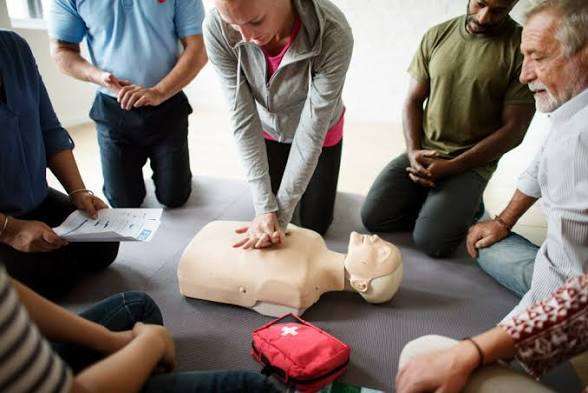
Hands on training means learning by doing, with a trainer beside you. In a first aid course, that looks like this:
- You kneel beside a manikin and practise chest compressions.
- You use a training defibrillator and follow its spoken prompts.
- You place a partner in the recovery position.
- You practise the movements for helping a choking person, safely and without real force.
- You apply dressings and bandages to a partner or a training model.
- You work through scenarios, such as a colleague collapsing at their desk.
Throughout, the trainer watches, corrects and encourages you. That personal feedback is the heart of the experience.
Why Videos Alone Fall Short
Videos are good at showing. They are not so good at teaching your body. Here are the main reasons.
1. Watching is not the same as doing
Imagine learning to swim by watching a video. You would understand the movements, but you would still sink the first time you got in the water. First aid works the same way. Chest compressions, the recovery position and bandaging all depend on how your body moves, not just what your eyes have seen.
2. Nobody can correct you
A video cannot see your hands. It cannot tell you that your hand position is slightly too low, that you are pushing too softly or that your rhythm is off. A trainer can. Small corrections make a big difference, and you often do not know you are making a mistake until someone points it out.
3. You cannot feel the effort
Good CPR takes real effort. Pushing hard and fast on a chest is tiring, and many people are surprised at how much work it is. You only find that out when you try it. Knowing that feeling in advance means you are less likely to give up too soon in a real emergency.
4. Stress changes everything
When something goes wrong, your heart races and your mind can go blank. Skills that were easy on a calm afternoon can disappear. Practising in a realistic setting, with a trainer and other learners, gets you used to a little pressure. It builds habits that hold up when you are nervous.
5. You miss the questions you did not know to ask
In a room with a trainer, questions come up naturally. What if the person is heavier than me? What if they are on the floor in a tight space? What if there is no AED? A trainer can answer them. A video cannot answer questions you have not thought of yet.
6. There is no proper assessment
A quiz at the end of a video can check what you remember. It cannot check whether you can actually perform the skills. A regulated qualification needs a qualified trainer to watch you do it.
7. It is easy to switch off
Watching alone at home, it is easy to get distracted or skip ahead. In a room with others, you stay engaged. The group, the trainer and the equipment keep you focused.
How People Really Learn Physical Skills
Think about how people learn other physical skills, such as driving, cooking or sport. Nobody becomes a safe driver by only watching videos. They sit behind the wheel with an instructor who corrects them. Over time, the movements become automatic.
First aid skills are similar. Repeating the movements builds what is often called muscle memory. After enough practice, you do not have to think about each step. Your body starts to follow the pattern. This is exactly what you need in a stressful moment.
The same idea explains why trainers ask you to repeat key skills such as CPR several times during a course. Each repetition makes the next one easier.
What Videos Are Still Good For
This does not mean videos have no place. Used well, they are a useful extra. They can:
- Introduce the basics. A short video can give you a first idea of what first aid involves.
- Show steps clearly. Good videos use close ups and slow motion to show details.
- Help you refresh. Watching a short clip between courses can remind you of the key steps.
- Prepare you for a course. Some providers share videos or reading before the practical day.
- Support blended learning. Online theory plus a face to face practical session can work well when it is properly run and assessed.
The point is to use videos as a helper, not a replacement. Think of them as a map, and hands on training as the actual walk.
What the Guidance Says
The Health and Safety (First Aid) Regulations 1981 require employers to provide adequate and appropriate first aid for their employees. Employers must make sure their first aiders are properly trained, and that the training provider is competent. HSE stopped approving first aid training providers in 2013, so employers need to check for themselves.
HSE guidance points to practical training and assessment as an important part of a good first aid course. The Emergency First Aid at Work course is a one day, regulated Level 3 qualification, and HSE guidance says it should include at least six hours of training time, not counting breaks. Much of that time is practical.
Resuscitation guidance in the UK also stresses the value of practising CPR on a manikin with feedback. Many first aid providers build their courses around this idea.
What a Good Hands On Course Looks Like
Not every course that says it is practical gives you enough practice. Look for these signs.
- Enough manikins. Ideally only two or three people share one, so everyone gets plenty of turns.
- Training AEDs. You should get to switch one on, place the pads and follow the prompts.
- A qualified trainer who watches you. Not just someone who talks at the front of the room.
- Small groups. Many awarding organisations set a maximum of around 12 learners per trainer, and smaller groups give you more attention.
- Time for repetition. Key skills such as CPR should be practised several times.
- Realistic scenarios. You should get to try a mix of skills, such as a collapsed colleague who is not breathing.
- Practical assessment. The trainer should watch you perform the key skills.
- A friendly atmosphere. You should feel safe to try, make mistakes and try again.
You can review the Emergency First Aid at Work training page to see how a course is described and compare it with this list.
What You Practise on an EFAW Course
Here is what a good Emergency First Aid at Work course gives you hands on practice with.
- Assessing a scene and a casualty safely. You practise the step by step method with a partner.
- Adult CPR. You practise chest compressions and rescue breaths on a manikin.
- Using an AED. You use a training machine and follow its prompts.
- The recovery position. You practise rolling a partner and checking their airway.
- Helping a choking adult. You practise the movements safely.
- Controlling bleeding. You use real dressings and bandages.
- Managing shock and minor injuries. You practise what to do and when to call for help.
Each of these is a physical skill. Each is easier to learn by doing than by watching.
Warning Signs of a Weak Course
Be careful if you spot any of these.
- No practical session at all. A course with only videos and a quiz is not suitable for a workplace first aider.
- Too many learners per manikin. If you only get a minute or two of practice, you will not learn much.
- No named awarding organisation. Regulated qualifications have one.
- A very short course. HSE guidance says Emergency First Aid at Work should include at least six hours of training time.
- Vague claims. Phrases such as fully approved or HSE approved are warning signs, because HSE no longer approves providers.
- A guarantee that everyone passes. Assessment should be real.
What About Blended Learning?
Blended learning combines online theory with a face to face practical session. It can be a good option when it is done properly. The key points to check are:
- It is a regulated Level 3 Award in Emergency First Aid at Work (RQF).
- The awarding organisation allows blended delivery.
- The practical session is led and assessed by a qualified trainer.
- There is enough hands on time for every key skill.
- Your employer accepts the format.
In a good blended course, the videos teach the theory and the trainer focuses on practice. That is a sensible way to use both.
How to Keep Your Skills Fresh After the Course
Even the best course is only the start. Skills such as CPR can fade within months if you do not practise. Here is how to keep them sharp.
- Review your notes a few days after the course.
- Watch a short refresher video from time to time. This is a great use of video.
- Practise the recovery position with a friend or family member.
- Walk through the steps for CPR in your head.
- Find your workplace first aid kit and AED.
- Take a short refresher each year. HSE recommends this, although it is not a legal rule.
- Put your three year expiry date in your diary and book your renewal early.
Notice that videos work well here, because you have already had the hands on training. They remind you of something you have done before.
How Many First Aiders Does Your Workplace Need?
If you are an employer, you may be wondering how many people to train. It depends on your first aid needs assessment. As a starting point for low hazard workplaces, such as offices, HSE suggests at least one appointed person for fewer than 25 employees, at least one first aider trained in Emergency First Aid at Work for 25 to 50 employees, and at least one first aider trained in First Aid at Work for every 100 employees above that, or part of 100. Higher hazard workplaces need more. Many employers also train an extra person to cover holidays and sickness.
Why Train in London?
London is a huge, busy city with thousands of workplaces. Roads and transport can be crowded, so in an emergency the people on site are often the first help available. There are plenty of training venues, and many providers can deliver hands on training at your workplace, which is handy for teams who want to learn together.
Final Thoughts
Videos can show you what first aid looks like. Hands on training teaches your body to do it. It gives you feedback, builds muscle memory, prepares you for stress and lets a trainer check that you can really perform the skills. That is why regulated first aid courses include practical teaching and assessment, and why employers and insurers value them.
Use videos to prepare and to refresh, but choose a course that puts a manikin, a trainer and real practice in front of you. When you are ready, take a look at the Emergency First Aid at Work course in London and choose a date that suits you.
Frequently Asked Questions
1. Why is hands on training important in first aid?
First aid is a physical skill. Hands on training lets you practise with real equipment, get feedback from a trainer, build muscle memory and be assessed on what you can actually do. Videos cannot provide these things on their own.
2. Can I learn first aid from videos alone?
Videos can teach you the basics and help you refresh your memory. But for a workplace first aider role, you need practical training and in person assessment with a qualified trainer.
3. Is a video based first aid course valid for work?
A course based only on videos and quizzes is generally not suitable for a workplace first aider. HSE guidance expects practical training and assessment, and a regulated Level 3 qualification requires you to show your skills in person.
4. What is muscle memory in first aid?
Muscle memory means your body learns a movement through repeated practice, so you can do it without thinking too hard. It helps you perform skills such as CPR even when you are stressed.
5. What equipment should a good first aid course use?
A good course should have enough CPR manikins, training AEDs, dressings, bandages and mats, so every learner gets plenty of practice. Ask your provider how many manikins they bring and how many learners share each one.
6. Are videos useful at all in first aid training?
Yes. Videos are useful for introducing the basics, showing steps clearly, preparing for a course and refreshing your memory between courses. They work best as a supplement to hands on training.
7. Is blended learning as good as a full classroom course?
Blended learning can be a good option if the course is regulated, the practical session is led and assessed by a qualified trainer and your employer accepts the format. Always check these points before you book.
8. How long should the Emergency First Aid at Work course be?
It is a one day course. HSE guidance says it should include at least six hours of training time, not counting breaks, and much of that time is practical.
9. How can I keep my first aid skills fresh?
Review your notes, practise the recovery position with a friend, watch short refresher videos, take a yearly refresher course and renew your certificate before it expires. Certificates are valid for three years.
10. Where can I book a hands on Emergency First Aid at Work course in London?
You can book through a training provider that offers the regulated qualification, either as a public course or as training at your workplace. Check the trainer’s experience, the amount of practical time and what the price includes before you book.