Someone collapses in the middle of a busy office. Two colleagues rush over. One learned first aid by watching videos on a laptop. The other spent a day on a practical course with a trainer, a manikin and a defibrillator. Both know the steps in theory. But who is more likely to act calmly, quickly and correctly?
That question sits at the heart of this guide. We explain why hands on training matters more than videos in first aid courses, in simple words, and we show what to look for when you choose a course in London. If you want to see a real course page as you read, here is the Emergency First Aid at Work course in London.
The Short Answer
Videos help you understand first aid. Hands on training helps you perform it. In a real emergency, understanding is not enough. You need skills that your body can carry out under pressure, and you need someone to have checked that you can do them.
That is why HSE guidance expects workplace first aid training to include practical teaching and assessment, and why a regulated Level 3 Award in Emergency First Aid at Work (RQF) needs you to show your skills in person.
Two Learners, One Emergency
Let us picture the scene properly. A colleague slumps at their desk and does not respond. They are not breathing normally.
Learner One watched videos at home. She remembers the main idea: call for help and push on the chest. But she has never knelt over a person, even a practice one. She is not sure where exactly to place her hands. She does not know how hard to push. After a minute she feels tired and unsure whether she is doing it right. She hesitates before using the defibrillator, because she has never touched one.
Learner Two did a hands on course. He remembers the method: check for danger, check the person, call for help, check breathing, give care. He has practised chest compressions on a manikin several times and had his technique corrected by a trainer. He has switched on a training AED and followed its prompts. He sends one person to call 999 and another to fetch the machine, then starts CPR with confidence.
Both people wanted to help. But practice turned Learner Two’s knowledge into action. That gap is exactly what hands on training closes.
What Hands On Training Actually Means
In first aid, hands on training means you learn by doing, with qualified guidance. In a good course, you will:
- Practise chest compressions and rescue breaths on a manikin.
- Use a training defibrillator and follow its voice prompts.
- Roll a partner into the recovery position.
- Practise the movements used to help a choking person, safely and without real force.
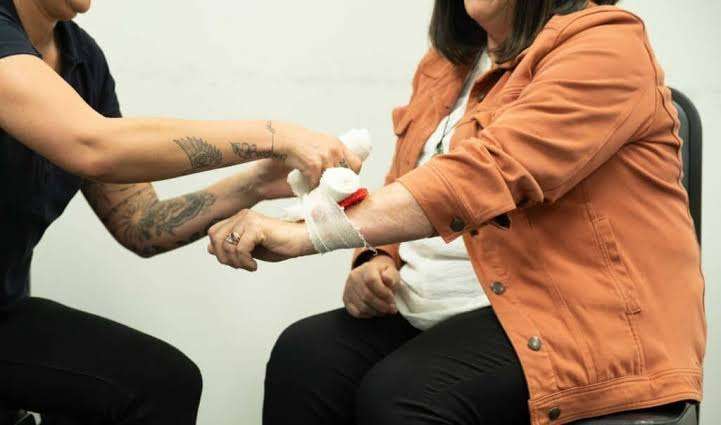
- Apply real dressings and bandages.
- Work through realistic scenarios with other learners.
- Receive feedback from a trainer who watches and corrects you.
The trainer is the key ingredient. Equipment alone is not enough. Feedback turns practice into improvement.
Eight Reasons Hands On Beats Videos
1. Your body learns by moving
Some skills live in the hands and arms, not just in the head. You cannot learn to ride a bike or swim by watching. First aid skills such as CPR and the recovery position are the same. The more you repeat them, the more natural they become.
2. You get instant correction
A video cannot see your hands. A trainer can. If your hand position is a little off, your rhythm is too slow or your arms are bent, the trainer tells you straight away. Small fixes make a big difference to how well the skill works.
3. You feel the real effort
Good CPR is physically demanding. Many people are surprised by how tiring it is. Experiencing that in a safe setting means you will not be shocked in a real emergency. You also learn why rescuers swap over.
4. You practise under mild pressure
A training room has a trainer watching and other learners nearby. This is a gentle version of stress. It helps you get used to acting while a little nervous, which is better preparation than calm viewing on a sofa.
5. You can ask your own questions
In a room, questions arise naturally. What if the person is on a tight staircase? What if the AED pads do not stick? What if I am the only person there? A trainer can answer them and adapt the practice. A video can only answer the questions it was made for.
6. You learn how equipment really feels
A defibrillator can look intimidating on screen. Holding the pads, peeling the backing and hearing the spoken prompts make it much less scary. The same goes for dressings, bandages and gloves.
7. You get a real assessment
A quiz can check what you remember. Only a person watching you can check what you can do. A regulated qualification needs this practical assessment, which gives employers confidence in your certificate.
8. You build confidence
People often say the biggest change is how they feel. After practising each skill several times, they believe they can do it. That belief matters, because hesitation can cost precious seconds.
Where Videos Shine
This does not mean videos are bad. They have a valuable place, as long as they support practical training rather than replace it.
- Before a course. A short video can give you a first picture of what to expect.
- During online theory. In a blended course, good videos explain concepts clearly, leaving more time for practice.
- After a course. A quick refresher video reminds you of steps you have already practised.
- For awareness. If you simply want to know the basics for personal interest, videos are a decent start.
The best way to think about it is this: videos are the map, hands on training is the walk.
What the Rules and Guidance Say
The Health and Safety (First Aid) Regulations 1981 require employers to provide adequate and appropriate first aid for their employees. That includes making sure first aiders are properly trained. HSE stopped approving first aid training providers in 2013, so employers need to check for themselves that a provider is competent.
HSE guidance on first aid training highlights practical teaching and assessment. The Emergency First Aid at Work course is a one day, regulated Level 3 qualification, and HSE guidance says it should include at least six hours of training time, not counting breaks. A course that is only videos and a quiz does not give an employer much reassurance.
The Hands On Checklist: What to Look For
Some courses say they are practical but offer very little practice. Use this checklist when you compare providers.
- Manikins. How many are there, and how many learners share each one? Two or three learners per manikin is a good sign.
- AED trainers. Will you get to place the pads and follow the prompts yourself?
- Trainer qualifications. Does the provider tell you who teaches and what qualifications they hold?
- Class size. Many awarding organisations set a maximum of around 12 learners per trainer. Smaller groups give more feedback.
- Repetition. Will you practise CPR more than once?
- Scenarios. Will you work through realistic situations that mix skills?
- Assessment. Will a trainer watch you perform the key skills?
- Regulated qualification. Is it a Level 3 Award in Emergency First Aid at Work (RQF) from a recognised awarding organisation?
- Timetable. Does it include at least six hours of training time?
- Friendly atmosphere. Do reviews suggest that learners felt supported?
You can review the Emergency First Aid at Work training page to see how a course is described and use the checklist to compare.
Red Flags
Be cautious if you see any of these.
- No practical session. If everything is online, think twice before paying.
- A very short course. Something far shorter than the six hour standard may skip important practice.
- No named awarding organisation. Regulated qualifications always have one.
- A promise that everyone passes. A real assessment should check real skills.
- Claims that HSE has approved the course. HSE no longer approves providers.
- Crowded rooms with very little equipment. You will not get enough turns.
What About Blended Learning?
Blended learning mixes online theory with a face to face practical session. It can work well when it is run by a competent provider. The important questions are:
- Is the qualification regulated?
- Does the awarding organisation allow blended delivery?
- Is the practical session led and assessed by a qualified trainer?
- Is there enough time to practise every key skill?
- Does your employer accept the format?
When the answers are yes, blended learning uses videos for what they do best and keeps the hands on practice that matters most.
Practising After the Course
Even a great course is just the beginning. Skills such as CPR can fade within months if you never use them. Here are simple ways to keep them alive.
- Review your notes a few days after the course.
- Watch a short refresher video now and then. After hands on training, this is a perfect use of video.
- Practise the recovery position with a friend or family member.
- Walk through the CPR steps in your head when you have a quiet moment.
- Learn where your workplace first aid kit and AED are.
- Take a short refresher each year. HSE recommends this, although it is not a legal rule.
- Put your three year expiry date in your diary and book your renewal early.
What Employers Should Remember
If you manage first aid at work, consider these points.
- Do a first aid needs assessment to decide how many first aiders you need. As a starting point for low hazard workplaces, HSE suggests at least one appointed person for fewer than 25 employees, at least one first aider trained in Emergency First Aid at Work for 25 to 50 employees, and at least one first aider trained in First Aid at Work for every 100 employees above that, or part of 100. Higher hazard workplaces need more.
- Choose providers that offer proper practical training and assessment.
- Train an extra person to cover holidays and sickness.
- Keep a list of certificate expiry dates and book renewals early.
- Make sure staff know who the first aiders are.
Why London Learners Benefit
London is a busy, crowded city with thousands of workplaces. When an emergency happens, the people on site are often the first help available. There are many training venues across the city, and many providers can deliver practical courses at your workplace, which is a good way to train a team together and let everyone practise in a space they know.
Final Thoughts
Videos are helpful, but they cannot replace the feel of a manikin under your hands, a trainer who corrects your technique and the confidence that comes from doing it yourself. First aid is a skill that has to be practised to be trusted. That is why hands on training matters more than videos, and why a regulated course includes practical assessment.
Use videos to prepare and to refresh, and choose a course that puts real practice at the centre. When you are ready, take a look at the Emergency First Aid at Work course in London and choose a date that suits you.
Frequently Asked Questions
1. Why does hands on training matter in first aid courses?
First aid skills such as CPR, using an AED and the recovery position are physical. Hands on training lets you practise them, receive feedback and be assessed in person, which videos alone cannot do.
2. Is watching a first aid video enough to help in an emergency?
A video can teach you the basic steps, but it does not prepare your body to perform them. Practising with a trainer and equipment gives you the skills and confidence to act.
3. Can I get a valid workplace first aid certificate from videos?
Generally no. HSE guidance expects practical training and assessment, and a regulated Level 3 qualification requires you to show your skills in person with a qualified trainer.
4. What is the benefit of practising on a manikin?
A manikin lets you practise chest compressions and rescue breaths safely. You can feel the effort, learn the right depth and rhythm and get feedback, all without risk to a real person.
5. How many learners should share one manikin?
The fewer the better. Ideally only two or three learners share one, so everyone gets plenty of practice time. Ask your provider how many manikins they bring.
6. Are videos useful for refreshing first aid skills?
Yes. After a hands on course, short videos are a great way to remind yourself of the steps. They work best as a supplement to practical training, not a replacement.
7. Is blended learning a good compromise?
It can be, if it is a regulated qualification, the awarding organisation allows it and the practical part is led and assessed by a qualified trainer. Check that your employer accepts it.
8. How long is a hands on Emergency First Aid at Work course?
It is a one day course. HSE guidance says it should include at least six hours of training time, not counting breaks, and a large part of that time is practical.
9. How long does the certificate last?
The certificate is valid for three years. HSE recommends a short yearly refresher, although it is not a legal requirement, and you need to retake the course before the certificate expires.
10. Where can I take a hands on first aid course in London?
You can book through a training provider that offers the regulated Emergency First Aid at Work qualification, either as a public course or as training at your workplace. Check the amount of practical time, the equipment and the trainer’s experience before you book