Reading a course outline is one thing. Walking into the room on the day is another. What will it feel like? Will you be nervous? Will other people know more than you? Will you actually enjoy it?
In this guide, we follow a made up learner called Maya through a typical Emergency First Aid at Work course in London. Maya is an example, not a real person, but her day is built from the way these courses usually run. Every provider has its own timetable, so use this as a friendly picture rather than a fixed schedule. If you want to see a real course page as you read, here is the Emergency First Aid at Work course in London.
Meet Maya
Maya works as an office administrator at a small company in London. There are about 30 people on her team. Last month, her manager did a first aid needs assessment and found that the office needed at least one trained first aider. Maya put her hand up. Now she has a place on a one day Emergency First Aid at Work (EFAW) course.
She has no medical background. She once put a plaster on a colleague’s finger, and that is about the limit of her experience. She is excited, but also a little worried.
A Quick Reminder of the Course
EFAW is a one day, regulated Level 3 qualification. HSE guidance says it should include at least six hours of training time, not counting breaks. By the end, learners can assess an emergency, give adult CPR, use an AED, place someone in the recovery position, help a choking adult, control serious bleeding, spot shock and treat minor injuries. The certificate lasts three years.
The Night Before
Maya reads her booking confirmation. It tells her the venue, the start time and what to bring. She notices a line asking learners to wear comfortable clothes, because there will be kneeling on the floor. She lays out trousers and a loose top.
She also remembers that she can tell the provider about any health or access needs in advance. She does not have any, but she is glad to know the option is there.
Her worries run through her head. What if she freezes? What if she forgets everything? What if she is the slowest in the room? She tells herself that everyone starts as a beginner, goes to bed early and sets two alarms.
Morning: The Journey and Arrival
Maya eats breakfast, packs a water bottle and a notebook, and travels across London. She leaves early, because she does not want to arrive stressed. The venue is easy to find, and a friendly person at the door points her to the training room.
Inside, there are chairs set in a horseshoe shape. At the front, she spots something that makes her stomach flip a little: several training manikins lying on mats, and a bright yellow box that looks like a defibrillator.
She finds a seat and says hello to the person beside her. His name is Dev, and he is a gym instructor. Across the room, there is a teacher, a café owner and two people from a small accountancy firm. Everyone looks slightly nervous. That makes Maya feel better.
The Welcome
The trainer introduces herself and shares a little about her background. She has worked in emergency care and now teaches first aid full time. She explains how the day will run:
- Short talks, followed by lots of practice.
- Breaks at sensible times, plus a lunch break.
- Assessment during the day, mostly by watching practical skills.
- No scary exam, and no one will be put on the spot.
She also asks everyone to say their name and why they are here. Maya says she is the new office first aider. Dev says clients keep asking him for a certificate. The teacher says she wants to be ready. The café owner says a customer once choked in her shop, and she did not know what to do.
By the end of the introductions, the room feels warmer. Everyone is here for a real reason.
The First Session: Your Role and Staying Safe
The first teaching block is about the role of a first aider. The trainer explains that a first aider is not a doctor or nurse. The job is to give quick, safe help and to call for professional help when needed.
Maya learns about:
- Staying safe, including checking for dangers and using gloves.
- The law, in simple terms. Employers must provide adequate and appropriate first aid under the Health and Safety (First Aid) Regulations 1981.
- Why records matter, and how to note what happened.
- The difference between a first aider and an appointed person.
She writes in her notebook: Safety first, always. If I get hurt, I cannot help anyone.
The trainer then introduces a simple method for any emergency. Check for danger. Check the person. Call for help. Check breathing. Give care. Maya writes it down and underlines it twice. She senses that this will be the backbone of the day.
They practise in pairs. Maya and Dev take turns pretending to find a colleague on the floor. They feel a bit silly at first, but the trainer smiles and says that is normal. By the end of the exercise, they are both calling out the steps with confidence.
Mid Morning: The First Break
Tea, coffee and biscuits. Maya chats with the teacher, who tells her she was nervous too. They compare notes about what they have learned so far. Maya realises she has not once felt lost.
The Big Block: CPR and the Defibrillator
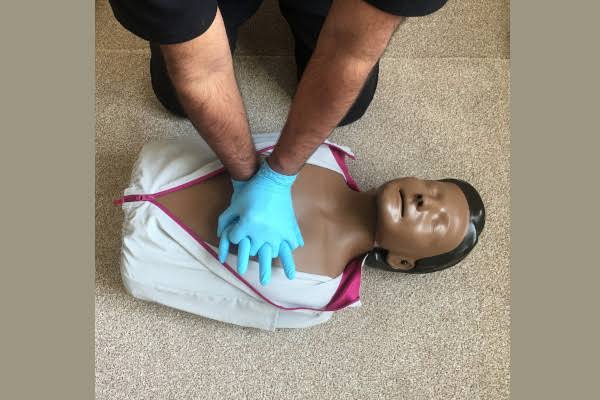
Now comes the part Maya has been quietly dreading. The trainer explains that CPR, or cardiopulmonary resuscitation, is what you do when someone is not breathing normally. She demonstrates on a manikin, speaking clearly as she goes: where to place the hands, how deep and how fast to push, and when to give breaths.
Then it is the learners’ turn.
Maya kneels beside a manikin, places her hands and starts pushing. It is harder than she expected. Her arms start to tire after a minute. The trainer crouches beside her and says, Good depth. Keep the rhythm. You are doing well. A small adjustment to her hand position makes a big difference, and she feels the difference straight away.
She tries again, and then once more. By the third time, it feels more natural. She notices that Dev is getting the rhythm quickly, but the café owner is finding it tiring. The trainer reminds everyone that in real life, rescuers swap over, so no one has to keep going alone.
Next comes the defibrillator. Maya had always imagined it as something complicated, only for doctors. The trainer switches on the training machine and it starts to speak. It tells her exactly what to do, step by step. Maya places the practice pads on the manikin, follows the voice and listens as it tells her to stand clear. The whole thing feels surprisingly calm.
She thinks, I could actually do this.
Lunch
Lunch is a proper break. Some people eat in the room, others go out for a walk. Maya sits with Dev and the teacher. They talk about the morning, share small worries and laugh about how tired their arms are. Maya notices that her nerves from the morning have almost gone.
Early Afternoon: The Recovery Position and Choking
After lunch, the trainer moves to two more skills.
First, the recovery position. She explains that if someone is unresponsive but still breathing, you place them on their side to keep the airway clear. Maya practises with Dev. She rolls him carefully, adjusts his arm and leg, and checks that his head is tilted properly. Then they swap. Lying on the floor in the recovery position, Maya understands why it matters. It feels stable and safe.
Next, choking. The trainer explains the difference between mild and severe choking. For a severe case, she shows how to give back blows and abdominal thrusts. The learners practise the movements on each other using gentle pressure only, never real force, and on a training aid.
The café owner is quiet for a moment. She says, I wish I had known this last year. The trainer nods kindly. That is exactly why we are here.
Mid Afternoon: Bleeding, Shock and Minor Injuries
The next block covers injuries Maya is most likely to see at work. She learns how to control serious bleeding with firm pressure and a dressing, and how to recognise shock, which can happen after heavy blood loss or a serious injury. She also covers minor problems, such as small cuts, grazes and burns.
They practise with real dressings and bandages. Maya wraps a bandage around Dev’s arm, and the trainer shows her how to check that it is firm but not too tight. She finds that this part feels the most familiar, like the kind of thing she would do at home, but with a clear method behind it.
A short break follows. Maya stretches her arms and refills her water bottle.
Late Afternoon: Putting It All Together
In the final session, the trainer runs scenarios that mix several skills. In Maya’s group, the scenario is that a colleague collapses at their desk and is not breathing normally. Maya takes the lead. She checks for danger, checks the person, asks Dev to call 999 and fetch the AED, and starts CPR. Another learner uses the AED and follows the prompts.
When the scenario ends, the trainer gives feedback. She praises the clear instructions and the good teamwork. She suggests one improvement: Maya could speak a little louder when she gives directions. Maya laughs and nods.
During the day, the trainer has been watching everyone’s practical skills. This is how the assessment works. There is no big written exam. Instead, she has been ticking off what each person can do. If anyone needs another try, she gives them time and support.
At the end, the trainer asks a few short questions as a group. Maya answers one about when to call 999. She is surprised at how easily the answer comes.
The Wrap Up
The trainer reviews the key points of the day and invites last questions. She explains that the certificate is valid for three years, and that HSE recommends a short yearly refresher, although it is not a legal rule. She suggests that learners put the expiry date in their diary and practise now and then.
She also reminds them of simple next steps:
- Find the first aid kit at work and check it is stocked.
- Find out where the nearest AED is, if there is one.
- Tell colleagues who the first aiders are.
- Keep notes and review them in a few days.
Maya packs up her notebook. She feels tired in a good way. She also feels something she did not expect: pride.
The Journey Home
On the way home, Maya thinks through what she has learned. She runs the steps in her head: Check for danger. Check the person. Call for help. Check breathing. Give care. She feels more confident than she has in a long time. She texts her manager: Passed my first aid course today. Ready to help.
The Next Week at Work
Back at the office, Maya does three things.
- She finds the first aid kit and checks what is inside.
- She asks the facilities team where the nearest AED is.
- She tells her team that she is now a first aider, and puts her name on the noticeboard.
A colleague asks her to help with a small cut from a paper shredder. Maya cleans and dresses it, using what she learned. It is a small moment, but it feels good.
Three Years Later
Maya’s certificate will last three years. In that time, she plans to:
- Review her notes every few months.
- Practise the recovery position with a friend.
- Take a short refresher each year.
- Book her renewal a month or two before the certificate expires.
She knows that skills like CPR can fade without practice, so she treats her training like a habit rather than a one time event.
What Maya Wishes She Had Known Before
When she looks back, Maya has a few tips for other learners.
- Everyone is nervous at the start. You are not the only one.
- Wear comfortable clothes. You will kneel on the floor.
- Ask questions. Even the basic ones. Other people want to know too.
- Take part in every practical task. The more you practise, the more it sticks.
- Make your own notes. Write the steps in words that make sense to you.
- Do not worry about being perfect. The trainer is there to help you improve.
- Review soon after. A quick look at your notes a few days later helps a lot.
How Many First Aiders Does a Workplace Need?
Maya’s company had around 30 staff, so the needs assessment pointed to at least one trained first aider. HSE gives suggested minimums for low hazard workplaces, such as offices. With fewer than 25 employees, at least one appointed person. With 25 to 50 employees, at least one first aider trained in Emergency First Aid at Work. With more than 50 employees, at least one first aider trained in First Aid at Work for every 100 employees, or part of 100. Higher hazard workplaces need more. A first aid needs assessment gives the best answer for any workplace, and many employers train an extra person to cover holidays and sickness.
Choosing a Good Course in London
If you are planning your own day, here is what to look for.
- A regulated Level 3 qualification from a recognised awarding organisation.
- Experienced trainers with real emergency, medical or teaching backgrounds.
- Plenty of practical practice, with enough manikins and AED trainers.
- Small groups, so the trainer can give feedback.
- A clear timetable and honest pricing.
You can review the Emergency First Aid at Work training page to see how a course is described and what to compare.
Why Train in London?
London has thousands of workplaces and a busy, crowded transport network. In an emergency, the people nearby are often the first help available. There are plenty of venues across the city, and many providers can deliver training at your workplace, which is a good way to train a whole team together.
Final Thoughts
A day on an Emergency First Aid at Work course is usually friendlier and more practical than people expect. You start nervous, meet a group of people with the same worries, learn one skill at a time and practise until it feels natural. By the end, like Maya, you leave with a certificate, new skills and real confidence.
If you would like to have a day like Maya’s, take a look at the Emergency First Aid at Work course in London and choose a date that suits you.
Frequently Asked Questions
1. What is a typical day like on an Emergency First Aid at Work course?
You arrive, meet your trainer and the group, learn the role of a first aider, practise CPR and AED use, then move through the recovery position, choking, bleeding, shock and minor injuries. You are assessed during the day and receive a certificate at the end.
2. How long is the course day?
The course takes one day. HSE guidance says it should include at least six hours of training time, not counting breaks. Many courses run from morning to late afternoon.
3. Will I be put on the spot or embarrassed?
Good trainers do not embarrass anyone. You see each skill demonstrated first, then you try it with support. Everyone is a beginner, so mistakes are normal and welcome.
4. What should I wear and bring?
Wear comfortable clothes you can kneel in, because CPR practice is usually done on the floor. Bring photo ID if your provider asks, a water bottle and something to write with. Check whether lunch and drinks are included.
5. Is the course physically hard?
Chest compressions take some effort, and you will kneel on the floor, but trainers show you the best technique and you can swap with a partner. If you have a health or mobility need, tell your provider in advance.
6. How is the course assessed?
Assessment is mostly practical. The trainer watches your skills during the day and may ask a few short questions. It is not a long written exam. If you need another try, a good trainer helps you.
7. Will I feel confident at the end of the day?
Most people feel much more confident, because they have practised each skill with real equipment. Confidence grows further if you review your notes and take a yearly refresher.
8. What happens after I pass?
You receive a certificate valid for three years. You should keep a copy, give one to your employer, note the expiry date and tell colleagues who the first aiders are. HSE recommends a short yearly refresher, although it is not a legal requirement.
9. Can I bring a colleague, or train as a team?
Yes. Many people book together, and many providers offer private training at your workplace, which is convenient for teams.
10. Where can I book an Emergency First Aid at Work course in London?
You can book through a training provider that offers the regulated qualification, either as a public course or as on site training for your team. Check the trainer’s experience, the class size and what the price includes before you book