When people start looking for training, they run into a pile of similar sounding names: emergency first aid, first aid at work, basic life support, CPR, AED, immediate life support. It is easy to feel lost. One of the most common questions is simple: what is the difference between emergency first aid and basic life support?
The short version is that basic life support is one important part of emergency first aid, but it is not the whole of it. In this guide, we explain both terms in plain English, show where they overlap, and help you decide which one you need. If you are thinking about a workplace course, you can see the Emergency First Aid at Work course in London as you read.
The Short Answer
Emergency first aid is the quick, practical help given to someone who is injured or suddenly ill, until professional help takes over. It covers a range of situations, such as cardiac arrest, choking, heavy bleeding, shock and minor injuries.
Basic life support (BLS) is a narrower set of skills. It focuses on keeping a person alive when their breathing or heart has stopped. It usually means CPR and, where available, the use of a defibrillator.
So you can think of it like this: BLS is the core life saving engine inside emergency first aid. Emergency first aid is the bigger toolbox around it.
What Is Emergency First Aid?
Emergency first aid is what an ordinary person is trained to do when something serious happens, and an ambulance may not be there yet. The aim is often summed up in three simple goals:
- Preserve life.
- Prevent the situation getting worse.
- Promote recovery.
In a workplace, this is usually taught through a course such as Emergency First Aid at Work (EFAW). It is a one day, regulated Level 3 qualification. HSE guidance says it should include at least six hours of training time, not counting breaks. A typical EFAW course teaches you how to:
- Assess an incident and stay safe.
- Check a casualty and decide when to call 999.
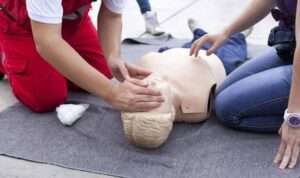
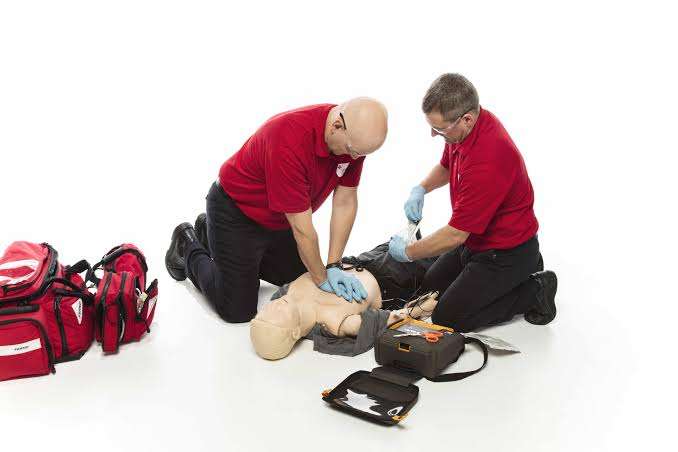
- Give adult CPR and use an AED.
- Place an unresponsive, breathing person in the recovery position.
- Help a choking adult.
- Control serious bleeding.
- Recognise and manage shock.
- Treat minor injuries such as small burns, cuts and grazes.
As you can see, CPR and AED use sit inside the list, but there is more around them.
What Is Basic Life Support?
Basic life support is the set of skills used to keep someone alive when their breathing or heartbeat has stopped, or is failing. It is built around a simple chain of actions:
- Recognise that the person is unresponsive and not breathing normally.
- Call for help and ask for an AED.
- Start chest compressions.
- Give rescue breaths where trained and able.
- Use an AED as soon as it arrives.
- Carry on until help takes over or the person shows signs of life.
BLS is often described as the first links in the chain of survival. In the UK, the Resuscitation Council UK publishes widely used guidance on resuscitation. BLS can be taught to anyone, and it is also a standard skill set for people who work in healthcare.
The Main Differences at a Glance
Scope
- Emergency first aid: wide. Covers many injuries and sudden illnesses.
- Basic life support: narrow. Focuses on a person whose breathing or heart has stopped.
Typical skills
- Emergency first aid: CPR, AED, recovery position, choking, bleeding, shock, minor injuries.
- Basic life support: CPR, AED use, airway and breathing support, and working as part of a resuscitation team.
Who it is mainly for
- Emergency first aid: people in workplaces, schools, clubs and communities.
- Basic life support: healthcare staff and others who may be expected to take part in resuscitation, as well as members of the public who want focused CPR training.
Course length
- Emergency first aid (EFAW): about one day.
- Basic life support: often shorter, from around a few hours, though it varies with the provider and the audience.
Link to workplace rules
- Emergency first aid: a recognised route for employers who need to provide first aid under the Health and Safety (First Aid) Regulations 1981.
- Basic life support: a valuable skill, but on its own it may not meet a workplace’s full first aid needs.
Where the Two Overlap
The overlap is real, and it is why people mix up the terms. Both include:
- Checking if a person responds.
- Calling for help.
- Giving chest compressions.
- Using an AED.
In fact, an EFAW course includes BLS style skills for adults. So when you finish a good EFAW course, you will know how to give CPR and use a defibrillator. That part of your training is basic life support.
The difference is that EFAW does not stop there. It also teaches you what to do when the problem is not a cardiac arrest, which is far more common in everyday workplaces.
Why the Difference Matters in the Workplace
Most workplace emergencies are not cardiac arrests. People faint, cut themselves, choke on food, burn a hand on a kettle or feel suddenly unwell. If a workplace only had BLS trained staff, they might handle a cardiac arrest well but feel unsure about a bad bleed or a choking colleague.
That is why emergency first aid training is the usual answer for employers. It covers the life-threatening events, and it also covers the everyday ones.
Under the Health and Safety (First Aid) Regulations 1981, employers must provide adequate and appropriate first aid. A first aid needs assessment helps decide what that means. As a starting point for low-risk workplaces, HSE suggests:
- Fewer than 25 employees: at least one appointed person.
- 25 to 50 employees: at least one trained first aider.
- More than 50 employees: at least one first aider for every 50 people.
Higher-risk workplaces need more, and usually the three-day First Aid at Work course.
Is BLS Ever Enough on Its Own?
Sometimes, yes. A BLS course can be a good fit when:
- You are a member of the public who wants quick, focused CPR and AED training.
- You work in healthcare and need resuscitation skills for your role.
- You already hold a full first aid qualification and want a refresher on CPR.
- A club or community group wants as many people as possible to know CPR.
But if you are named as the first aider in a workplace, BLS alone will usually not be enough. Employers should check what their needs assessment says and choose a first aid qualification that fits.
What About Immediate Life Support and Advanced Life Support?
You may also hear about higher levels of resuscitation training. These are mainly for healthcare professionals.
- Immediate Life Support (ILS) builds on BLS. It adds skills such as using airway equipment and recognising certain heart rhythms.
- Advanced Life Support (ALS) goes further and prepares clinical teams to lead a full resuscitation.
Neither of these is part of a workplace first aid course. They are separate clinical qualifications. So if you work in an office, shop or school, you do not need them.
A Simple Example
Imagine two situations in the same office.
Situation one: A colleague collapses and is not breathing normally. Here, BLS skills are what matter most. A first aider calls 999, starts chest compressions and sends someone to fetch an AED. A person trained in either BLS or EFAW can do these steps.
Situation two: A colleague drops a glass and cuts their hand deeply. There is a lot of blood. This is not a BLS problem. The first aider needs to apply firm pressure, use a dressing, check for shock and decide whether to call an ambulance. Only a wider first aid course teaches this.
The two situations show why the broader training is so valuable at work.
Which Should You Choose?
Here is a quick guide.
Choose emergency first aid (such as EFAW) if:
- You will act as a first aider in a low risk workplace.
- You want a recognised qualification that covers many situations.
- Your employer needs to show they have met their first aid duties.
- You want to feel ready for choking, bleeding and other common emergencies, as well as cardiac arrest.
Choose basic life support if:
- You want focused CPR and AED training.
- You work in healthcare and need resuscitation skills for your role.
- You already have a full first aid certificate and want to refresh your CPR.
Choose First Aid at Work (three days) if:
- Your workplace is higher risk or larger.
- Your needs assessment says you need a wider range of skills.
If you are unsure, ask your employer or your training provider. A short first aid needs assessment can point to the right answer.
How Long Do the Certificates Last?
An EFAW certificate is valid for three years. HSE recommends a short yearly refresher, although it is not a legal rule.
For BLS, the guidance on how often to refresh varies between providers and employers. Many recommend a yearly update, because CPR skills can fade within months if you do not practise. Check the policy of your employer or provider.
In both cases, small habits help. Re read your notes, walk through the steps in your mind and note where the nearest AED is.
Common Mix-Ups to Avoid
- Myth: BLS and first aid are the same. Fact: BLS is part of first aid, but first aid is broader.
- Myth: CPR is all you need. Fact: Many workplace emergencies need other skills, such as bleeding control and helping a choking person.
- Myth: A BLS card makes you a workplace first aider. Fact: Workplace first aiders usually need a recognised first aid qualification that matches the needs assessment.
- Myth: Only medical people can do BLS. Fact: Members of the public can learn it too.
How to Choose a Good Course in London
Whichever path you choose, look for quality. Good signs include:
- A regulated qualification from a recognised awarding organisation.
- Trainers with real emergency or medical experience.
- Plenty of hands on practice with manikins and AED trainers.
- Small groups, so the trainer can give feedback.
- Clear information about content, timing and price.
You can look at the Emergency First Aid at Work training page to see how a course is described and compare it with this list.
Why Train in London?
London is one of the busiest cities in the world. Workplaces are close together, roads can be crowded and many people travel a long way to work. In an emergency, the people nearby are the first line of help. There are many training venues across the city, and many providers can also deliver on site training, so the trainer visits your workplace. That is a handy choice for teams.
Final Thoughts
Emergency first aid and basic life support are close cousins, not twins. Basic life support is the focused set of skills for when breathing or the heart has stopped. Emergency first aid includes those skills and adds help for choking, bleeding, shock, unresponsive casualties and minor injuries.
For most workplaces, an emergency first aid course such as EFAW is the better choice, because it prepares you for the wide range of things that can go wrong. When you are ready, take a look at the Emergency First Aid at Work course in London and choose a date that suits you.
Frequently Asked Questions
1. What is the difference between emergency first aid and basic life support?
Emergency first aid is a broad set of skills for helping people who are injured or suddenly ill, including CPR, choking, bleeding and shock. Basic life support is narrower. It focuses on CPR, AED use and supporting a person whose breathing or heart has stopped.
2. Is CPR part of emergency first aid?
Yes. CPR and the use of a defibrillator are key parts of emergency first aid. They sit alongside skills such as the recovery position, choking and bleeding control.
3. Does an Emergency First Aid at Work course teach basic life support?
It teaches the BLS style skills for adults, including CPR and using an AED. It also covers other emergencies, such as choking, bleeding, shock and minor injuries.
4. Is basic life support enough to be a workplace first aider?
Usually not. Workplace first aiders typically need a recognised first aid qualification, such as Emergency First Aid at Work, that matches the workplace’s needs assessment.
5. Who needs basic life support training?
Healthcare staff often need it for their roles. Members of the public, community groups and workers who want focused CPR and AED skills can also take it.
6. How long is an Emergency First Aid at Work course compared with basic life support?
EFAW is a one day course with at least six hours of training time. Basic life support courses are often shorter, though the length varies by provider and audience.
7. What is the difference between basic life support and immediate life support?
Immediate life support builds on basic life support. It is aimed at healthcare professionals and adds skills such as using airway equipment and recognising certain heart rhythms.
8. Which course is better for a small office?
For most small, low risk offices, an Emergency First Aid at Work course is a better fit. It covers cardiac arrest and also the more common problems, such as choking, bleeding and minor injuries.
9. How often should I refresh my CPR skills?
HSE recommends a short yearly refresher for first aiders, though it is not a legal requirement. CPR skills can fade quickly, so regular practice helps.
10. Where can I book an Emergency First Aid at Work course in London?
You can book through a training provider that offers the regulated qualification, either as a public course or as on site training for your team. Check the trainer’s experience, the timetable and what the price includes before you book.