You have taken an Emergency First Aid at Work (EFAW) course in London, and your certificate is in your inbox. Now you are thinking about a job in Dublin, a contract in Dubai, a season in the Alps or a move to Australia. Will your certificate come with you?
The honest answer is: it depends on the country, the job and who is asking. Your skills will always be useful, but a UK workplace certificate is not an international passport. In this guide, we explain how recognition works abroad in plain English, why Ireland is a special case, what to check before you travel and how to protect yourself and your employer. This is general information, not legal advice. If you want to see a real course page as you read, here is the Emergency First Aid at Work course in London.
The Short Answer
An EFAW certificate is designed to meet UK workplace first aid rules, so it is built for UK employers. Outside the UK, each country makes its own rules about who counts as a workplace first aider. In many places, a UK certificate will not automatically satisfy local law, though a foreign employer may still accept it as evidence of training. In some countries, such as Ireland, it will not be accepted for legal purposes at all.
So before you rely on your certificate abroad, check the rules in the country where you will work and ask your employer.
Why a UK Certificate Is Built for the UK
In Great Britain, the Health and Safety (First Aid) Regulations 1981 require employers to provide adequate and appropriate first aid. Northern Ireland has its own matching regulations. A regulated Level 3 Award in Emergency First Aid at Work (RQF) is a one day course that includes at least six hours of training time, not counting breaks, according to HSE guidance. The certificate lasts three years, and it is widely accepted across the UK.
Those rules and that qualification belong to the UK system. Other countries have their own laws, their own regulators, their own approved training providers and their own certificate formats. A UK certificate is therefore recognised because of UK law, not because of any worldwide agreement.
Ireland: A Clear Example
Ireland is the closest neighbour, and it shows how this works.
- Ireland has its own system. Under Irish workplace safety rules, employers must have a sufficient number of trained occupational first aiders based on a risk assessment. Since September 2017, the Health and Safety Authority has only recognised first aid training approved by PHECC, the Pre Hospital Emergency Care Council.
- No mutual recognition. The Health and Safety Authority states that there are no mutual recognition agreements between Ireland and other countries on occupational first aid. A well known Irish first aid training body says that occupational first aid certificates obtained in other countries are not transferable and are not valid in Ireland, and that to be a valid occupational first aider in Ireland, you must do the training in Ireland.
- Northern Ireland training does not count either. HSENI states that training carried out under the Northern Ireland regulations is not recognised in the Republic of Ireland, and that for certificates to be valid there, an Irish occupational first aid certificate must be held.
- The other direction. HSENI explains that Irish occupational first aid qualifications can be accepted in Northern Ireland or Great Britain if the employer carries out due diligence, but that is about using Irish certificates in the UK, not the other way round.
So if you are moving to Ireland for a workplace first aider role, plan to take the Irish course. Your UK certificate may still show an employer that you have training, but it will not satisfy the Irish legal requirement.
What About Other Countries?
For other countries, the situation is similar in principle, though the details differ.
Europe
The European Union sets general health and safety principles, including that employers must make provision for first aid. But each country decides how to carry that out, including who can train first aiders and what certificates are valid. There is no single European first aid certificate for workplaces. If you work in an EU country, check with the local authority or your employer which training is recognised.
The Middle East, Asia and Africa
Many countries, especially those with large international workforces, have their own approved training centres, and some require certificates from locally approved providers for workplace first aiders. Some employers accept international or UK certificates for non statutory purposes. Always check with the employer and the relevant authority.
Australia, New Zealand and Canada
These countries each have their own national or regional training standards and approved providers, and employers usually expect first aiders to hold locally recognised certificates. A UK certificate may be valued as evidence of training but may not replace the local requirement.
The United States
Workplace first aid is regulated at federal and state levels, and employers commonly look for certificates from recognised US training organisations. A UK certificate may help show your skills, but it is unlikely to replace a locally recognised certificate.
These are general pictures, not a full guide to each country. The right approach is to ask the local employer or authority.
Why Your Skills Still Matter
Even if a certificate is not formally recognised, the knowledge you gained is valuable. CPR, using an AED, helping a choking person, controlling bleeding and placing someone in the recovery position are useful anywhere in the world. In an emergency abroad, you can still help, as any member of the public can.
Some details of resuscitation guidance differ between countries and organisations, and it can help to read local guidance or take a local refresher. But the core skills travel well.
Situations Where the Question Comes Up
Here are common cases, and what to think about in each.
Working for a UK company with staff overseas
The company may still follow UK rules for its UK staff, but local law applies to workplaces abroad. Ask your employer whether local training is needed.
Moving abroad for a new job
Your new employer will tell you what they accept. Ask early, and check whether you need a local course.
Working in a specialist field
Some sectors, such as maritime, aviation, offshore and rail, have their own international or industry standards for first aid that go beyond a general workplace course. HSE keeps its own approval only for specialist offshore first aid training in the UK. EFAW is not a substitute for these.
Seasonal work and travel
If you take seasonal work, for example at a ski resort, a camp, a hotel or on a boat, the employer may ask for a specific certificate. A UK EFAW certificate may be accepted, or you may be asked to do a different course.
Volunteering abroad
Charities and projects often value first aid skills. They may accept a UK certificate as evidence, or provide their own training.
Freelancing for international clients
Clients may ask for a current certificate. A UK certificate may be accepted by international clients based in the UK or those who recognise UK qualifications.
Moving to Scotland, Wales or Northern Ireland
This is not abroad, but it is often confused with it. EFAW is generally accepted across the UK. See our guide on whether an emergency first aid certificate is recognised across the UK.
How to Check Before You Go
Here is a simple routine.
- Ask the employer. What first aid certificates do they accept, and do they need a local one?
- Check local rules. Look at the website of the national or local health and safety authority.
- Ask the local training bodies. They can tell you which providers and certificates are approved.
- Check your certificate’s details. Qualification title, awarding organisation, dates and number.
- Ask about translation. Some employers or authorities may want an official translation.
- Ask about verification. Some may ask to verify a certificate with the awarding organisation.
- Check the expiry date. A certificate that expires soon is worth less than one with plenty of time left.
- Consider a local course. If local law requires it, plan the time and cost.
What to Carry
If you will work abroad, keep these ready.
- A digital copy of your certificate saved in at least two places.
- The name of your provider and awarding organisation.
- The qualification number, if your provider can give it.
- A short course outline from the provider, showing what you learned.
- Your expiry date in your calendar.
If your employer abroad asks for more, your provider may be able to supply a letter confirming that you completed the course.
What Does a UK Certificate Prove?
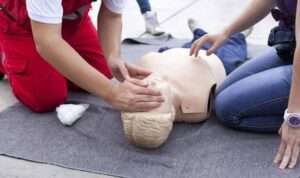
A regulated Level 3 Award in Emergency First Aid at Work (RQF) shows that you completed a one day course and were assessed in person by a qualified trainer. You learned how to assess an incident safely, give adult CPR, use an AED, place someone in the recovery position, help a choking adult, control serious bleeding, manage shock and treat minor injuries. For an international employer, that is useful evidence of training, even if it is not their legal standard.
What If Your Certificate Expires While You Are Abroad?
An EFAW certificate is valid for three years. After that, it expires, and there is no general grace period. Renewal means retaking the one day course. If you are abroad, you may not be able to renew with a UK provider, so plan ahead. You could renew before you leave, or take a locally recognised course abroad. HSE recommends a short yearly refresher, although it is not a legal rule, and a refresher does not extend the certificate.
Should You Take a UK Course Before You Go?
It can still be worth it, for several reasons.
- It gives you real skills. They travel with you.
- It may help you get a job. Many international employers value first aid training.
- It may be accepted. Some employers accept UK qualifications.
- It is a good base. If you need a local certificate later, you will already know the basics.
But do not rely on it for legal compliance abroad without checking.
In London in 2026, public prices for a one day course commonly range from about £65 to £150 per person. One provider page, linked above, lists £89 per person for classroom training and £75 per person for groups of five or more, at the time of writing in October 2026. Prices change, so always confirm. You can review the Emergency First Aid at Work training page to see how one provider presents its course, price and booking options.
A Note for Employers With Overseas Staff
If you run a UK business with staff abroad, remember that local law applies to local workplaces. Do a first aid needs assessment for each site, check local requirements and use locally recognised training where needed. For your UK sites, HSE suggests, as a starting point for low hazard workplaces, at least one appointed person for fewer than 25 employees, at least one first aider trained in Emergency First Aid at Work for 25 to 50 employees, and at least one first aider trained in First Aid at Work for every 100 employees above that, or part of 100. Higher hazard workplaces need more. HSE stopped approving first aid training providers in 2013, so employers must check for themselves that training is competent.
Warning Signs and Pitfalls
Watch out for these traps.
- Assuming a UK certificate is accepted everywhere. Always check.
- Online only certificates. HSE guidance expects practical training and in person assessment for a workplace first aider, and many employers abroad will expect the same.
- Claims of worldwide recognition. Be cautious of any course that says its certificate is valid in every country.
- Claims of HSE approval. HSE no longer approves providers.
- Ignoring local rules. Failing to hold a locally required certificate can cause problems for you and your employer.
Why London Is a Good Place to Train Before You Travel
London has a very large number of training providers, venues and dates, so you can often fit a course in before a move or a trip. Many providers also deliver training at your workplace, which helps teams who work internationally. A regulated course gives you real skills and a certificate that many employers value, which is a useful starting point wherever you go.
Final Thoughts
So, can you use an EFAW certificate abroad? Your skills will always be useful, and some employers may accept your certificate as evidence of training. But it is not an international passport. Each country has its own rules, and some, such as Ireland, state clearly that certificates from other countries are not valid for workplace first aid. Always check with the employer and the local authority before you rely on it.
Keep a digital copy, know your expiry date and plan ahead if you may need a local course. When you are ready, take a look at the Emergency First Aid at Work course in London and choose a date that suits you.
Frequently Asked Questions
1. Is an Emergency First Aid at Work certificate valid abroad?
Not automatically. It is designed for UK workplace first aid rules. Other countries have their own laws and approved training, so a UK certificate may or may not be accepted. Always check with the employer and the local authority.
2. Is a UK first aid certificate valid in Ireland?
Not for workplace first aid law. The Health and Safety Authority in Ireland states that there are no mutual recognition agreements on occupational first aid, and HSENI says Northern Ireland training is not recognised in the Republic of Ireland. To be a valid occupational first aider in Ireland, you must do the Irish training.
3. Will employers in the EU accept my UK first aid certificate?
Some may accept it as evidence of training, but each EU country decides which training is valid for workplace first aiders. There is no single European certificate, so check with the employer and local authority.
4. Can I still help in an emergency abroad with a UK certificate?
Yes. Your skills are useful anywhere, and any person can help in an emergency. Local guidance on details may differ, so it can help to read local advice or take a local refresher.
5. Do I need a local first aid course if I move abroad for work?
Possibly. It depends on the country, the job and local law. Ask your new employer and check the rules of the local health and safety authority before you travel.
6. Does an online only first aid certificate work abroad?
Often not for a workplace first aider role. HSE guidance in the UK expects practical training and in person assessment, and many employers and authorities abroad expect the same. Check before you buy.
7. How long does my EFAW certificate last if I am abroad?
It is valid for three years wherever you are. After that, you need to retake the course. HSE recommends a short yearly refresher, although it is not a legal requirement, and a refresher does not extend the certificate.
8. What should I carry to prove my training abroad?
A digital copy of your certificate, the names of your provider and awarding organisation, the qualification number if available and a short course outline. Your provider may be able to supply a letter confirming that you completed the course.
9. Is the Scottish equivalent of EFAW recognised in England, Wales and Northern Ireland?
Some Scottish qualifications are described by their awarding organisations as equivalent to the Level 3 Award in Emergency First Aid at Work (RQF) in England, Wales and Northern Ireland. Always check with your employer, and see our guide on recognition across the UK.
10. Where can I book an Emergency First Aid at Work course in London before I travel?
You can book through a training provider that offers the regulated qualification, either as a public course or as training at your workplace. Check the awarding organisation, the practical assessment, what the certificate will show and the total price before you book.