You have passed your Emergency First Aid at Work (EFAW) course in London, and you are proud of it. Now you wonder whether it belongs on your LinkedIn profile and your CV. Will it look relevant? Where should it go? How should you word it? And is there anything you should avoid?
The short answer is that a valid first aid certificate is a good thing to list, especially if you work with people, in a team or in a role where safety matters. In this guide, we explain in plain English how to add your EFAW certificate to LinkedIn and your CV, with ready to copy wording, placement tips and a few cautions. If you want to see a real course page as you read, here is the Emergency First Aid at Work course in London.
The Short Answer
Yes, you can and usually should add your EFAW certificate to both. On LinkedIn, use the Licenses and certifications section. On your CV, list it under a heading such as Qualifications, Training or Certifications. Include the full qualification title, the awarding organisation or provider, the date and the expiry date. Keep it accurate, and update it when you renew.
Why It Is Worth Listing
A first aid certificate says something useful about you, beyond the skills themselves.
- It shows responsibility. Taking a first aid course suggests that you care about the people around you.
- It is directly useful in many jobs. Roles in gyms, schools, hospitality, retail, care, events, childcare support, youth work, activity centres and offices often value or require it.
- It can be a tie breaker. When two candidates are similar, a valid first aid certificate can help.
- It supports freelance work. Clients and venues often ask for proof before you start.
- It shows initiative. Particularly for students and early career people, it shows that you invest in useful skills.
- It helps employers meet their duty. The Health and Safety (First Aid) Regulations 1981 require employers to provide adequate and appropriate first aid for their employees. A candidate who already holds a valid certificate makes that easier.
Before You Add It: Check Three Things
Before you post anything, make sure your information is accurate.
1. The exact qualification title
Copy it from your certificate. For a regulated course, it is likely to read Level 3 Award in Emergency First Aid at Work (RQF). If your document only says attendance, you may not hold a qualification, so check. See our guide on the difference between an EFAW certificate and an attendance letter.
2. The awarding organisation and provider
Note who awarded the qualification and who trained you. The awarding organisation is usually named on the certificate.
3. The dates
Note the date you achieved it and the expiry date. An EFAW certificate is valid for three years. If there is no expiry date shown, add three years to the course date.
How to Add It to LinkedIn
LinkedIn has a dedicated section for this. The menu names can change, so use these steps as a guide.
Step by step
- Go to your LinkedIn profile.
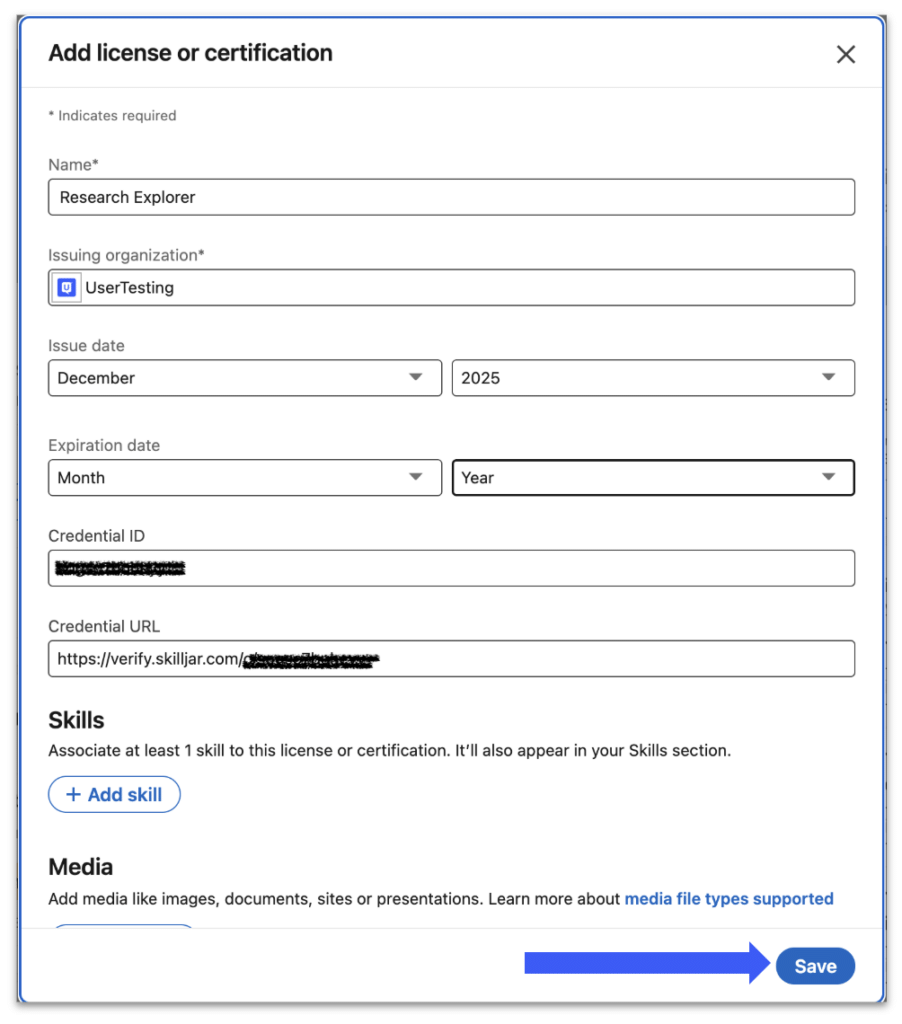
- Choose the option to add a profile section, then look for the Licenses and certifications option, usually under Recommended.
- Fill in the fields.
- Name: Emergency First Aid at Work (Level 3 Award, RQF), or the exact title on your certificate.
- Issuing organisation: the awarding organisation, or the training provider if the awarding organisation is not listed.
- Issue date: the date you passed.
- Expiration date: the date three years later, or the date shown on your certificate. Only tick the does not expire option if the certificate really has no expiry, which is not the case for EFAW.
- Credential ID: optional. You can add your certificate number if you are comfortable sharing it.
- Credential URL: optional. Add a verification link if your certificate has one.
- Save.
Your certificate will then appear in a section on your profile. You can reorder it so the most relevant certifications appear first.
Extra LinkedIn tips
- Add a skill. Add First Aid, CPR or Emergency Response to your Skills section, if they apply, so recruiters can find you.
- Mention it in your About section. One short sentence is enough, for example: I hold a current Level 3 Emergency First Aid at Work certificate.
- Use it in your headline if it is central to your role. For example, a personal trainer or activity leader may want to mention it. For most people, it is better as a supporting detail than the headline.
- Share a post. If you like, share a short post about completing the course. Keep it simple and positive.
- Tag the provider carefully. If you tag a training provider, make sure it is appropriate and accurate.
- Keep it current. Update the section when you renew, so it never shows an expired certificate as current.
Privacy: What to Share and What to Keep Private
Be sensible about personal information.
- Certificate number. It is optional on LinkedIn. If you are not comfortable making it public, leave it out. You can give it privately when an employer asks.
- Photos of the certificate. Avoid posting images that show personal details such as your date of birth, address or any ID numbers.
- Home address and contact details. Never add them to a certificate entry.
- Verification links. Only add them if they do not expose more than you intend.
You can always say on request that you can provide a copy.
How to Add It to Your CV
On a CV, the key is clarity and honesty. Here is where and how to list it.
Where it goes
- A Qualifications or Certifications section. The most common place.
- A Training section. If you have several short courses.
- Your profile or summary. A short mention if first aid is relevant to the job.
- Your skills list. For example: First aid and CPR.
- Your work experience. If you have acted as a first aider, mention it under the relevant job.
What to include
A clear entry has four parts.
- The qualification title.
- The awarding organisation or training provider.
- The date achieved.
- The expiry date or validity, so employers can see that it is current.
Example entries
Here are some ready to copy lines. They are examples only, so replace the details with your own. They are written without dashes, so they are easy to paste.
Short version
Emergency First Aid at Work, Level 3 Award (RQF), [awarding organisation], October 2026. Valid until October 2029.
Version with provider and location
Level 3 Award in Emergency First Aid at Work (RQF), awarded by [awarding organisation], delivered by [training provider], London. Achieved October 2026, valid for three years.
Version for a work experience entry
Nominated workplace first aider, trained in Emergency First Aid at Work, responsible for responding to incidents and checking the first aid kit.
Version for a skills list
First aid and CPR, including AED use, trained to Emergency First Aid at Work standard.
What to Include About Your Skills
If the job benefits from first aid, you can add a short line describing what you can do. For example: trained to assess an incident safely, give adult CPR, use an AED, place someone in the recovery position, help a choking adult, control serious bleeding, manage shock and treat minor injuries. Keep it brief, and match the line to the job.
Tailoring It to Different Roles
How you present it can vary.
- Fitness and sport. Put it near the top, alongside coaching or instructor qualifications.
- Education and youth work. List it with safeguarding and other training. If you work with young children, remember that paediatric first aid may be needed as well.
- Hospitality and retail. Mention it in your skills or profile, as it shows customer care and calm under pressure.
- Office roles. List it as an extra qualification, especially if you are willing to become the office first aider.
- Care and support work. Show it alongside other care qualifications.
- Events and activity work. Put it prominently, since clients often require it.
- Freelancers. Add it to your CV, your website and your proposals, with the expiry date.
Using It in a Cover Letter and Interview
A certificate gives you something concrete to talk about.
- In a cover letter. One sentence is enough, for example: I hold a current Emergency First Aid at Work certificate and am happy to act as a first aider.
- At interview. Be ready to explain what the course covered and how you would apply it. Employers like to hear that you understand your limits, for example that a first aider helps until professional help arrives and does not diagnose or give medical treatment.
- If asked for proof. Say that you can provide a copy of your certificate, and have a digital copy ready.
Be Honest: Dos and Don’ts
Accuracy matters, especially for a safety qualification.
Do
- Use the exact title on your certificate.
- Show the real dates.
- Update your profile and CV when you renew.
- Remove or mark the entry as expired if you do not renew.
- Be ready to show proof.
Do not
- List a certificate you do not hold.
- Describe an attendance letter or an online certificate as a Level 3 qualification.
- Leave an expired certificate showing as current.
- Claim to be a qualified first aider when your certificate has expired.
- Exaggerate what the course covers. For example, it does not make you a medical professional.
Employers often check certificates, and presenting something misleading can have serious consequences, including for your job prospects. For more on this, see our guide on whether employers check emergency first aid certificates.
What If Your Certificate Expires?
An EFAW certificate is valid for three years, and there is no general grace period. Once it expires, you should update your profile and CV.
- On LinkedIn. The expiry date will usually show automatically. Update the entry when you renew, or remove it.
- On your CV. Change the date, or note that you are renewing. Do not leave an expired certificate looking current.
- If you are about to renew. You can write that you are booked on a renewal course, with the date, though your qualification technically ends at expiry.
A renewal means retaking the one day course, which includes at least six hours of training time, not counting breaks, according to HSE guidance. HSE recommends a short yearly refresher, although it is not a legal rule, and a refresher does not extend the certificate. You can add refreshers to your CV as training, described accurately, for example as a refresher or attendance, not as a new qualification.
Keeping Your Record Tidy
A few habits make it easy.
- Save a digital copy of your certificate in two places.
- Put your expiry date in your calendar, with reminders six months and three months before.
- Set a reminder to update LinkedIn and your CV after each renewal.
- Keep your training provider and awarding organisation details handy.
For a fuller routine, see our guide on how to keep track of your first aid certificate expiry date.
Choosing a Course That Employers Respect
To make sure your certificate adds value, choose a good course.
- A regulated Level 3 Award in Emergency First Aid at Work (RQF) from a recognised awarding organisation.
- At least six hours of training time, not counting breaks.
- Practical training and in person assessment. HSE guidance expects this for a workplace first aider, so online only certificates are often not accepted.
- Qualified, experienced trainers.
- Sensible class sizes. Many awarding organisations set a maximum of around 12 learners per trainer.
- A clear certificate that can be verified.
HSE stopped approving first aid training providers in 2013, so be cautious of any claim that a course is HSE approved. In London in 2026, public prices for a one day course commonly range from about £65 to £150 per person. One provider page, linked above, lists £89 per person for classroom training and £75 per person for groups of five or more, at the time of writing in October 2026. Prices change, so always confirm. You can review the Emergency First Aid at Work training page to see how one provider presents its course, price and booking options.
For Employers: Encouraging Staff to Keep Profiles Honest
If you manage first aiders, remind them to keep professional profiles accurate, and keep your own records separate. As a starting point for low hazard workplaces, HSE suggests at least one appointed person for fewer than 25 employees, at least one first aider trained in Emergency First Aid at Work for 25 to 50 employees, and at least one first aider trained in First Aid at Work for every 100 employees above that, or part of 100. Higher hazard workplaces need more. A first aid needs assessment gives the best answer. Your internal training record, not a social profile, is what shows your first aid cover.
Why London Candidates Benefit
London has a very competitive job market, with many candidates for each role. A valid first aid certificate is a simple, affordable way to stand out, especially in roles that involve the public, teams or events. London also has a very large number of training providers and dates, and many deliver training at your workplace, which makes it easy to get certified. With busy roads and crowded transport, employers value people who can respond calmly in an emergency.
Final Thoughts
So, can you add an EFAW certificate to your LinkedIn profile and CV? Yes. On LinkedIn, use the Licenses and certifications section with the exact title, the awarding organisation, the issue date and the expiry date. On your CV, list it under Qualifications or Training with the same details. Keep it honest, keep it current and keep private details private.
A certificate that you can prove, and that is in date, is a quiet but useful advantage. When you are ready to get or renew yours, take a look at the Emergency First Aid at Work course in London and choose a date that suits you.
Frequently Asked Questions
1. Can I add my Emergency First Aid at Work certificate to LinkedIn?
Yes. Use the Licenses and certifications section. Add the exact qualification title, the awarding organisation or provider, the issue date and the expiry date. A credential ID and a verification link are optional.
2. How do I list a first aid certificate on a CV?
Put it under Qualifications, Certifications or Training. Include the qualification title, the awarding organisation or provider, the date achieved and the expiry date or validity, so employers can see that it is current.
3. Should I include the expiry date?
Yes. An EFAW certificate is valid for three years, and showing the expiry date tells employers that it is current. On LinkedIn, use the expiration date field. Do not tick does not expire for EFAW.
4. Is it safe to share my certificate number on LinkedIn?
It is optional. If you are not comfortable making it public, leave it out and share it privately when an employer asks. Avoid posting images of your certificate that show personal details.
5. What should I do when my first aid certificate expires?
Update or remove the entry on LinkedIn and your CV so it does not look current. You can note that you are booked on a renewal course, but your qualification ends at expiry. Renewal means retaking the one day course.
6. Can I list an online or attendance certificate as a qualification?
Only describe it accurately. A certificate of attendance or an online CPD certificate is not the same as a regulated Level 3 qualification. List it as training or attendance, with its real title, not as a Level 3 qualification.
7. Will a first aid certificate help me get a job?
It can help, especially in roles in fitness, education, hospitality, retail, care, events and activity work, and for freelancers. It shows responsibility and practical skills, and some roles require it.
8. Where on my CV should the first aid certificate go?
Usually in a Qualifications or Certifications section. If first aid is central to the job, you can also mention it in your profile or summary, your skills list and the relevant work experience.
9. How do I describe my first aid skills without exaggerating?
Keep it factual: trained to assess an incident safely, give adult CPR, use an AED, place someone in the recovery position, help a choking adult, control serious bleeding, manage shock and treat minor injuries. Do not suggest that you are a medical professional.
10. Where can I take an Emergency First Aid at Work course in London?
You can book through a training provider that offers the regulated qualification, either as a public course or as training at your workplace. Check the awarding organisation, the practical assessment, what the certificate will show and the total price before you book.