Every workplace needs a first aid kit, but many people could not say what is inside theirs. Is it a green box in the staff kitchen? Does anyone know whether the plasters are in date? Has the kit been opened since the last time someone cut a finger? A kit that is empty, out of date or hidden in a cupboard is not much use when a colleague is bleeding.
In this guide, we explain in plain English what should be in a workplace first aid kit, what the law and HSE guidance actually require, how to choose and place your kits and how often to check them. We also show how it connects to what you learn on an Emergency First Aid at Work (EFAW) course in London. If you want to see a real course page as you read, here is the Emergency First Aid at Work course in London.
The Short Answer
There is no single legal list of what a workplace first aid kit must contain. HSE says the contents should be based on your first aid needs assessment. For a low hazard workplace, HSE gives a suggested minimum list of items such as plasters, sterile wound dressings, triangular bandages, eye pads, safety pins, disposable gloves and a guidance leaflet. Kits should not contain tablets or medicines. You should check your kits regularly, restock them after use and replace items that are past their expiry dates. HSE does not set a fixed checking interval, but many workplaces check monthly or at least every few months, and always after use.
What the Law Says
The Health and Safety (First Aid) Regulations 1981 require employers to provide adequate and appropriate first aid equipment, facilities and people for their employees. HSE guidance explains that the minimum first aid arrangements for any workplace are:
- A suitably stocked first aid kit.
- An appointed person to take charge of first aid arrangements.
- Information for employees about first aid arrangements.
The law does not give an exact list of contents, because workplaces differ. A small office and a busy kitchen need different things. That is why the contents should come from your first aid needs assessment, which looks at your hazards, the number of people, your layout and your working patterns.
HSE’s Suggested Minimum Contents
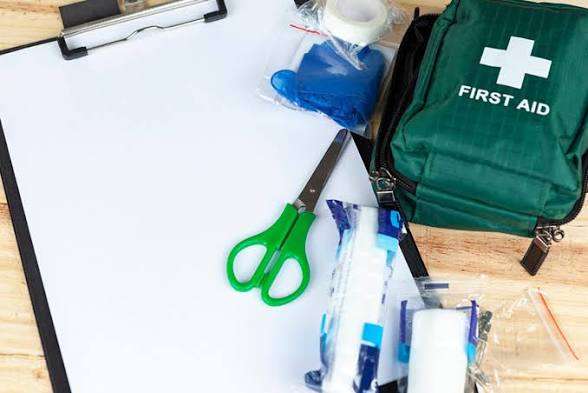
HSE guidance gives a suggested minimum stock for a low hazard workplace, such as an office or a shop, where there is no special risk. A typical list is:
- A leaflet giving general advice on first aid.
- Individually wrapped sterile adhesive dressings, also called plasters, in a range of sizes suitable for your workplace. In food handling areas, they should be blue.
- Sterile eye pads, two.
- Individually wrapped triangular bandages, ideally sterile, usually four.
- Safety pins, usually six.
- Medium sized sterile, unmedicated wound dressings, individually wrapped, usually six.
- Large sterile, unmedicated wound dressings, individually wrapped, usually two.
- Disposable gloves, at least one pair.
These quantities are a guide for a small number of employees, and HSE notes that where there are more people, you will need more. They are not a legal minimum, and your assessment may call for more or different items.
Other Items You Might Add
HSE says that equipment such as the following may also be kept in the first aid container, if the first aider has been trained to use it:
- Scissors.
- Tweezers.
- Adhesive tape.
- Disposable aprons.
- Individually wrapped moist wipes, for cleaning the skin around a wound.
- A face shield or pocket mask for rescue breaths.
- Foil blankets for warmth.
- A resuscitation face shield.
- A waterproof bag for waste.
- Eye wash, see below.
- A notebook and pen for recording what happened.
The key phrase is if the first aider has been trained to use it. A pair of scissors is useful, but an untrained person might misuse some items. Training helps you decide what to include.
What Should NOT Be in the Kit
- Tablets and medicines. HSE guidance says that first aid kits should not contain tablets or medicines, such as painkillers or antihistamines. A first aider should not give them. People can use their own prescribed medicines, and may help someone use their own inhaler or auto injector.
- Creams, sprays and antiseptic lotions, unless your assessment and training support their use. They are not part of the standard list.
- Out of date or open sterile items. Once a sterile pack is opened or its seal is damaged, it is no longer sterile.
- Cotton wool. Loose fibres can stick to wounds.
- Personal items. The kit is for first aid only.
British Standard Kits: BS 8599 1
Many suppliers sell first aid kits that comply with a British Standard, BS 8599 1, which sets out the contents of workplace kits in sizes. These are commonly described as small, medium and large, intended for roughly 1 to 25, 26 to 100 and 101 to 200 people, though you should check the standard and the supplier’s description. HSE guidance says that kits meeting this standard are one way to meet your needs, but it is not a legal requirement to use them. What matters is that your kit matches your needs assessment.
A kit that meets BS 8599 1 usually also has a labelled, clean container, a contents list and an expiry date label for sterile items, which are helpful features.
Special Kits for Special Situations
Travel and mobile workers
People who drive, work alone, work outdoors or visit customer sites need a kit they can carry. Small travel kits, with essentials for a vehicle or a bag, are available. Lone workers should know where theirs is, and how to call for help.
Vehicles
Work vehicles should have a kit, especially minibuses, delivery vans and site vehicles. Check them as part of vehicle checks.
Kitchens and food areas
In kitchens and food handling areas, use blue plasters, so they can be seen if they fall into food, and consider metal detectable plasters if your food safety plan calls for them. Burns and cuts are common in kitchens, so consider larger dressings, cling film for burns and easy access to cool running water. See our guide on how to treat a burn in the workplace.
Workshops, sites and higher hazard workplaces
Where there is a risk of serious injury, such as heavy machinery, sharp tools, chemicals or heights, your needs assessment may call for larger dressings, more bandages, foil blankets, eye wash, burn dressings and larger stocks. Higher hazard workplaces usually need more first aiders and more equipment.
Chemical hazards and eye injuries
If chemicals are used, consider eye wash. HSE guidance says that where mains tap water is not readily available for eye irrigation, at least a litre of sterile water or sterile normal saline, in sealed disposable containers, should be provided. Once the sterile seal is broken, the container should not be kept for reuse. Eye baths, eye cups and refillable containers should not be used. Check the safety data sheets for your chemicals.
Public facing workplaces
Shops, gyms, schools, hotels and other places with visitors may need more supplies, because first aid is likely to be needed for non employees as well. HSE strongly recommends including the public in your first aid planning.
Remote and shared workplaces
In shared or serviced offices, find out who is responsible for the building’s first aid kit and whether it covers your staff, and agree arrangements in writing.
How Many Kits Do You Need?
There is no fixed number. Think about:
- Number of employees, and how many are on site at once.
- Layout. Several floors, buildings or distant areas may each need a kit, so help is quick to reach.
- Hazards. Higher risk areas may need their own kit.
- Shifts and out of hours working. A kit must be available whenever people work.
- Distance from medical help.
- Lone and remote workers.
- Visitors and the public.
A simple rule is that anyone should be able to reach a kit quickly, without walking far or finding a key.
Where to Put Your First Aid Kits
The best kit is the one people can find. Good practice is to:
- Place it where it is easy to reach. Near hazards, kitchens, workshops, reception and each floor.
- Make it visible. Use the standard first aid sign, a white cross on a green background, so people can spot it.
- Do not lock it away. If a key is needed, make sure everyone knows who has it.
- Keep it clean, dry and protected. Use a waterproof container, and away from heat and damp, which can damage sterile items.
- Tell everyone where it is. In inductions, notices and staff briefings.
- Put the first aider list and emergency numbers nearby.
Who Is Responsible for the Kit?
HSE guidance says that an appointed person should take charge of first aid arrangements, including looking after the first aid equipment and facilities. In practice, name a person, and a backup, who is responsible for checking and restocking the kit. Make sure they know what to do, and that staff know to tell them when items are used.
How Often Should a First Aid Kit Be Checked?
HSE guidance says that you should check kits regularly, make sure there are sufficient quantities, replace used items and replace anything past its expiry date. HSE does not set a specific number of days. So the interval is a judgement for your workplace, but good practice suggests:
- After every use. Restock anything used straight away.
- At least monthly in busy or higher risk places. Kitchens, workshops, sites, shops and public facing places.
- At least every three months in low risk places. Small offices with little use.
- Before any holiday or busy period. To make sure that stocks are full.
- When you move office, change layout or hire more staff.
- When your needs assessment changes.
If you are unsure, monthly checks are simple, quick and hard to get wrong. Choose an interval you will actually keep.
A Simple Checking Routine
Here is a routine you can copy.
- Find the kit and check it is in the right place, visible and accessible.
- Check the container. Clean, dry, undamaged, with the lid closing properly.
- Check the contents against your list. Make sure that each item is present, in the right quantity and individually wrapped where needed.
- Check expiry dates. Look at sterile dressings, bandages, eye pads, wipes, eye wash and any other dated items. Replace anything that is out of date or has damaged packaging.
- Check for damp, dirt or damage. Replace items that have been exposed.
- Remove anything that should not be there, such as tablets or personal items.
- Restock. Top up anything missing or used.
- Update the contents list and the date of the check. Sign and date a checklist, and keep it with the kit.
- Check related items. Eye wash, foil blankets, face shields, any AED and its pads and battery, and cooling supplies in kitchens.
- Tell staff of any changes. For example, if the kit has moved.
A Sample Checklist You Can Copy
Here is a simple layout, written as a list so you can paste it into a document or spreadsheet.
- Kit location:
- Date of check:
- Checked by:
- Container clean, dry and undamaged: yes or no
- Guidance leaflet present: yes or no
- Plasters, assorted sizes, in date: quantity and expiry
- Blue plasters, where needed: quantity and expiry
- Sterile eye pads: quantity and expiry
- Triangular bandages: quantity and expiry
- Safety pins: quantity
- Medium wound dressings: quantity and expiry
- Large wound dressings: quantity and expiry
- Disposable gloves: quantity
- Other items such as scissors, wipes, foil blanket and face shield: quantity and expiry
- Eye wash, if provided: quantity and expiry
- Items removed or replaced:
- Items to order:
- Next check due:
Keep the completed checklists as a simple record that you check your kits.
Restocking After Use
When a first aider uses items from the kit, make it easy to restock.
- Ask first aiders to note what they used, in the accident record or on a slip inside the kit.
- Replace items straight away, not at the next scheduled check.
- Keep a small stock of spares. In a cupboard, so restocking is quick.
- Dispose of used items safely. Put contaminated waste in a bag and follow your employer’s procedure. Wash hands afterwards.
- Keep the accident record up to date. Some serious injuries must be reported to the authorities under the Reporting of Injuries, Diseases and Dangerous Occurrences Regulations, often called RIDDOR, and your employer decides what is needed.
Common Mistakes to Avoid
- A kit nobody checks. Contents run out, and sterile items expire.
- A kit in a locked room, or one that nobody can find.
- Medicines in the kit. Tablets should not be there.
- Reusing opened sterile items.
- Using the wrong plasters in food areas.
- One kit for a large, multi floor site.
- No kit for vehicles or lone workers.
- Equipment that nobody is trained to use.
- Forgetting the AED. If you have one, check its pads and battery.
- Not telling staff where the kit is.
- Not linking the kit to the needs assessment. The contents should reflect your risks.
Where an EFAW Course Fits
An Emergency First Aid at Work course teaches you how to use the things in a first aid kit. You practise controlling serious bleeding with dressings and bandages, dealing with minor injuries such as small cuts and burns, wearing gloves and preventing infection, using a face shield for rescue breaths, treating shock with warmth, and recording what you did. Trainers often explain what items should be in a kit and why, which helps you check and restock it with confidence.
The course is a one day, regulated Level 3 qualification, and HSE guidance says it should include at least six hours of training time, not counting breaks. You also learn how to assess an incident safely, give adult CPR, use an AED, place someone in the recovery position and help a choking adult. The certificate is valid for three years. HSE strongly recommends a short refresher each year, although it is not a legal requirement.
How Many First Aiders Does Your Workplace Need?
A good kit works best in the hands of a trained person. As a starting point for low hazard workplaces, HSE suggests at least one appointed person for fewer than 25 employees, at least one first aider trained in Emergency First Aid at Work for 25 to 50 employees, and at least one first aider trained in First Aid at Work for every 100 employees above that, or part of 100. Higher hazard workplaces need more. A first aid needs assessment gives the best answer. Many employers also train an extra person to cover holidays and sickness.
Choosing a Good Course in London
Look for:
- A regulated Level 3 Award in Emergency First Aid at Work (RQF) from a recognised awarding organisation.
- At least six hours of training time, not counting breaks.
- Hands on practice with dressings, bandages and gloves.
- Practical assessment in person. HSE guidance expects this for a workplace first aider, so online only courses are generally not suitable.
- Qualified, experienced trainers.
- Small classes. Many awarding organisations set a maximum of around 12 learners per trainer.
- A clear certificate and a clear total price.
HSE stopped approving first aid training providers in 2013, so be cautious of any claim that a course is HSE approved. In London in 2026, public prices for a one day course commonly range from about £65 to £150 per person. One provider page, linked above, lists £89 per person for classroom training and £75 per person for groups of five or more, at the time of writing in October 2026. Prices change, so always confirm. You can review the Emergency First Aid at Work training page to see how one provider presents its course, price and booking options.
Why London Workplaces Need Well Kept Kits
London workplaces are busy, tightly packed and often spread over several floors, with shared kitchens, stairs and visitors. Roads and public transport can be congested, so ambulances may take time to arrive, and a well stocked kit within easy reach helps first aiders act in those first minutes. There is also a very large number of training providers and dates in London, and many deliver training at your workplace, which is a practical way to teach a whole team where the kit is and how to use it.
Final Thoughts
So, what is in a workplace first aid kit, and how often should it be checked? There is no single legal list, but HSE suggests, for a low hazard workplace, items such as plasters, sterile wound dressings, triangular bandages, eye pads, safety pins, disposable gloves and a guidance leaflet, with no tablets or medicines. Your needs assessment should decide the real contents. Check kits regularly, restock after every use and replace anything past its expiry date. Many workplaces check monthly, or at least every few months.
A kit is only useful if it is stocked, in date and easy to find, and if someone knows how to use it. When you are ready to learn with a trainer, take a look at the Emergency First Aid at Work course in London and choose a date that suits you.
Frequently Asked Questions
1. What should be in a workplace first aid kit?
There is no single legal list, but HSE suggests for a low hazard workplace a guidance leaflet, individually wrapped sterile plasters in assorted sizes, sterile eye pads, triangular bandages, safety pins, medium and large sterile wound dressings and disposable gloves. Your first aid needs assessment decides the final contents.
2. Is there a legal list of first aid kit contents?
No. The Health and Safety (First Aid) Regulations 1981 require adequate and appropriate first aid equipment, but do not list the contents. HSE gives suggested minimums, and the contents should reflect your needs assessment.
3. Should a first aid kit contain painkillers or other medicines?
No. HSE guidance says that first aid kits should not contain tablets or medicines. A workplace first aider should not give them. People can use their own prescribed medicines, and a first aider may help them use their own inhaler or auto injector.
4. How often should a workplace first aid kit be checked?
HSE says to check kits regularly, restock after use and replace items past their expiry date, but does not set a fixed interval. Good practice is to check after every use, at least monthly in busy or higher risk places and at least every three months in low risk places.
5. Who is responsible for checking the first aid kit?
HSE guidance says that an appointed person should take charge of first aid arrangements, including looking after the equipment. Name a person and a backup to check and restock the kits, and make sure staff know to report used items.
6. How many first aid kits does my workplace need?
There is no fixed number. Think about how many people are on site, the layout, the hazards, shifts, lone workers, visitors and distance from medical help. Anyone should be able to reach a kit quickly. Large or multi floor sites often need more than one.
7. Do I need a BS 8599 1 kit?
It is not a legal requirement. BS 8599 1 is a British Standard for first aid kit contents, and many suppliers sell compliant kits in small, medium and large sizes, which is one way to meet your needs. What matters is that the kit matches your needs assessment.
8. Do I need eye wash in my first aid kit?
If chemicals are used, consider it. HSE guidance says that where mains tap water is not readily available for eye irrigation, at least a litre of sterile water or sterile normal saline in sealed disposable containers should be provided. Do not reuse containers once opened, and do not use refillable eye baths.
9. What colour should plasters be in a kitchen?
Blue. In food handling areas, blue plasters are recommended so that they can be seen if they fall into food. Some food businesses also use metal detectable plasters, depending on their food safety plans.
10. Where can I learn how to use a first aid kit in London?
You can book an Emergency First Aid at Work course through a training provider that offers the regulated qualification, either as a public course or as training at your workplace. Check the practical content, the awarding organisation, the class size and the total price before you book.