If you are looking to start a career in the private security industry in London, you have likely come across terms like “accredited training,” “certification,” and “SIA licensing.” While these terms are often used interchangeably, understanding the difference is key to ensuring you choose a legitimate training provider and embark on a legal, rewarding career path.
In this guide, we will break down exactly what these standards mean, why they matter for your career, and the specific steps you need to take to become a licensed Door Supervisor in the United Kingdom.
1. Accreditation vs. Certification: What’s the Difference?
When you search for a door supervisor course in London, you will see many providers claiming to be “accredited.” Knowing the difference between accreditation and certification helps you identify high-quality training.
What is Certification?
Certification is the formal recognition that an individual or a course meets a specific standard. In the security industry, after you complete your training and pass your assessments, you receive a certificate of completion for a “licence-linked qualification.” This document proves to the Security Industry Authority (SIA) that you have the required knowledge and practical skills to perform your job safely.
What is Accreditation?
Accreditation is the “check of the checkers.” It is a higher-level process where an authoritative body (such as a government-backed regulator or an awarding organization) verifies that a training provider is competent, impartial, and follows the correct curriculum.
When a course is “SIA-approved,” it means the training provider has been vetted by an awarding organization that is recognized by the SIA. This ensures the training you receive is reliable, consistent, and legally recognized across the UK.
Key Takeaway: Always ensure your chosen training provider is an SIA-approved training provider. This guarantees that the certification you receive at the end is accepted by the SIA for your licence application.
2. Why Licensing Matters in London
In the United Kingdom, the private security industry is strictly regulated by the Security Industry Authority (SIA). If you are working on the door of a pub, club, or any licensed venue, you are legally required to hold a valid front-line SIA Door Supervisor licence.
Operating without this licence is a criminal offense. Beyond the legal necessity, the licence provides:
- Professional Credibility: It shows employers that you have passed rigorous background and identity checks.
- Employment Opportunities: Most reputable security firms in London will only hire candidates who hold a valid, current SIA badge.
- Safety Standards: It ensures that you are trained in conflict management and physical intervention, keeping both you and the public safe.
3. The Door Supervisor Course: What to Expect
The training course for a Door Supervisor licence is designed to be comprehensive. It typically takes about 6 days to complete and covers four primary units.
Unit 1: Working in the Private Security Industry
This covers the legal framework, including the Private Security Industry Act 2001, human rights, health and safety, and fire safety. You will learn the importance of your role and the professional standards required.
Unit 2: Working as a Door Supervisor
This module focuses on the day-to-day realities of the job. You will learn about:
- Licensing laws.
- Searching procedures.
- Arrest techniques.
- Drugs awareness and reporting incidents.
- Protecting vulnerable individuals and recognizing signs of exploitation or abuse.
Unit 3: Conflict Management
Conflict is a part of the job in busy London nightlife venues. You will learn how to:
- Avoid conflict through effective communication.
- Defuse tense situations before they turn physical.
- Reduce personal risk.
Unit 4: Physical Intervention
This is the practical, hands-on portion of the training. You will be taught safe, legal, and proportionate methods for restraining or escorting individuals when necessary. It is crucial for ensuring you can protect the public and yourself without exceeding the law.
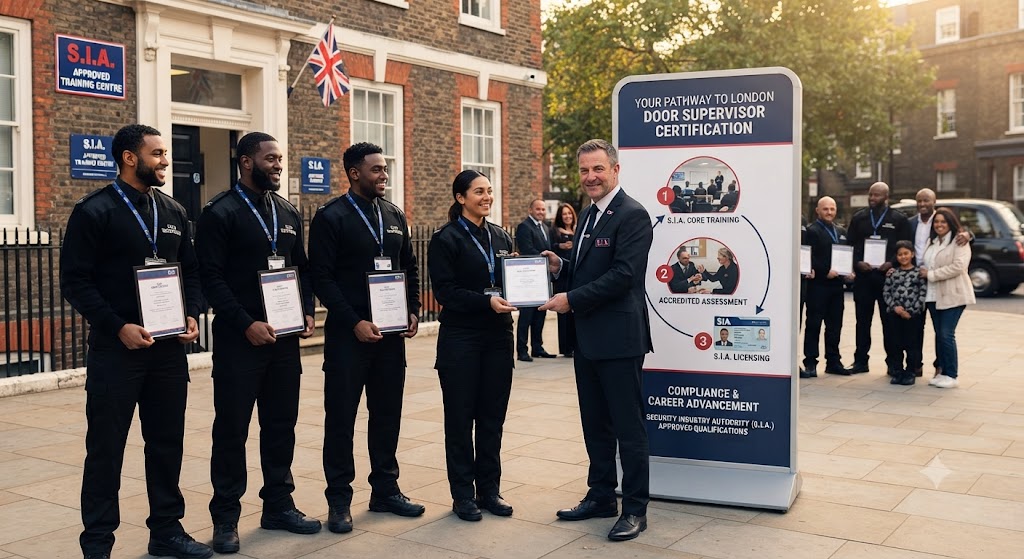
4. How to Become a Door Supervisor in London: A Step-by-Step Guide
If you are ready to start your journey, follow these steps in order to ensure you meet all regulatory requirements.
Step 1: Meet the Requirements
Before booking, ensure you meet the basic criteria:
- Age: You must be 18 or older.
- Right to Work: You must have the legal right to work in the UK.
- English Language Skills: You must be able to communicate effectively in English, as the course and the exams require it.
Step 2: Complete Your First Aid Training
The SIA requires you to have a valid Emergency First Aid at Work (EFAW) qualification (or higher) before you can take the door supervisor training. If you do not have this, your training provider can often bundle it with your course.
Step 3: Choose an SIA-Approved Provider
Use the official SIA website to find a training center in London. When comparing providers, check their:
- Reviews: Look for feedback from past students.
- Pass Rates: Reputable centers are transparent about their training success.
- Support: Do they offer mock exams or extra support for the theory units?
Step 4: Pass the Exams and Practical Assessments
Your course will culminate in multiple-choice exams and a practical assessment. Focus on your revision for the theory units and participate fully in the physical intervention exercises.
Step 5: Apply for Your SIA Licence
Once you pass the course, you will receive your certificate. You must then:
- Create an online account on the official GOV.UK/SIA portal.
- Submit your application and pay the licence fee (currently £204).
- Complete identity and background checks (this often involves a visit to the Post Office).
- Wait for processing: This can take a few weeks. Once approved, your physical badge will be mailed to you.
5. Tips for Success in the London Security Market
London is a competitive, fast-paced city. To stand out after you receive your licence:
- Highlight Soft Skills: Emphasize your customer service abilities, communication skills, and conflict resolution experience on your CV.
- Network: Connect with local security agencies and event companies.
- Stay Updated: Regulations, especially regarding safety and anti-spiking measures, can change. Keep your knowledge sharp.
- Maintain Your Badge: Your licence is valid for three years. Keep your contact details updated with the SIA to ensure you receive renewal reminders on time.
By choosing an accredited training path and staying committed to the professional standards set by the SIA, you are building a solid foundation for a long and successful career in the security industry.
Disclaimer: This article is for informational purposes only. Licence fees, legislation, and application processes can change. Always refer to the official Security Industry Authority (SIA) website for the most current information