If you want to work in security in London, you have probably asked yourself one simple question: should I buy the Door Supervisor course and the first aid course together, or pay for them one by one? Money matters when you are starting a new career, and training costs can add up fast.
In this guide, we look at how combined pricing works, where the real savings are, and where a “bundle” may not be as cheap as it looks. We also explain why an Emergency First Aid at Work Course London is a key part of this journey, and how to choose the right option without wasting money.
Why First Aid Matters for Door Supervisors
A door supervisor looks after people at pubs, clubs, bars, events, and other busy places. The job is not only about checking bags or managing queues. It also means keeping people safe. Crowds, alcohol, loud music, and tense moments can lead to falls, fights, fainting, choking, and even cardiac arrest.
Because of this, first aid is a required part of becoming a licensed door supervisor in the UK. The Security Industry Authority, known as the SIA, asks applicants for a Door Supervisor licence to hold a valid first aid certificate. The first aid course must meet SIA rules, so always check the latest requirements on the official SIA website before you book anything.
This is the reason why so many training providers sell the two courses together. They know most students need both.
What Does a Door Supervisor Course Include?
The Door Supervisor course is a Level 2 qualification for the private security industry. It usually runs over several days. Exact timings depend on the provider, so you should always ask for the full schedule.
The course often covers:
- The role and responsibilities of a door supervisor
- Basic UK law and how it applies to security work
- Searching people and bags in a safe and lawful way
- Handling conflict and calming tense situations
- Physical intervention skills, taught safely
- Emergency procedures such as fire and evacuation
- Counter terrorism awareness
- Safe working practices and record keeping
Students take exams at the end. These are usually multiple choice questions and a practical assessment, and the provider will explain this before you start.
What Does an Emergency First Aid at Work Course Include?
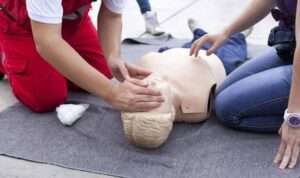
Emergency First Aid at Work, often shortened to EFAW, is a one day course. It teaches simple and practical skills that anyone can learn. You do not need any medical background.
On the course, you learn how to:
- Check for danger before you help someone
- Call the emergency services at the right time
- Give CPR to an adult who is not breathing
- Use an automated external defibrillator, also called an AED
- Help a person who is choking
- Control serious bleeding
- Place an unconscious person in the recovery position
- Treat shock, burns, cuts, and small injuries
The certificate is normally valid for three years. You can read more about how this training works on the Emergency First Aid at Work course page from Betrain.
How Combined Pricing Usually Works
A combined package means a training provider offers the Door Supervisor course and the first aid course in one booking. Instead of paying two separate prices, you pay one package price. Many providers set this package price lower than the two separate prices added together.
Here is a simple example to show the idea. These numbers are only for illustration and are not real prices.
- Door Supervisor course on its own: Price A
- First aid course on its own: Price B
- Combined package: a little less than A plus B
The difference between the two is your saving. In many cases, providers give a small discount, because they want to win your full booking rather than just one course.
Some providers go further. They may include extras such as free exam retakes, study materials, or help with the licence application. These extras do not always show up in the headline price, but they can still save you money.
So, Is the Combined Package Really Cheaper?
The honest answer is: often yes, but not always. Whether a bundle is cheaper depends on a few things. Let us go through them one by one.
1. The discount may be real, or it may be small
Some providers give a clear and fair discount. Others add a tiny reduction that barely changes the total. Always add up the separate prices yourself and compare them with the package price. Do this on paper before you decide.
2. You may already have a first aid certificate
Many people already hold a valid first aid certificate from a previous job or a past course. If yours is still in date and meets SIA rules, you may not need to buy first aid again. In that case, a combined package could cost you more than needed.
Check your certificate carefully. Look at the expiry date, the course name, and the awarding body. If you are unsure, ask the SIA or your training provider before you spend any money.
3. Hidden fees can change the picture
A low headline price can hide extra costs. Look out for these:
- Exam fees that are not included
- Fees for retaking a failed test
- Charges for course materials or a workbook
- Costs for ID checks or passport photos
- The SIA licence fee, which is paid separately to the SIA
A package that looks cheap may end up costing more once these are added. A clear provider will list everything in plain words.
4. Time is also money
When you book two courses separately, you may have to take extra days off work or find two sets of dates. A combined package often fits both courses into a smooth plan. This can save you travel costs and lost wages. If you work in a job that pays by the day, this saving can be larger than the discount itself.
5. Quality matters more than a small saving
A very cheap course is not a good deal if the training is poor. A weak trainer, a crowded room, or too little hands on practice can leave you unprepared for both the exam and the real job. Saving a small amount is not worth failing a test and paying again.
Buying Separately: When It Can Make Sense
Combined packages are not always the best choice. Buying the courses separately can be smarter in some cases.
You want to pick the best provider for each course. One company may be excellent at door supervisor training, while another may offer a more convenient first aid date near your home or work.
You need first aid sooner. If your first aid certificate is about to expire, or you need it for another job, you may want to book it quickly on its own.
You already have one of the two. There is no need to pay for something you already hold.
Your budget is tight right now. Paying for one course at a time can spread the cost over a longer period. A combined package asks you to pay a larger amount at once, although some providers offer payment plans.
A Simple Way to Compare Prices
Use these steps to find the best deal in London.
- Write down what you need. Do you need both courses, or only one?
- Ask for full prices. Request the price of each course alone and the combined package price.
- Ask what is included. Check exam fees, materials, certificates, and retakes.
- Add up the true total. Include travel, time off work, and any extra fees.
- Compare the real savings. Look at the difference between buying together and buying apart.
- Check the provider. Make sure the trainers are qualified and the certificates are recognised.
- Read reviews. Look for honest feedback from past students.
This takes a little time, but it can save you from a poor choice.
Why London Is a Special Case
London has more security jobs than almost any other city in the UK. Pubs, clubs, hotels, concert venues, sports grounds, and festivals all need trained staff. This high demand means many training providers compete for your business. Competition can be good for you, because it leads to fair prices and flexible dates.
However, London also has higher living and travel costs. A course that looks cheap but is far from your home may cost more once you add transport. A good Emergency First Aid at Work Course London option near you, or at a venue that suits your daily route, can save you both money and energy.
Courses in London are also offered on weekdays, weekends, and sometimes evenings. If you already have a job, weekend courses may let you train without losing wages.
What Else Should You Budget For?
Course fees are only part of the cost of becoming a door supervisor. Plan ahead for these items as well:
- The SIA licence fee. This is paid to the SIA and is separate from your training cost.
- Identity documents. You will need valid ID and proof of address for your application.
- Passport style photos. These are needed for your licence.
- Travel. Daily transport to the training venue adds up over several days.
- Clothing. Smart and comfortable clothes help you feel ready for practical sessions.
- Refresher training. Your first aid certificate lasts three years, and your SIA licence also needs renewal after a set period.
When you count all of this, the saving from a combined course package is helpful, but it is only one piece of your total budget.
The Real Value of First Aid for Your Career
Let us look beyond price for a moment. First aid is not just a box to tick for your licence. It can make you a better and more employable security professional.
You become more valuable to employers. A door supervisor who can give CPR or use a defibrillator is a real asset to any venue. Managers like staff who can stay calm and act fast in an emergency.
You can protect people. Venues are busy and unpredictable. A trained person on the door can make the difference between life and death if someone collapses.
You are ready for many settings. First aid skills help you in bars, events, shops, offices, and even at home. They are skills for life.
You build confidence. Knowing what to do in an emergency makes you calmer under pressure. This confidence also helps you handle other difficult moments on the job.
Seen this way, the first aid course is not only a cost. It is an investment in your safety, your reputation, and your future.
How to Choose the Right Training Provider
Price is important, but it should not be your only guide. When you compare providers, look for these signs of quality:
- Clear course details, including dates, hours, and what is covered
- Trainers who are qualified and experienced
- Recognised awarding bodies and valid certificates
- Small class sizes with plenty of hands on practice
- Honest pricing with no surprise fees
- Friendly support before and after the course
- Good reviews from real students
A provider who answers your questions clearly and patiently is usually a good sign. If a company refuses to explain its prices, think twice before booking.
You can see how a clear and trusted provider presents its first aid training on the Emergency First Aid at Work training page.
Common Mistakes to Avoid
Many students make the same errors when they buy training. Avoid these and you will save time and money.
Choosing only the lowest price. A very low fee can mean poor quality or hidden costs later.
Not checking certificate rules. Make sure your first aid certificate meets SIA rules and will still be valid when you apply for your licence.
Booking too early or too late. If you complete first aid long before you apply, your certificate may run closer to its end date. Plan your timing so both courses work together.
Ignoring the full cost. Always count exam fees, the SIA licence, travel, and time off work.
Skipping the small print. Read the terms about refunds, rescheduling, and retakes before you pay.
A Quick Example
Imagine two students in London, Sam and Ali. Both want to become door supervisors.
Sam looks only at the lowest headline price. He books a very cheap course without asking questions. Later, he finds that exam fees and materials are extra. He also has to take two separate weeks off work because the dates do not fit together. His total cost ends up higher than he expected.
Ali takes a little time to compare options. She asks for the full price of each course and the combined package. She learns that the package includes exam fees and a retake. The dates also fit neatly into one plan, so she loses fewer days of work. Her total cost is lower, and her stress is lower too.
The lesson is simple. The cheapest looking price is not always the cheapest in the end. A clear and complete package can be better value.
Final Thoughts
So, is a combined Door Supervisor and first aid course cheaper in London? In many cases, yes. Providers often give a discount when you book both together, and you may also save on time and travel. But the saving is not guaranteed. It depends on your situation, the provider, and what is included in the price.
The best approach is to compare carefully. Check whether you already hold a valid first aid certificate, ask for the full price breakdown, and look at the quality of the training as well as the cost. Remember that first aid is a skill that protects real people, so it deserves your attention.
If you need first aid training for your SIA licence or for your workplace, take a look at an Emergency First Aid at Work Course London option that fits your plans. You can explore the details and book through the Emergency First Aid at Work Course London page, then choose the path that gives you the best value.
Frequently Asked Questions (FAQs)
1. Is a combined Door Supervisor and first aid course cheaper in London?
Often it is, because many providers offer a package discount when you book both courses together. The saving can be small or large depending on the provider. Always compare the combined price with the total of the two separate prices.
2. Do I need a first aid certificate to get a Door Supervisor licence?
Yes, the SIA asks Door Supervisor licence applicants to hold a valid first aid certificate that meets its rules. Check the latest requirements on the official SIA website before you book, as rules can change.
3. How long does an Emergency First Aid at Work course take?
It is normally a one day course, with about six hours of training. Exact timings can differ between providers, so check the course details before you book.
4. How long is a first aid certificate valid for?
An Emergency First Aid at Work certificate is usually valid for three years. After that, you need to retake the course to stay qualified.
5. Can I buy the first aid course separately if I already have the Door Supervisor course?
Yes. Many providers let you book the first aid course on its own. This is a good choice if you only need first aid or want to choose a different provider for each course.
6. What extra costs should I expect besides course fees?
You may need to pay for the SIA licence, exam fees if they are not included, identity documents, passport style photos, and travel. Always ask for a full list of costs before you pay.
7. Is the SIA licence fee included in the course price?
Usually no. The SIA licence fee is paid directly to the SIA and is separate from your training fee. A clear provider will explain this before you book.
8. Can I do first aid training at weekends in London?
Yes, many London training providers offer weekday, weekend, and sometimes evening courses. Weekend dates are useful if you already have a job and want to avoid losing wages.
9. What skills will I learn on an Emergency First Aid at Work course?
You will learn how to check for danger, give CPR, use a defibrillator, help a choking person, stop serious bleeding, and place an unconscious person in the recovery position. You also learn how to treat shock, burns, and small injuries.
10. How do I choose the best first aid training provider in London?
Look for qualified trainers, recognised certificates, clear pricing, small class sizes, and good student reviews. Compare the full cost, including exam fees and travel, rather than only the headline price.
Word count: about 2,500 words, with no hyphens or dashes used in the text. I can also prepare this in a Word file if you want.