
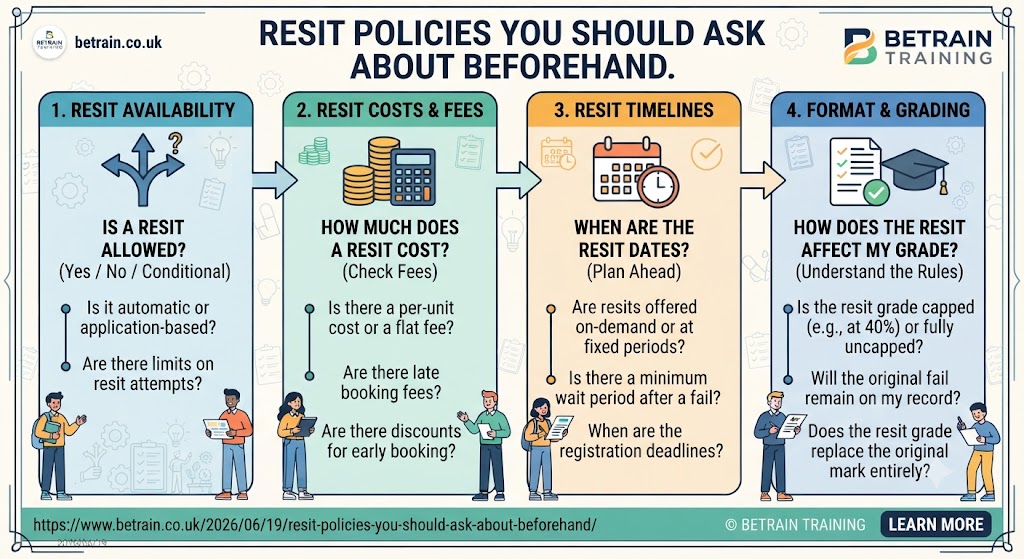
Resit Policies You Should Ask About Beforehand
Before you book a door supervisor course in London, most people focus on the price, the dates, and the location. But one thing that gets overlooked far too often is the provider’s resit policy. Asking about this before you pay for your course can save you money, time, and a lot of stress if you don’t pass on your first attempt. In this guide, we will walk through exactly what questions to ask and why each one matters.
Why Resit Policies Matter More Than You Think
Not everyone passes their exam on the first try, and that is completely normal. What separates a good experience from a stressful one is often how well the training provider handles resits. Some providers make the process simple, affordable, and supportive. Others leave students confused, out of pocket, and waiting weeks for another chance.
If you check the resit policy before booking your door supervisor course in London, you avoid nasty surprises later. It also gives you a good sense of how much the provider actually cares about your success, rather than just taking your money for the initial course.
Question 1: Is a Resit Included in the Course Price?
This is probably the most important question to ask. Some providers include one free resit as part of their course package. Others charge extra, sometimes a small administration fee, and sometimes almost as much as a portion of the original course.
Ask clearly:
- Is my first resit free?
- If not, how much does it cost?
- Does this apply to all three exam units, or only certain ones?
Knowing this upfront helps you budget properly and avoid being caught off guard if you need another attempt.
Question 2: How Many Resits Am I Allowed?
Most providers allow more than one resit, but there is often a limit. After a certain number of failed attempts, some providers require you to retake the full course rather than just resitting the exam. Ask:
- How many resit attempts am I allowed before I need to redo the whole course?
- Does the cost increase for a second or third resit?
Knowing the limit in advance helps you plan how seriously to prepare for each attempt.
Question 3: How Soon Can I Book a Resit Date?
Waiting a long time for a resit can be frustrating, especially if you are eager to start working. Some providers run resit exams every week, while others only offer them once a month. Ask:
- How often do you run resit exam dates?
- Is there a minimum waiting period before I can retake the exam?
- Can I choose a date that fits my schedule easily?
A provider with frequent resit dates means less time waiting around and more chances to get back on track quickly.
Question 4: Do I Need to Redo the Whole Course or Just One Unit?
As covered in earlier guides, the door supervisor course in London usually has three exam units. If you fail one, you typically only need to resit that specific unit, not the entire course. But policies can differ between providers. Ask:
- If I fail one unit, do I only resit that unit?
- If I fail more than one unit, does that change anything?
- Is there a time limit on how long after the original course I can resit without needing to restart everything?
This clarity prevents confusion and unnecessary extra costs.
Question 5: Is There Extra Support Before My Resit?
A good training provider won’t just book you in for another exam and leave you to figure it out alone. Ask if they offer:
- One-on-one revision sessions
- Extra study materials or workbooks
- Mock exams to practice before the real resit
- Feedback on which specific areas you struggled with
Providers that offer this kind of support usually have better long-term pass rates, because they actually help students improve rather than just repeating the same content.
Question 6: What Happens If I Fail the Resit Too?
It is worth asking this question even if you hope you’ll never need the answer. Some providers have a clear plan for students who fail more than once, such as offering additional coaching or a longer revision period before the next attempt. Others may not have a clear process at all. Ask:
- What is your policy if I don’t pass the resit either?
- Will I get any additional support at that stage?
- Is there an extra cost involved?
A provider with a thoughtful answer to this question is generally more trustworthy than one who seems unprepared for the possibility.
Question 7: Does the Resit Policy Cover the Practical Exam Too?
The door supervisor course in London includes both written exams and a practical assessment, usually covering physical intervention techniques. Some providers have different resit rules for the practical part compared to the written units. Ask:
- Is the resit policy the same for the practical exam as for the written units?
- Do I need extra practical training time before resitting that section?
Physical skills often need more hands-on practice, so it helps to know if extra sessions are available.
Question 8: Is There a Deadline for Booking a Resit?
Some providers require you to book your resit within a certain time frame after your original exam, otherwise you may need to redo more of the course. Ask:
- Is there a deadline for booking my resit?
- What happens if I miss that deadline?
This is especially important if you think you might need a few weeks to revise before trying again.
Question 9: Will Failing Affect My SIA Licence Application?
This is a common worry for many students. The honest answer is no. Once you pass your exam, whether it took one attempt or several, your final certificate does not show how many times you tried. Your SIA licence application only requires proof that you passed. Still, it’s worth asking your provider to confirm this clearly, just for peace of mind.
Question 10: Are Resit Policies the Same for Online and In-Person Courses?
Some providers offer a mix of online learning and in-person practical sessions. If part of your door supervisor course in London was completed online, ask whether resit rules are different for the online modules compared to the in-person exam. This is becoming more relevant as some providers offer hybrid learning options.
Comparing Resit Policies Across Providers
Once you have gathered answers to these questions, it becomes much easier to compare providers side by side. Here is a simple way to organise what you find out:
- Cost of first resit – free, low-cost, or full price?
- Number of resits allowed – one, two, unlimited (within reason)?
- Time between attempts – weekly, monthly, or longer?
- Support offered – extra coaching, materials, mock exams?
- Clarity of policy – did they answer your questions clearly and confidently?
A provider that scores well across these areas is generally a safer, more supportive choice, even if their upfront price is slightly higher than a competitor.
Red Flags to Watch Out For
While asking about resit policies, watch out for these warning signs:
- The provider seems unsure or vague about their own policy
- They refuse to put resit terms in writing
- Resit costs are unusually high compared to other providers
- There is no support offered to help you improve before a second attempt
- Reviews mention students struggling to book a resit date
If you notice several of these signs, it may be worth considering a different training provider, even if their initial course price looks appealing.
Why Transparency Matters
A provider who is open and honest about their resit policy is usually more trustworthy overall. Training providers that hide this information, or make it hard to understand, are not necessarily giving you the best experience. Clear, upfront answers show that a provider values your success and wants to be fair with you if things don’t go perfectly on the first try.
Final Thoughts
Asking about resit policies before booking your door supervisor course in London is one of the smartest things you can do. It helps you avoid unexpected costs, understand your options if you don’t pass first time, and choose a provider that genuinely supports its students.
Take the time to ask clear questions about cost, waiting times, support, and limits on resits. A little bit of research now can save you a lot of stress and money later, and help you feel more confident no matter what happens on exam day