If you work in an office, shop, warehouse, or any busy London workplace, you have probably heard the term “EFAW” mentioned when talking about workplace safety. Maybe your manager asked who the appointed first aider is, or you saw a job advert that listed an Emergency First Aid at Work Course London as a requirement. Either way, if you are new to first aid training, the jargon can feel confusing.
This guide breaks EFAW down in plain English. You will learn what the course actually teaches, who legally needs it, how it is different from the longer First Aid at Work (FAW) course, and how to pick a good training provider near you in London. By the end, you will know exactly what to expect from your first EFAW session.
What Is Emergency First Aid at Work (EFAW)?
Emergency First Aid at Work, usually shortened to EFAW, is a one-day workplace first aid course. It is designed to give ordinary employees the confidence and basic skills to act as a first responder if someone at work suddenly becomes ill or gets hurt.
Unlike a medical qualification, EFAW does not try to turn you into a paramedic. Instead, it focuses on the few minutes right after an accident happens, before an ambulance or a more senior first aider arrives. Those early minutes often matter the most, and the course is built around exactly that gap.
The course follows guidelines set by the Health and Safety Executive (HSE), the UK body responsible for workplace safety rules. Once you finish the training and pass the practical assessment, you receive a certificate that is valid for three years. Many UK employers accept this certificate as proof that their workplace meets the legal minimum for first aid cover under the Health and Safety (First Aid) Regulations 1981.
In short, EFAW teaches you how to stay calm, assess a situation safely, and give basic life-saving help until proper medical support takes over.
Who Needs EFAW Training?
UK law does not name one single job title that must take EFAW. Instead, employers must carry out a first aid needs assessment and decide how many trained first aiders their workplace needs. That said, EFAW is the most common choice for lower-risk workplaces, and these groups usually benefit most from it:
- Office and retail staff in small to medium workplaces with few serious hazards
- Appointed workplace first aiders in shops, cafes, salons, and small businesses across London
- Security staff and door supervisors, who are often first on the scene during an incident
- Teaching assistants and childcare workers, where quick action matters
- Receptionists and front-of-house teams who deal directly with the public
- Anyone applying for an SIA licence role, since many employers list EFAW as a preferred or required certificate
Even if your job does not legally require it, having an EFAW certificate on your CV shows employers that you are responsible, calm under pressure, and ready to help in an emergency.
What Does an EFAW Course Cover?
An EFAW course is usually delivered in one day, combining short theory sessions with hands-on practice. The exact syllabus can vary slightly between providers, but a standard HSE-approved course covers:
- The role and responsibilities of a first aider, including when to call 999
- How to assess an emergency scene safely before approaching
- Managing an unresponsive casualty, including the recovery position
- Cardiopulmonary resuscitation (CPR) and how to use a defibrillator (AED)
- Dealing with choking in adults
- Treating external bleeding and minor injuries
- Recognising and helping someone having a seizure
- Spotting signs of shock and treating it correctly
- Basic understanding of minor illnesses that can appear at work
- Accurate record-keeping after a first aid incident
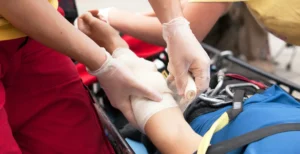
Most of the course is practical. You will practise CPR on training manikins, learn bandaging techniques, and work through realistic workplace scenarios with your trainer and classmates. This hands-on approach is what makes the skills stick, so you can use them confidently if a real emergency ever happens.
EFAW vs FAW: What’s the Difference?
Beginners often mix up EFAW with its bigger sibling, First Aid at Work (FAW). Both are HSE-approved, but they are built for different workplaces.
| Feature | EFAW | FAW |
| Course length | 1 day | 3 days |
| Best suited for | Lower-risk workplaces (offices, shops, small venues) | Higher-risk workplaces (construction, manufacturing, warehouses) |
| Depth of training | Core emergency skills only | Full range, including fractures, burns, and more complex injuries |
| Certificate validity | 3 years | 3 years |
| Typical learner | General staff, receptionists, door supervisors | Designated senior first aiders in higher-risk settings |
If your workplace is generally low-risk, such as a retail store, office, or hospitality venue in London, EFAW is usually enough to meet your legal first aid cover. Higher-risk employers, like those running heavy machinery, usually need at least one FAW-qualified first aider on site.
How Long Does EFAW Training Take, and How Long Is It Valid?
An EFAW course typically takes just one day, often around six hours including breaks. This makes it a popular choice for busy employees and employers who cannot afford to lose staff for several days of training.
Once you pass the practical assessment, your EFAW certificate is valid for three years. After that, you will need to retake the full course or complete a recognised requalification course to keep your certificate current. Many training providers send reminder emails as your renewal date approaches, so it is worth keeping your certificate details on file.
Why Take an Emergency First Aid at Work Course in London?
London’s busy pace means thousands of people pass through shops, offices, venues, and transport hubs every single day. With that much footfall, the chances of a medical emergency happening somewhere on your premises are higher than in a quiet rural setting. That is exactly why so many London employers now treat EFAW as a standard part of staff training.
Choosing a local Emergency First Aid at Work Course London also has practical advantages. You train with an instructor who understands London workplaces, from compact retail units to large event venues, and you avoid long travel times to reach a training centre. Many providers run regular weekday and weekend sessions across the city, so fitting a course around your shift pattern is usually straightforward.
If you are ready to book, Betrain’s Emergency First Aid at Work training is run by experienced instructors across London, with small class sizes so everyone gets proper hands-on practice before the day ends.
How to Choose the Right EFAW Training Provider in London
Not all first aid courses are created equal. Before you book, check for these things:
- HSE approval. The provider should clearly state that their EFAW course meets Health and Safety Executive guidelines.
- Qualified instructors. Ask about the trainer’s background and real-world first aid or medical experience.
- Small class sizes. Practical skills like CPR are easier to learn properly in a smaller group.
- Clear certification. You should receive an official, dated certificate valid for three years, not just a printed handout.
- Convenient location and timing. Look for a training centre that is easy to reach from your part of London, with dates that fit your schedule.
- Good reviews. Check what past learners say about the trainer’s teaching style and the overall course experience.
If you want a straightforward, beginner-friendly option, Betrain’s EFAW course page lists upcoming London dates, pricing, and everything you need to get certified quickly.
10 Frequently Asked Questions About EFAW
1. What does EFAW stand for? EFAW stands for Emergency First Aid at Work. It is a one-day, HSE-approved course that teaches basic emergency first aid skills for the workplace.
2. Is EFAW a legal requirement in the UK? There is no single law naming EFAW by itself, but UK employers must provide adequate first aid cover under the Health and Safety (First Aid) Regulations 1981. EFAW is the most common course used to meet that requirement in lower-risk workplaces.
3. How long does an EFAW course take to complete? Most EFAW courses take one day, usually around six hours, including both theory and hands-on practical training.
4. How long is an EFAW certificate valid for? An EFAW certificate is valid for three years from the date you pass the course. After that, you need to requalify.
5. What is the difference between EFAW and First Aid at Work (FAW)? EFAW is a one-day course covering core emergency skills for lower-risk workplaces. FAW is a three-day course that goes into more depth and is aimed at higher-risk environments like construction sites.
6. Who should take an EFAW course? EFAW suits office workers, retail staff, receptionists, security staff, door supervisors, and anyone whose employer needs a certified first aider for a lower-risk workplace.
7. Can I do EFAW training online? The practical parts of EFAW, such as CPR and bandaging, must be done in person with an instructor, because they require hands-on assessment. Some providers offer a blended format with online theory followed by an in-person practical day.
8. What topics are covered in EFAW training? EFAW covers CPR, choking, managing bleeding, treating shock, the recovery position, using a defibrillator, and basic incident record-keeping.
9. Do I need any experience before taking an EFAW course? No previous first aid experience is needed. EFAW is designed as a beginner-friendly course for people with no medical background.
10. How much does an EFAW course cost in London? Prices vary by provider, class size, and location, generally ranging from around £60 to £100 per person. Check a provider’s course page directly for current London pricing and available dates.
Final Thoughts
Emergency First Aid at Work training is one of the most practical, confidence-building courses you can take, whether your employer requires it or you simply want to be ready to help in a crisis. In just one day, you gain skills that could genuinely save a life, and a certificate that stays valid for three years.
If you are based in London and want to get certified with experienced, friendly instructors, book your spot on Betrain’s Emergency First Aid at Work Course today.