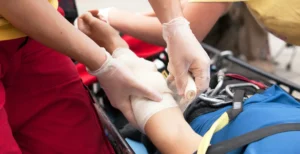

In everyday life, we say someone is in shock when they have had bad news and seem stunned. In first aid, the word means something much more serious. Shock is a life threatening medical condition in which the body is not getting enough blood flow, so the organs do not get enough oxygen. It can follow a serious injury, heavy bleeding, a severe allergic reaction, an infection, a heart problem or even heavy fluid loss.
Shock is one of the topics covered on an Emergency First Aid at Work (EFAW) course, because it often goes hand in hand with other emergencies and can turn a bad situation into a critical one. In this guide, we explain in plain English what shock is, how to recognise it, what causes it, what to do and what not to do. If you want to see a real course page as you read, here is the Emergency First Aid at Work course in London.
Important Notes First
- This guide is general information, not medical advice or training. A trainer can show you the steps and check your technique.
- Shock needs emergency medical care. First aid cannot fix it alone. Call 999.
- First aiders do not diagnose. Your job is to recognise the signs, get help quickly and keep the person as safe as possible.
- Guidance differs between countries. This guide follows UK first aid advice. Some overseas guidance differs on raising the legs, so always follow the training you have been given and the call handler’s advice.
- This guide is mainly for adults. Shock in babies and children needs extra care.
The Short Answer
If you think someone is in shock, call 999. Treat any obvious cause, such as severe bleeding. Help them lie down, raise and support their legs if there is no sign of injury to the legs, head, neck or back, loosen tight clothing, keep them warm with a coat or blanket, reassure them and do not give them anything to eat or drink. Watch their breathing and responsiveness. If they become unresponsive but breathe normally, place them in the recovery position. If they stop breathing normally, start CPR.
What Is Shock?
Shock happens when blood is not circulating properly around the body. Your organs, especially the brain, heart and kidneys, need a constant supply of oxygen carried in the blood. If blood pressure drops, or the heart cannot pump well, or there is not enough blood or fluid in the system, the organs begin to struggle. The body tries to compensate by speeding up the heart and breathing, and by redirecting blood from the skin and limbs to the vital organs. That is why a person in shock looks pale and feels cold.
If shock is not treated, it can get worse quickly and lead to organ damage, unconsciousness, cardiac arrest and death. That is why it is a medical emergency.
Shock Is Not Just Feeling Upset
It is worth separating two meanings of the word.
Shock as a medical emergency. The circulatory condition described in this guide.
Emotional shock. A strong emotional reaction after a frightening or upsetting event. A person may feel numb, shaky, tearful or confused. Emotional shock is not the same as medical shock, but the two can overlap, because a serious accident often causes both. Be calm, kind and reassuring with anyone who has been through something frightening, and watch for physical signs of shock too.
Different Types of Shock, in Simple Terms
Doctors describe several types of shock. A first aider does not need to tell them apart, but knowing the main ones helps you understand why shock can follow such different events.
- Low blood volume, often from bleeding or fluid loss. Severe bleeding, burns, heavy vomiting or diarrhoea, or dehydration.
- Heart related shock. The heart cannot pump blood effectively, for example after a heart attack.
- Allergic shock, called anaphylaxis. A severe allergic reaction causes blood vessels to widen and airways to narrow.
- Infection related shock, called septic shock. An overwhelming infection affects blood pressure.
- Nerve related shock. For example, after a spinal cord injury.
The first aid steps are broadly similar for all of them: call 999, lie the person down and keep them warm, treat the cause where you can and monitor them.
Common Causes of Shock at Work
In a workplace, shock can follow:
- Severe bleeding. From cuts, falls, machinery or knife injuries.
- Serious burns or scalds. Fluid loss from damaged skin.
- Fractures and crush injuries. Especially large bones or multiple injuries.
- Severe allergic reaction. To food, stings or medication.
- Heart problems. For example, a heart attack.
- Heat related illness and dehydration. Hot kitchens, outdoor work or heavy physical labour.
- Vomiting or diarrhoea. Heavy fluid loss.
- Infection. Which can progress to septic shock.
- Spinal injuries. After a fall or a blow.
- Electric shock. Which can damage the heart and cause other injuries.
Because shock often follows another emergency, always watch for it once you have treated the first problem.
Signs and Symptoms of Shock
Signs can develop quickly or gradually, and vary between people. St John Ambulance describes the following signs.
Early signs
- Pale skin, which may feel cold and clammy.
- Sweating.
- A fast pulse.
- Feeling dizzy, faint or weak.
- Feeling sick.
- Anxiety or restlessness.
As shock gets worse
- Fast, shallow breathing.
- A weak pulse, which may become slow in late stages.
- Grey blue skin, especially inside the lips.
- Nausea and sometimes vomiting.
- Thirst.
- Yawning and gasping for air.
- Confusion, restlessness and sometimes aggressive behaviour, as the brain gets less oxygen.
- Drowsiness.
Late and severe signs
- Blue lips, face, earlobes or fingernails, which is a late sign and means the person is very ill.
- The person may become unresponsive.
- Breathing may stop, and the heart may stop.
Not every sign will be present. If you suspect shock, treat it as an emergency. If you are not sure, call 999 and tell the call handler what you have seen and why you think it could be shock.
Step by Step: First Aid for Shock
Step 1: Make the scene safe
Check for danger, including machinery, spilt liquids, traffic, fumes or live electricity. Do not put yourself at risk.
Step 2: Call 999
Call 999, or ask someone to, as soon as you suspect shock, and tell the ambulance control that you think the person is in shock. If you can, explain what you think caused it. Put the phone on speaker so you can follow advice with your hands free. Ask someone to fetch the first aid kit and, if there is one, the AED, and to meet the ambulance.
Step 3: Treat the cause if you can
Shock often follows another injury or illness, so deal with that.
- Severe bleeding: apply firm direct pressure with a clean pad, and bandage it in place.
- Burns: cool the burn with running water for 20 minutes, if it is safe to do so, and cover it.
- Allergic reaction: follow the call handler’s advice, and help the person use their own adrenaline auto injector if they have one and know how to use it.
- Heart attack: help the person sit in a comfortable position, and follow the call handler’s advice.
- Fractures: support the injured part as it lies.
Step 4: Help the person lie down
Help them lie down on a rug, blanket or coat, rather than on a cold floor, if you can. Lying flat helps blood flow to vital organs.
Step 5: Raise and support their legs
In UK first aid advice from St John Ambulance, the next step is to raise the person’s legs, supporting them, for example on a chair, to improve blood supply to the vital organs. Do not raise the legs if:
- You suspect a head, neck, back or leg injury.
- Raising the legs causes pain.
- The person has difficulty breathing and is more comfortable sitting up.
In those cases, keep them in the position they find most comfortable, and call 999 for guidance.
Step 6: Loosen tight clothing
Loosen anything tight around the neck, chest and waist, such as a collar, tie or belt, so that blood flow is not constricted.
Step 7: Keep them warm, but not hot
Cover them with a coat or blanket to keep them warm, as shock can cause the body temperature to fall. Do not use direct heat, such as hot water bottles or heaters, because it can burn the skin and can draw blood to the skin and away from vital organs.
Step 8: Reassure them
Stay calm and talk gently. Tell them help is on the way. Fear and anxiety can make shock worse, and reassurance can help.
Step 9: Do not give food or drink
Even if the person is thirsty, do not give anything to eat or drink. They may vomit or choke, and they may need an urgent operation. You can moisten their lips if they are very dry.
Step 10: Monitor and record
Watch the person constantly. Check their breathing, pulse, colour and level of response regularly, and note the times and any changes. If you have a watch, count the pulse rate and breathing rate, and tell the ambulance crew.
Step 11: Be ready to change your approach
- If they become unresponsive but are breathing normally, place them in the recovery position, and keep checking their breathing. See our guide on what to do if someone is unresponsive but breathing.
- If they vomit or have trouble breathing, place them in the recovery position or help them sit up, depending on the situation, and follow the call handler’s advice.
- If they stop breathing normally, call 999 if you have not already, send for an AED and start CPR straight away. See our guide to adult CPR step by step.
Step 12: Hand over to the ambulance crew
Tell them what happened, what you found, what you did and when, how the person’s condition has changed, and anything you know about medical conditions, medication or allergies. Then let them take over.
What Not to Do
- Do not give food or drink, including water, tea or alcohol.
- Do not move the person unnecessarily, especially if you suspect a spinal or other serious injury.
- Do not use direct heat, such as hot water bottles or heaters.
- Do not let them smoke.
- Do not leave them alone, unless you have to leave to call for help and nobody else can.
- Do not let them get up or walk around.
- Do not raise the legs if you suspect leg, head, neck or back injuries, or if breathing is difficult.
- Do not give medicines, other than helping someone use their own prescribed emergency medicine, such as an adrenaline auto injector, if they are able to and know how.
- Do not delay calling 999.
- Do not assume the person is fine because they look better. Shock can get worse suddenly.
Special Situations
Severe allergic reaction
Anaphylaxis is a life threatening emergency. Signs include swelling of the face, lips or tongue, difficulty breathing, wheezing, a rash and feeling faint. Call 999 immediately, and help the person use their own adrenaline auto injector if they have one. If they have trouble breathing, they may prefer to sit up. If they feel faint, they may need to lie down. Follow the call handler’s advice. Not every EFAW course covers auto injectors in detail, so ask your provider what is included.
Heart attack
A heart attack can lead to shock. Signs include chest pain or pressure, pain spreading to the arm, jaw or back, breathlessness, sweating and feeling unwell. Call 999, help the person sit in a comfortable position, and follow the call handler’s advice. Be ready to start CPR if they become unresponsive and stop breathing normally.
Heat related illness
Heat exhaustion can cause pale, clammy skin, a fast pulse, headache, dizziness and nausea. Move the person to a cool place, help them lie down with their legs raised and give sips of water if they are fully alert. Heat stroke is an emergency, with very hot skin, confusion and sometimes unconsciousness. Call 999.
Burns
Large burns cause fluid loss and can lead to shock. Cool the burn for 20 minutes, cover it, keep the person warm and call 999. See our guide on how to treat a burn in the workplace.
Pregnancy
If the person is visibly pregnant, especially in later pregnancy, it may be better to lay them on their side, and call 999 for guidance.
Electric shock
Switch off the power first, and do not touch the person until it is safe. Call 999. Electric shock can damage the heart, so be ready to give CPR.
After the Incident
Once the ambulance has gone, there is more to do.
- Record what happened. Date, time, place, cause, signs you saw, what you did and what help arrived.
- Report to your employer. Some serious injuries must be reported to the authorities under the Reporting of Injuries, Diseases and Dangerous Occurrences Regulations, often called RIDDOR, and your employer decides what is needed.
- Restock the first aid kit.
- Look after yourself and others. Seeing someone seriously ill or injured can be upsetting, and emotional shock can affect you and your colleagues. Talk to someone you trust, and use any support your employer offers.
- Review. Employers should learn from incidents and make changes to prevent them.
How an EFAW Course Teaches Shock
On an Emergency First Aid at Work course, recognising and managing shock is part of the practical content. You learn what the signs look like, why shock follows bleeding and other injuries, how to position and warm a casualty, why you must not give food or drink, how to monitor and when to change approach. You practise with a partner and work through scenarios, such as a colleague with a deep cut who becomes pale and clammy.
On the day, you also learn how to assess an incident safely, give adult CPR, use an AED, place someone in the recovery position, help a choking adult, control serious bleeding and treat minor injuries. The course is a one day, regulated Level 3 qualification, and HSE guidance says it should include at least six hours of training time, not counting breaks. The certificate is valid for three years. The longer First Aid at Work course covers a wider range of injuries and illnesses in more detail.
What Workplaces Should Have Ready
The Health and Safety (First Aid) Regulations 1981 require employers to provide adequate and appropriate first aid for their employees. For shock, preparation helps.
- Trained first aiders on every shift. As a starting point for low hazard workplaces, HSE suggests at least one appointed person for fewer than 25 employees, at least one first aider trained in Emergency First Aid at Work for 25 to 50 employees, and at least one first aider trained in First Aid at Work for every 100 employees above that, or part of 100. Higher hazard workplaces need more. A first aid needs assessment gives the best answer.
- A well stocked first aid kit. With dressings, gloves and a foil blanket or a blanket nearby, depending on your needs assessment.
- Blankets or coats to hand. To keep a casualty warm.
- A clear procedure. Who calls 999, who stays with the casualty, who meets the ambulance.
- Regular refreshers. HSE strongly recommends them, although they are not a legal requirement.
- Support after incidents. Time, a quiet space and access to employee support.
Choosing a Good Course in London
Look for:
- A regulated Level 3 Award in Emergency First Aid at Work (RQF) from a recognised awarding organisation.
- At least six hours of training time, not counting breaks.
- Hands on practice, including bleeding control, positioning and monitoring.
- Practical assessment in person. HSE guidance expects this for a workplace first aider, so online only courses are generally not suitable.
- Qualified, experienced trainers.
- Small classes. Many awarding organisations set a maximum of around 12 learners per trainer.
- A clear certificate and a clear total price.
HSE stopped approving first aid training providers in 2013, so be cautious of any claim that a course is HSE approved. In London in 2026, public prices for a one day course commonly range from about £65 to £150 per person. One provider page, linked above, lists £89 per person for classroom training and £75 per person for groups of five or more, at the time of writing in October 2026. Prices change, so always confirm. You can review the Emergency First Aid at Work training page to see how one provider presents its course, price and booking options.
Why London Workplaces Should Be Ready
London has busy kitchens, building sites, workshops, shops and offices, many spread over several floors. Roads and public transport can be congested, so ambulances may take time to arrive, and what happens in the first minutes can decide how far shock progresses. There is also a very large number of training providers and dates in London, and many deliver training at your workplace, which is a practical way to prepare a whole team to recognise and respond to shock.
Final Thoughts
So, what is shock in first aid, and what do you do? Shock is a life threatening condition in which the body is not getting enough blood flow. Look for pale, cold, clammy skin, a fast weak pulse, fast shallow breathing, sweating, dizziness and anxiety. Call 999, treat the cause, lay the person down, raise and support their legs if there is no injury to the legs, head, neck or back, loosen tight clothing, keep them warm, reassure them and give nothing to eat or drink. Monitor them constantly, and be ready to use the recovery position or CPR.
Early recognition and calm action make a real difference. When you are ready to practise with a trainer, take a look at the Emergency First Aid at Work course in London and choose a date that suits you.
Frequently Asked Questions
1. What is shock in first aid?
Shock is a life threatening condition in which the body is not getting enough blood flow, so the organs do not get enough oxygen. It can follow severe bleeding, burns, a severe allergic reaction, infection, a heart problem or heavy fluid loss. It needs emergency medical care.
2. What are the signs of shock?
Pale, cold, clammy skin, sweating, a fast pulse that weakens as shock worsens, fast shallow breathing, dizziness, weakness, nausea, thirst, anxiety, yawning or gasping and confusion. In severe cases, lips and skin may turn grey blue, and the person may become unresponsive.
3. What should you do if you think someone is in shock?
Call 999, treat any obvious cause such as bleeding, help them lie down, raise and support their legs if there is no sign of leg, head, neck or back injury, loosen tight clothing, keep them warm, reassure them and give nothing to eat or drink. Monitor their breathing and responsiveness.
4. Should you give someone in shock food or water?
No. Do not give anything to eat or drink, even if they are thirsty. They may vomit or choke, and they may need an urgent operation. You can moisten their lips if they are very dry.
5. Should you raise the legs of someone in shock?
In UK first aid advice, yes, if there is no sign of injury to the legs, head, neck or back and it does not cause pain or breathing difficulty. Support the legs, for example on a chair. Guidance in some other countries differs, so follow your training and the call handler’s advice.
6. How do you keep someone in shock warm?
Cover them with a coat or blanket, and lay them on a rug or blanket rather than a cold floor if possible. Do not use direct heat such as hot water bottles or heaters.
7. What causes shock?
Common causes include severe bleeding, serious burns, loss of body fluids from vomiting, diarrhoea or dehydration, severe allergic reactions, heart problems, overwhelming infection and spinal injuries. At work, bleeding injuries and burns are common triggers.
8. What is the difference between shock and fainting?
Fainting is a brief loss of consciousness, and most people recover within a minute or two once lying flat. Shock is a serious, ongoing condition with persistent signs such as pale, clammy skin, a fast weak pulse and fast breathing. If you are unsure, call 999.
9. Does an EFAW course cover shock?
Yes. An Emergency First Aid at Work course covers recognising and managing shock, along with CPR, using an AED, the recovery position, choking, bleeding control and minor injuries. It is a one day regulated Level 3 qualification with at least six hours of training time.
10. Where can I learn first aid for shock in London?
You can book an Emergency First Aid at Work course through a training provider that offers the regulated qualification, either as a public course or as training at your workplace. Check the practical content, the awarding organisation, the class size and the total price before you book.