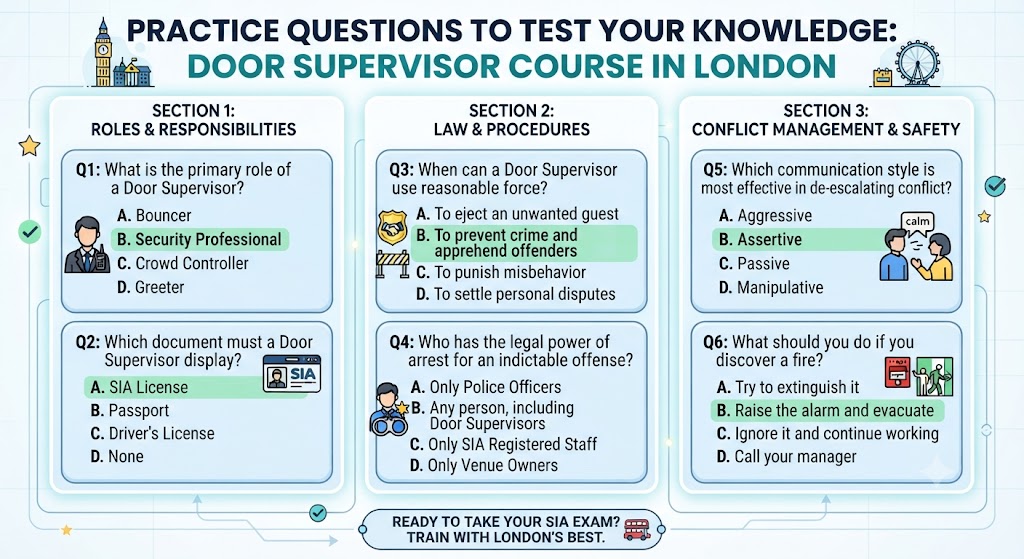
Preparing for your final assessment is the most critical stage of your journey to becoming a licensed security professional. The door supervisor course in London is designed to be rigorous, ensuring that only those who truly understand the law, safety protocols, and conflict resolution techniques can represent the industry. To help you succeed, we have compiled an extensive set of practice questions covering the four core modules of the SIA qualification.
Each section includes questions, the correct answers, and detailed explanations. Understanding the “why” behind an answer is just as important as knowing the answer itself, as it helps you apply this knowledge to real-world scenarios on the streets of London.
Module 1: Working in the Private Security Industry
This module covers the foundational knowledge required for any security role. It focuses on the legal framework, health and safety, and the structure of the industry.
Practice Questions
1. What is the primary role of the Security Industry Authority (SIA)? A) To provide physical security for government buildings. B) To regulate the private security industry through licensing. C) To act as a branch of the Metropolitan Police. D) To provide legal defense for security guards.
- Correct Answer: B
- Explanation: The SIA was established under the Private Security Industry Act 2001. Its main goal is to raise standards in the industry by licensing individuals and overseeing the Approved Contractor Scheme (ACS). If you are taking a door supervisor course in London, your ultimate goal is to obtain an SIA license.
2. Which of these is a legal requirement under the Health and Safety at Work Act? A) Employers must provide free lunch to all security staff. B) Employees must take reasonable care for their own safety and that of others. C) Security guards must always carry a firearm. D) Every building must have at least ten fire exits.
- Correct Answer: B
- Explanation: Health and safety is a shared responsibility. While employers must provide a safe environment, you as a door supervisor must follow training and report hazards to prevent accidents.
3. What should be the first action taken upon discovering a fire? A) Try to extinguish it immediately using any available liquid. B) Call your manager to ask for permission to leave. C) Raise the alarm to alert others in the building. D) Post a warning on social media.
- Correct Answer: C
- Explanation: Life safety is the priority. Raising the alarm ensures that the evacuation process starts immediately, which is vital in busy London venues.
4. What does the term “Duty of Care” mean for a door supervisor? A) You must care for the equipment provided by the venue. B) You have a legal obligation to avoid acts or omissions that could foreseeably harm others. C) You must like everyone who enters the venue. D) You are only responsible for people who pay an entry fee.
- Correct Answer: B
- Explanation: You are responsible for the safety of everyone on the premises, including staff and customers. Ignoring a hazard (an “omission”) is just as serious as causing an accident.
5. Which of the following is considered “Personal Protective Equipment” (PPE) for a security guard? A) A designer suit. B) A high-visibility vest or radio. C) A personal smartphone. D) A heavy flashlight used as a weapon.
- Correct Answer: B
- Explanation: PPE is equipment designed to keep you safe or make you more visible/audible during your duties.
Module 2: Working as a Door Supervisor
This unit is specific to the role of a door supervisor, focusing on the laws surrounding licensed premises, search procedures, and drug awareness.
Practice Questions
6. Under the Licensing Act 2003, what is one of the four licensing objectives? A) Increasing the profit of the venue. B) The prevention of crime and disorder. ) Ensuring every customer has a seat. D) Selling as much alcohol as possible before midnight.
- Correct Answer: B
- Explanation: The four objectives are: Prevention of crime and disorder, Public safety, Prevention of public nuisance, and Protection of children from harm. Every decision you make during your door supervisor course in London training should align with these.
7. When performing a search on a customer, what is the most important rule regarding gender? A) Any guard can search any customer. B) A search should only be conducted by a person of the same sex. C) Customers can only be searched if they are male. D) You must ask the manager to perform all searches.
- Correct Answer: B
- Explanation: To maintain dignity and avoid allegations of assault or harassment, searches must be conducted by a staff member of the same sex as the customer.
8. What must you do if you find a large quantity of illegal drugs during a search? A) Throw them in the bin outside. B) Keep them in your pocket until the end of the shift. C) Seize them, record the incident, and follow the venue’s policy for police notification. D) Give them back and ask the person to leave.
- Correct Answer: C
- Explanation: Handling evidence correctly is vital. You must follow the “chain of custody” to ensure that if the police are involved, the evidence remains valid.
9. What is an “Entry Policy”? A) A document that lists the prices of drinks. B) The criteria a venue uses to decide who is allowed to enter (e.g., dress code, age). C) A map showing the fire exits. D) A list of all staff members’ phone numbers.
- Correct Answer: B
- Explanation: As a door supervisor, you are the gatekeeper. You must enforce the venue’s policy fairly and consistently without discriminating.
10. Which of the following people should be refused entry to a licensed venue? A) Someone wearing a blue shirt. B) Someone who appears to be underage and has no valid ID. C) Someone who speaks a different language. D) Someone who is a regular customer.
- Correct Answer: B
- Explanation: Protecting children from harm is a licensing objective. Allowing an underage person into a venue can lead to the loss of the venue’s license and your SIA license.
Module 3: Conflict Management for the Security Industry
This module focuses on how to stop a situation from becoming violent through communication and psychology.
Practice Questions
11. What is the first stage of the “proactive” service model? A) Physical intervention. B) Communication and dynamic risk assessment. C) Running away from the scene. D) Calling for backup immediately without looking.
- Correct Answer: B
- Explanation: You should always try to assess the risk and talk to the individuals involved before things escalate.
12. Which of these is a sign of “escalating” anger in a person? A) Speaking in a calm, low voice. B) Making eye contact and smiling. C) Rapid breathing, pointing fingers, and shouting. D) Sitting down and looking at the floor.
- Correct Answer: C
- Explanation: Recognizing these physical signs early allows you to use de-escalation techniques before physical force becomes necessary.
13. What is “Non-Verbal Communication”? A) Using a radio to talk to colleagues. B) Body language, facial expressions, and hand gestures. C) Writing a report at the end of the night. D) Sending a text message.
- Correct Answer: B
- Explanation: Over 90% of communication in a conflict is non-verbal. How you stand (your stance) can either calm someone down or provoke them further.
14. What does the “LEAPS” model stand for in communication? A) Listen, Empathize, Ask, Paraphrase, Summarize. B) Loudly, Energetically, Actively, Positively, Strongly. C) Leave, Exit, Avoid, Protect, Stay. D) Look, Eat, Act, Play, Sit.
- Correct Answer: A
- Explanation: LEAPS is a standard tool taught in the door supervisor course in London to help resolve disputes through effective listening and understanding.
15. When dealing with a conflict, why should you maintain “Reaction Gap” (personal space)? A) To be rude to the customer. B) To give yourself time to react if the person becomes violent. C) Because you don’t like the person’s perfume. D) To make sure other people can walk past.
- Correct Answer: B
- Explanation: Staying roughly two arm-lengths away gives you the time and space to defend yourself or move away if an attack occurs.
Module 4: Physical Intervention Skills
This unit covers the legal and safety aspects of using physical force as a last resort.
Practice Questions
16. What is the definition of “Reasonable Force”? A) Using as much force as you want to win a fight. B) The minimum amount of force necessary to achieve a lawful objective. C) Force that is used only after the police arrive. D) Force that is used to punish someone for being rude.
- Correct Answer: B
- Explanation: Any force you use must be “proportionate” to the threat. If someone pushes you, you cannot respond by causing them serious injury.
17. What is “Positional Asphyxia”? A) A type of skin rash. B) A dangerous condition where a person cannot breathe due to the position of their body during a restraint. C) A feeling of dizziness after standing up too fast. D) A legal term for a citizen’s arrest.
- Correct Answer: B
- Explanation: This is a life-threatening risk. You must never put pressure on a person’s chest or back or hold them face-down for long periods.
18. When must you stop a physical intervention? A) When you get tired. B) When the person stops resisting or the threat is removed. C) Only when your manager tells you to. D) When the person’s friends leave the area.
- Correct Answer: B
- Explanation: Once the objective (e.g., removing a person or stopping an assault) is achieved, any continued force is considered an assault by you.
19. Why is “Dynamic Risk Assessment” important during a restraint? A) To see if the person has any money. B) To constantly check the person’s health, breathing, and the surrounding environment. C) To see if anyone is filming you on a phone. D) To decide which fire exit is closest.
- Correct Answer: B
- Explanation: Situations change rapidly. You must monitor the person you are holding to ensure they do not become unconscious or injured.
20. Which of these is a high-risk strike area that should be avoided? A) The arm. B) The shoulder. C) The neck and head. ) The thigh.
- Correct Answer: C
- Explanation: Strikes to the head or neck can be fatal or cause permanent damage. In a door supervisor course in London, you are taught that physical intervention is for protection, not for “fighting.”
Tips for Success in Your London Exam
While these questions provide a great starting point, success in your door supervisor course in London depends on your ability to apply these concepts under pressure. Here are three final tips to ensure you pass:
- Read the Question Twice: Many students fail because they rush. Look for “keyword” traps like “Always,” “Never,” or “Except.”
- Think Like a Professional: When in doubt, choose the answer that is most professional, legal, and safe. The SIA exams look for candidates who prioritize public safety over “toughness.”
- Learn the London Context: Remember that London venues are often crowded and high-stakes. Understand how to manage large groups and work closely with local authorities.
By mastering these practice questions and understanding the logic behind them, you are well on your way to earning your qualification and starting a successful career in London’s security