
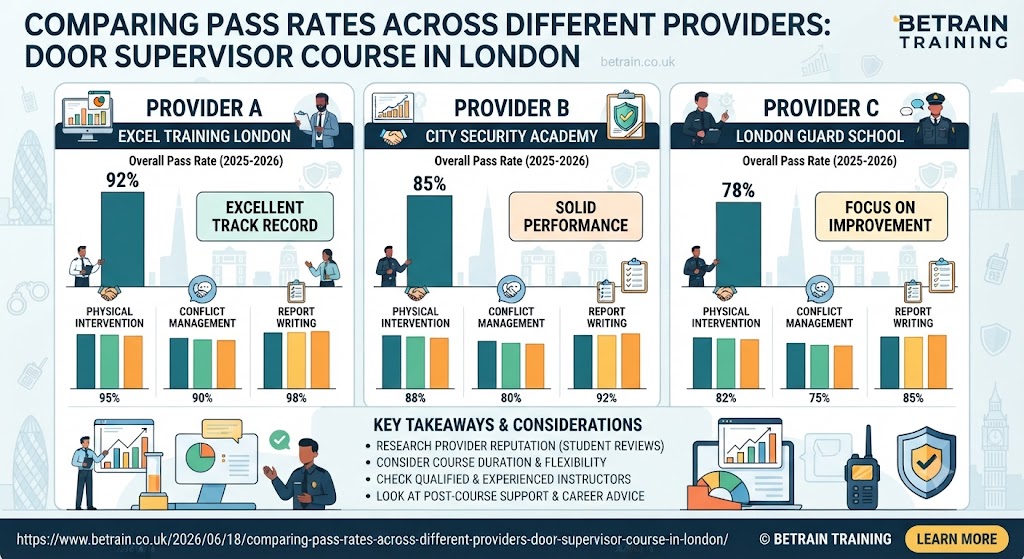
Comparing Pass Rates Across Different Providers: Door Supervisor Course in London
If you want to work as a door supervisor in London, you need to pass a door supervisor course in London and get your SIA licence. But not every training provider gives you the same chance of passing. Some providers have much higher pass rates than others. In this guide, we will look at why pass rates matter, what affects them, and how you can pick a provider that gives you the best chance of success.
Why Pass Rates Matter When Choosing a Door Supervisor Course in London
When you search for a door supervisor course in London, you will find many training companies. Some are well known and have trained thousands of students. Others are smaller and newer. The pass rate of a provider tells you how many students actually pass the exam after finishing the course.
A high pass rate usually means:
- The trainers explain things clearly
- The course materials are easy to understand
- Students get enough practice before the real exam
- The provider prepares students well for exam-style questions
A low pass rate can mean the opposite. It may point to rushed teaching, poor materials, or not enough exam practice. So before you book a course, it is smart to check the pass rate, not just the price.
What Is a Good Pass Rate for a Door Supervisor Course?
Most quality training providers in London report pass rates between 85% and 95%. This is considered a strong result. If a provider’s pass rate is much lower than this, for example under 70%, that could be a warning sign.
However, pass rates alone don’t tell the whole story. You should also look at:
- How many students take the course each year
- Whether the provider has SIA-approved trainers
- How long the course runs (rushed courses often have lower pass rates)
- What learning materials and mock exams are offered
A provider with a smaller number of students might report a very high pass rate, but this number may not be as reliable as a provider that trains hundreds of people each year.
Factors That Affect Pass Rates
1. Course Length and Structure
The standard door supervisor course in London usually runs over 4 to 6 days. This covers modules on conflict management, physical intervention, and general security duties. Providers that stick to the full recommended hours tend to have better pass rates than those that try to squeeze the course into fewer days.
2. Trainer Experience
Experienced trainers who have worked in the security industry themselves often explain real-life situations better. This helps students understand the material instead of just memorising it. Trainers with years of teaching experience usually produce higher pass rates.
3. Class Size
Smaller class sizes often lead to better results. When there are fewer students, trainers can give more one-on-one attention. Large classes of 20-30 people can mean less support for students who are struggling.
4. Quality of Study Materials
Some providers give students workbooks, practice tests, and revision guides. Others just give a quick verbal briefing. Providers with strong study materials tend to have students who feel more confident and prepared on exam day.
5. Mock Exams
Providers that run mock exams before the real test help students get used to the format and timing. This reduces exam-day nerves and mistakes, which raises pass rates.
How to Compare Pass Rates Between Providers
When comparing different training companies offering a door supervisor course in London, follow these steps:
Step 1: Ask for Their Pass Rate Directly
Not all providers publish their pass rates online. Don’t be afraid to call or email and ask. A good provider will be happy to share this information. If they refuse or seem unsure, that could be a red flag.
Step 2: Check Reviews and Testimonials
Look at Google reviews, Trustpilot, and social media pages. Students often mention whether they passed first time and how well the course prepared them. Real reviews give you a more honest picture than marketing claims.
Step 3: Compare Trainer Qualifications
Ask if the trainers are SIA-approved and how many years of experience they have. Providers with senior, experienced trainers usually produce better results.
Step 4: Look at Class Sizes
Ask how many students are usually in each class. Smaller groups often mean more personal support and better pass rates.
Step 5: Check What Happens If You Fail
Some providers offer a free resit or reduced-cost resit if you don’t pass first time. This shows they stand behind their training quality. Providers that charge full price for a resit with no support may not be as confident in their own pass rates.
Common Mistakes Students Make When Choosing a Provider
Many students choose a course simply because it’s the cheapest option. While saving money is understandable, a cheaper course is not always the best value. If a low-cost provider has a poor pass rate, you might end up paying for the course again, plus the exam resit fee, plus losing time before you can start working.
Other common mistakes include:
- Not checking if the provider is SIA-approved
- Booking a course with dates too close together, leaving no time to study
- Ignoring reviews from past students
- Not asking about the trainer’s background
- Choosing a provider based only on location, without checking quality
Why Pass Rates Can Vary So Much Across London
London has many training centres, from small local businesses to large national chains. This variety is part of why pass rates differ so much between providers.
Larger, well-established providers often have:
- More resources for study materials
- More experienced trainers
- Better facilities for practical training, such as physical intervention practice
Smaller providers can still offer excellent training, but it’s more important to check their track record carefully since they may have less public information available.
Tips to Improve Your Own Chances of Passing
Even with a great provider, your own effort matters. Here are some simple tips to boost your chances:
- Attend every session. Missing even one day can leave gaps in your knowledge.
- Ask questions during class. Don’t wait until the exam to clear up confusion.
- Use all the study materials provided. Read through workbooks and practice tests more than once.
- Get a good night’s sleep before the exam. Tiredness affects concentration and memory.
- Practice physical intervention techniques properly. This part of the exam requires physical skill, not just knowledge.
- Arrive early on exam day. Rushing in stressed can affect your performance.
Questions to Ask Before Booking Your Course
Before you commit to any door supervisor course in London, it helps to ask the provider these questions:
- What is your current pass rate?
- How many years have your trainers worked in the security industry?
- What is the average class size?
- What study materials do you provide?
- Do you offer mock exams?
- What happens if I don’t pass the first time?
- Is the course SIA-approved?
- How soon can I start working after passing?
Getting clear answers to these questions will help you compare providers fairly and choose the one that gives you the best chance of success.
Final Thoughts
Choosing the right door supervisor course in London is about more than just price and location. Pass rates give you a good idea of how well a provider prepares its students, but you should also look at trainer experience, class size, study materials, and student reviews.
Take your time to research different providers, ask direct questions about their pass rates, and read what past students have said. This extra effort before you book can save you time, money, and stress in the long run, and help you start your career as a door supervisor with confidence.