If you’ve been browsing training providers in the UK, you’ve probably seen the phrase “Ofqual-regulated” attached to almost every course listing. It sounds official, it sounds trustworthy, and most providers use it as a selling point. But what does it actually mean? And why should it matter to you, especially if you’re planning to take a door supervisor course in London?
This article breaks down what Ofqual regulation really involves, how it protects you as a learner, and why choosing a properly regulated door supervisor course can make or break your career in the security industry.
Who Is Ofqual and Why Do They Exist?
Ofqual stands for the Office of Qualifications and Examinations Regulation. It’s a non-ministerial government department that regulates qualifications, exams, and assessments in England. Ofqual doesn’t create courses or teach students itself. Instead, it sets the rules that awarding organisations must follow when they design, deliver, and certify qualifications.
Think of Ofqual as a quality control body. Its job is to make sure that when someone earns a certificate, that certificate actually reflects real skills and knowledge, not just a name on a piece of paper. Without a body like this, anyone could hand out “certificates” with no consistency, no standard, and no way for employers to trust them.
What Does “Ofqual-Regulated” Actually Mean?
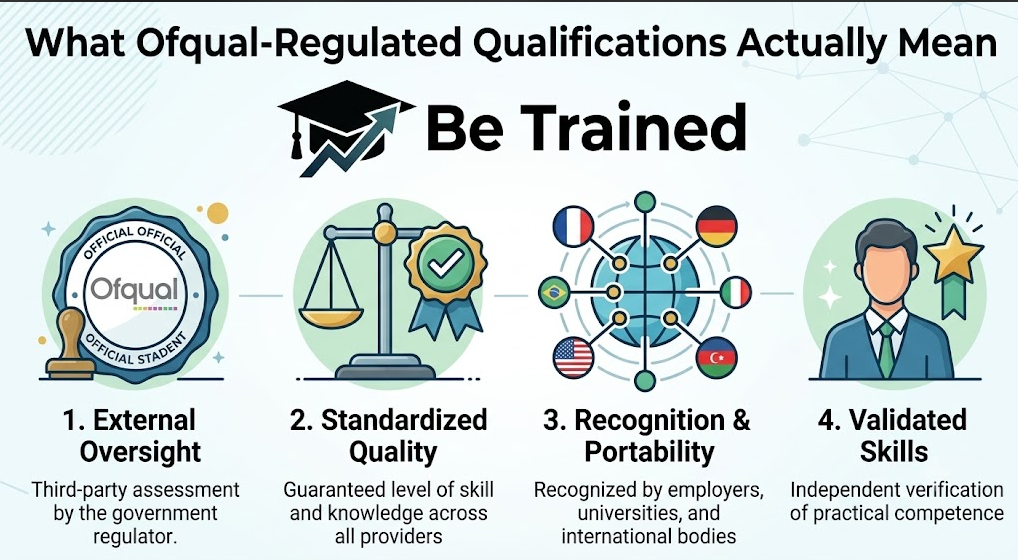
When a qualification is described as Ofqual-regulated, it means the qualification has gone through a formal accreditation process. Here’s what that involves in simple terms:
- An approved awarding organisation designed it. Only awarding bodies registered with Ofqual can offer regulated qualifications. These bodies must prove they have proper systems for writing course content, setting assessments, and marking work fairly.
- The content meets a national framework. Regulated qualifications sit within the Regulated Qualifications Framework (RQF), which assigns each qualification a level (like Level 2 or Level 3) based on its difficulty and depth.
- Assessments are standardised. Everyone who takes the qualification, no matter which training centre they attend, is tested against the same criteria.
- The certificate is nationally recognised. Because the qualification follows Ofqual’s rules, employers across the country know exactly what it represents.
In short, Ofqual regulation is a stamp of legitimacy. It tells you that a third party has checked the qualification and confirmed it meets a consistent national standard.
Why This Matters More Than You Might Think
A lot of learners assume all training certificates are basically equal. They aren’t. Some training providers offer “in-house” certificates that have no external oversight at all. These might still teach useful information, but they carry no formal recognition, and employers may not accept them for licensing purposes.
This distinction becomes critical in industries where a licence is legally required to work, such as the private security industry in the UK.
The Link Between Ofqual Regulation and SIA Licensing
If you want to work as a door supervisor in the UK, you need a licence issued by the Security Industry Authority (SIA). To apply for that licence, you must complete a specific, SIA-approved training qualification. That qualification has to be delivered by a training provider using an Ofqual-regulated awarding body.
This is where the two systems connect. The SIA doesn’t design or mark the training itself. It relies on the qualification being properly regulated through Ofqual’s framework so it can trust that everyone holding the certificate has met the same minimum standard of competence.
If you complete a course that isn’t properly regulated, or isn’t recognised by the SIA, your application for a licence could be rejected outright, no matter how good the training felt at the time. This is exactly why choosing the right provider for your door supervisor course in London is so important.
What a Genuine Door Supervisor Course Should Include
A proper, Ofqual-regulated door supervisor course typically covers:
- Working in the private security industry – understanding your legal responsibilities, the role of the SIA, and industry standards.
- Conflict management – learning to de-escalate situations verbally before they turn physical.
- Physical intervention skills – safe, legally sound techniques for restraining or removing individuals when absolutely necessary.
- Emergency procedures – fire safety, first aid awareness, and how to respond to medical or security emergencies.
- Licensing law – knowing what you’re legally allowed to do and where the boundaries are.
At the end of the course, you’ll usually sit a multiple-choice exam and, depending on the qualification, a practical assessment for physical intervention. Passing both is what allows you to apply for your SIA licence.
How to Check If a Course Is Genuinely Regulated
Before booking any course, it’s worth doing a quick check. Here’s how:
- Ask which awarding organisation issues the certificate. Legitimate providers will name it clearly, for example, Highfield, NCFE, or a similar recognised body.
- Search the Ofqual Register. Ofqual maintains a public register of all regulated qualifications. You can search by awarding body or qualification title to confirm it’s listed.
- Confirm SIA approval separately. Being Ofqual-regulated is necessary but not sufficient on its own; the specific qualification also needs to appear on the SIA’s list of approved training courses for the licence you want.
- Look for transparency in course materials. Reputable providers are upfront about exam structure, pass marks, and what happens if you don’t pass first time.
A good training provider will never hesitate to answer these questions directly. If a provider is vague about who awards the certificate or dodges questions about SIA recognition, that’s a red flag worth taking seriously.
Why Location Matters Too: Choosing a Course in London
London has one of the highest concentrations of licensed door supervisors in the country, thanks to its huge nightlife, events, and hospitality industry. That means demand for well-trained, properly licensed staff is constant, but it also means competition among training providers is high.
Choosing a door supervisor course in London gives you a few practical advantages:
- Easier access to assessment centres and practical training venues.
- More flexible scheduling, since providers in busy cities often run frequent course dates.
- Networking opportunities, as trainers and classmates are often already connected to security companies actively hiring in the capital.
- Faster turnaround from certificate to employment, since London’s security sector has consistent staffing needs.
If you’re weighing up your options, Be Trained’s door supervisor course is worth looking into as part of your research. Always confirm independently, through the Ofqual Register and SIA’s approved training list, that any course you’re considering meets the regulatory standards outlined above before you commit.
Common Misconceptions About Regulated Qualifications
“Regulated means government-run.” Not true. Ofqual sets and enforces the standards, but the actual awarding organisations and training providers are independent businesses.
“A more expensive course is automatically more regulated.” Price has no bearing on regulation status. A course can be affordable and fully regulated, or expensive and not regulated at all. Always verify independently rather than judging by cost.
“Once you’re regulated, the qualification never needs updating.” Ofqual periodically reviews qualifications, and awarding bodies must update content to reflect changes in law, industry practice, or safety standards.
“All security training is regulated by the SIA.” The SIA sets licensing requirements and approves specific qualifications, but the qualifications themselves are developed and regulated through Ofqual’s framework, not by the SIA directly.
Final Thoughts
Ofqual regulation exists to protect the value of your certificate long after you’ve finished a course. For anyone pursuing a career as a licensed door supervisor, this isn’t just a technicality, it’s the difference between a certificate that opens the door to SIA licensing and one that leads to a rejected application.
Before you enrol in any door supervisor course in London, take the extra few minutes to confirm the qualification is properly regulated and SIA-approved. It’s a small step that protects your time, your money, and your career.
Frequently Asked Questions
1. What does Ofqual-regulated actually mean? It means an independent awarding organisation, registered with Ofqual, has designed the qualification according to national standards, and it appears on the official Regulated Qualifications Framework.
2. Is Ofqual a government body? Yes, Ofqual is a non-ministerial UK government department responsible for regulating qualifications, exams, and assessments in England.
3. Do I need an Ofqual-regulated qualification to become a door supervisor? Yes. To apply for an SIA licence, you must complete a training qualification delivered through an SIA-approved, Ofqual-regulated awarding organisation.
4. How do I check if my course is Ofqual-regulated? You can search the Ofqual Register online using the awarding organisation’s name or the qualification title to confirm it is officially listed.
5. What’s the difference between Ofqual regulation and SIA approval? Ofqual regulates the qualification’s structure and standards, while the SIA separately confirms that specific qualification meets its licensing requirements. A course needs both to lead to an SIA licence.
6. How long does a door supervisor course usually take? Most door supervisor courses run over three to four days, combining classroom learning with practical training and a final assessment.
7. What happens if I fail the exam on a door supervisor course? Most training providers offer a resit option, though this may involve an additional fee. Always ask about resit policies before enrolling.
8. Can I work as a door supervisor without an SIA licence? No. Working as a door supervisor without a valid SIA licence is illegal in the UK and can result in fines or prosecution for both the individual and the employer.
9. Are all training providers in London equally recognised? No. Recognition depends on whether the provider works with an Ofqual-regulated awarding body and offers a qualification approved by the SIA, not on the provider’s size or location alone.
10. How long does an SIA licence last once I qualify? An SIA licence is typically valid for three years, after which you’ll need to complete renewal training and reapply before it expires.