Choosing a door supervisor course in London is not just about ticking a box so you can start earning. It is about making sure the qualification you walk away with is actually recognised, respected, and legally valid. The private security industry in the UK is tightly regulated, and the standards behind your training determine whether your SIA licence application goes smoothly or hits a wall before it even begins. Every year, people unknowingly enrol on courses that look professional on the surface but fall short of the accreditation required to hold a licence, costing them time, money, and delayed job opportunities. This guide breaks down what accreditation and certification really mean, why they matter, and how to make sure the course you choose meets every standard it needs to.
What Accreditation Actually Means in the Security Training Industry
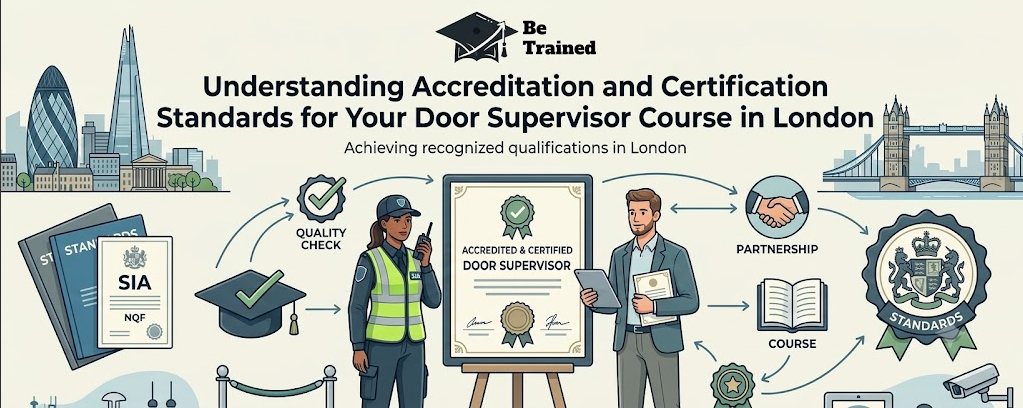
Accreditation is the formal recognition that a training provider, course, and awarding body meet a defined set of quality and content standards. For door supervisor training, this is not optional. A course must be linked to a qualification that is recognised by the Security Industry Authority (SIA) and delivered by a centre approved to run that qualification.
This recognition does not happen automatically. Training centres must apply to an approved awarding organisation, demonstrate that their tutors are suitably qualified, prove their facilities are fit for practical assessment, and agree to ongoing monitoring. Only once all of this is confirmed can a centre legally advertise itself as delivering an accredited door supervisor qualification.
Certification, on the other hand, is the proof you receive once you have completed the course and passed the assessments. It is your paper (or digital) trail showing that you met the required learning outcomes set out by the awarding body. Together, accreditation and certification form the backbone of trust in the security training sector they tell employers, venues, and licensing bodies that your training was not just a quick weekend seminar but a properly assessed, nationally regulated qualification.
SIA Approval: The Non-Negotiable Standard
Every door supervisor course in London must lead to a qualification on the SIA’s approved list. Without this, you simply cannot apply for your SIA licence, regardless of how good the training itself was or how much you paid for it. The SIA does not deliver training directly. Instead, it approves specific qualifications developed by recognised awarding organisations, and it is these qualifications not the training provider’s own branding that carry legal weight.
When researching providers, always check that the specific qualification title matches what is currently listed as SIA-approved. Course names can look very similar to one another, sometimes deliberately so, but only the exact approved qualification will satisfy licensing requirements. A reputable provider will state the qualification title clearly, along with its qualification number, on their course page, and will not object to being asked for further proof.
It is also worth remembering that SIA requirements can be updated periodically, so a qualification that was approved several years ago is not automatically still valid today. Reputable providers keep their course listings current and update their marketing the moment any changes are announced.
Awarding Bodies Behind Your Door Supervisor Course in London
Accredited door supervisor courses are developed and certified by recognised awarding organisations regulated by Ofqual (or the equivalent regulator in Scotland and Wales). These bodies design the curriculum, set the assessment criteria, and audit training centres to make sure standards are maintained consistently across the country.
This structure matters because it removes inconsistency. Whether you take your course in East London, South London, or anywhere else in the country, an accredited qualification guarantees the same core content, the same assessment rigour, and the same recognised outcome. Training centres are regularly inspected and can lose their approval if they fail to maintain these standards, which is why choosing a centre with a long-standing, unblemished accreditation record is worth the extra research before you commit your time and money.
Why Accreditation Standards Protect Your Career
Accreditation is not bureaucratic red tape it is what protects you as a working professional. An SIA licence obtained through a properly accredited course is fully portable and recognised by every licensed venue, security company, and client across England, Scotland, and Wales. It also protects you legally: working the door without a valid licence backed by accredited training is a criminal offence, and the consequences fall on you personally, not on the training provider that failed to deliver a compliant course.
Beyond legality, accreditation standards ensure the training itself covers what actually happens on the job — conflict management, physical intervention, emergency procedures, and the legal powers and limitations of a door supervisor. Courses that cut corners on accreditation often cut corners on this practical content too, leaving newly licensed supervisors underprepared for real situations on a busy Friday night in a London venue. Employers know this, and many will ask directly which awarding body certified your training before offering you shift work.
How to Verify a Training Provider’s Accreditation
Before booking, take a few minutes to confirm a provider’s credentials rather than relying on their marketing claims alone:
- Check the SIA’s published list of approved qualifications and confirm the exact qualification name and code against what the provider is advertising.
- Look up the awarding body’s website to confirm the training centre is listed as an approved delivery centre in good standing.
- Ask the provider directly for their centre approval number — legitimate providers share this without hesitation or delay.
- Read independent reviews that specifically mention licence approval outcomes and job placement, not just the general training experience.
- Confirm that the certificate you will receive carries the awarding body’s name and logo, not only the training centre’s branding.
Providers with a transparent, verifiable accreditation trail, such as the door supervisor course in London offered by BeTrain, make this information easy to find because they have nothing to hide about their standards, their tutors, or their track record with the SIA.
Red Flags: Spotting Unaccredited or Substandard Courses
A handful of warning signs should make you pause before enrolling. Be cautious of providers who are vague about which awarding body certifies their course, who cannot produce a centre approval number on request, or who promise unrealistically fast turnaround times that skip proper practical assessment altogether. Extremely low prices compared to the rest of the market are also worth questioning, since accredited training involves real costs for qualified tutors, licensed assessment materials, venue hire, and ongoing quality assurance audits.
Other red flags include certificates that only display the training company’s own logo with no reference to a recognised awarding body, staff who cannot clearly explain the assessment structure, and an unwillingness to let you see sample course materials before you pay in full. If a provider cannot clearly answer the simple question “which SIA-approved qualification does this lead to, and who is the awarding body?”, treat that as a serious warning sign and look elsewhere.
What to Expect From an Accredited Door Supervisor Course in London
A properly accredited course typically runs across several days and combines classroom learning with practical, scenario-based assessment. You can expect modules covering the role and responsibilities of a door supervisor, health and safety awareness, emergency procedures, the law relevant to the private security industry, conflict management, and physical intervention skills. Assessments are usually a mix of written multiple-choice exams and hands-on practical demonstrations, marked against the awarding body’s set criteria rather than the trainer’s personal judgement, which keeps results fair and consistent from one candidate to the next.
Once you pass, your certification is issued by the awarding body itself, not the training centre, which is exactly why the accreditation chain matters so much your certificate carries the authority of a nationally regulated qualification, not just the reputation of the company that delivered your classroom sessions. This is also the certificate you will submit as part of your SIA licence application, so any errors in accreditation at this stage can delay your ability to start work by weeks or months.
Frequently Asked Questions
What does SIA accreditation mean for a door supervisor course?
It means the qualification the course leads to is officially recognised by the Security Industry Authority, making it eligible for use when applying for an SIA licence. Without this recognition, completing a course will not allow you to legally work as a door supervisor anywhere in the UK.
How do I know if a door supervisor course in London is legitimate?
Check that the qualification is on the SIA’s approved list, confirm the awarding body regulating it, and ask the training provider for their centre approval number. Legitimate providers display this information openly on their website and course booking pages.
Who actually issues my certificate after training?
The awarding organisation issues the certificate, not the training centre. The training provider delivers the course and runs the assessments, but your final qualification is granted by the regulated awarding body overseeing that specific standard.
Can I use a door supervisor certificate from London to work anywhere in the UK?
Yes. As long as the qualification is SIA-approved, your resulting licence is valid across England, Scotland, and Wales, since the licensing standard is set nationally rather than by region or city.
How long does an accredited door supervisor course usually take?
Most accredited courses run over three to four days, combining classroom instruction with practical training and formal assessment. Exact course length can vary slightly between providers depending on their delivery schedule and format.
What happens if I complete a course that isn’t SIA-approved?
You will not be able to use it to apply for your SIA licence, meaning you cannot legally work as a licensed door supervisor. Any money and time spent on that course would need to be repeated in full with a properly approved provider.
Is physical intervention training a required part of accreditation standards?
Yes. Physical intervention is a mandatory module within SIA-approved door supervisor qualifications, since it directly relates to the safe and lawful handling of real-world conflict and security situations on the job.
How often are training centres checked for compliance?
Approved awarding bodies conduct regular audits and quality checks on training centres to confirm they continue to meet delivery and assessment standards, and centres can lose their approval status entirely if they fail to comply.
Does accreditation affect how employers view my qualification?
Yes. Employers and licensed venues specifically look for SIA-approved qualifications, since these confirm your training met a nationally recognised standard rather than an informal, unverifiable, or locally invented one.
Where can I check the accreditation of a specific training provider?
You can cross-reference the SIA’s published list of approved qualifications with the awarding body’s centre directory, or simply ask the provider directly for their accreditation and centre approval details in writing.
Final Thoughts
Accreditation and certification standards are the foundation of every legitimate door supervisor course in London. They determine whether your SIA licence application will be accepted, whether employers will trust your training, and whether you are genuinely prepared for the realities of the job once you are on shift. Taking the time to verify a provider’s accreditation before you enrol is one of the simplest and most valuable ways to protect your time, your money, and your career from day one.