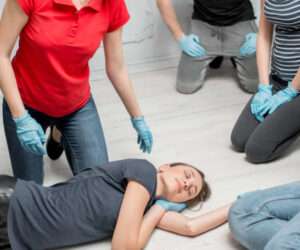
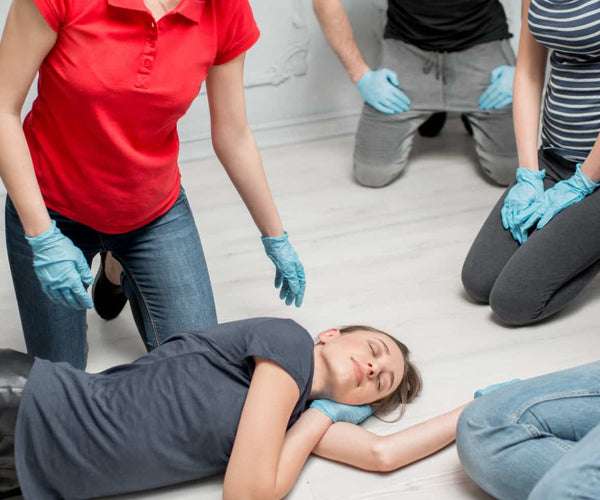
Someone goes pale, says they feel dizzy and suddenly crumples to the floor. The room goes quiet, and people look at you. Fainting is one of the most common reasons for a first aid call at work, in offices, shops, kitchens, classrooms and on building sites. Most of the time it is brief and harmless. But it can also look exactly like something much more serious, so it is important to know what to do and what to watch for.
In this guide, we explain in plain English how to recognise fainting, how to respond calmly, when to call 999 and how it fits with what you learn on an Emergency First Aid at Work (EFAW) course in London. If you want to see a real course page as you read, here is the Emergency First Aid at Work course in London.
Important Notes First
- This guide is general information, not medical advice or training. A trainer can show you the checks and the recovery position and watch your technique.
- A first aider does not diagnose. Fainting can have simple causes, but it can also be a sign of something serious.
- If you are unsure, call 999.
- This guide is mainly for adults. Fainting in children and babies needs extra care, so learn about it on a paediatric first aid course.
The Short Answer
If someone faints, check that they are breathing normally, lay them on their back and raise their legs. Loosen tight clothing, give them fresh air and stay with them. Most people wake within about 30 seconds and recover within a few minutes. Call 999 if they are not breathing normally, if they cannot be woken within a minute, or if they have chest pain, an irregular heartbeat, seizure like movements, an injury or do not fully recover. If they are breathing but remain unresponsive, place them in the recovery position and call 999.
What Is Fainting?
Fainting, sometimes called a faint or syncope, is a brief loss of consciousness caused by a short drop in blood flow to the brain. The person falls, and when they are lying flat, blood can flow back to the brain more easily, so they usually wake up quickly.
NHS advice says that most people who faint come round within about 20 to 30 seconds, and that fainting is often not a sign of anything serious. But the NHS also advises that anyone who has fainted should usually be checked by a GP to find out what might have caused it, especially if it is the first time or it happens often.
What Causes Fainting at Work?
There are many possible causes, and often more than one is involved. Common ones include:
- Standing up too quickly. Especially after sitting or crouching for a long time.
- Standing still for a long time. For example, shop assistants, security staff, chefs and event staff.
- Heat and poor ventilation. Hot kitchens, stuffy offices and summer weather.
- Dehydration. Not drinking enough fluids.
- Missed meals or low blood sugar.
- Strong emotion, stress, fear or pain. Including the sight of blood or a needle.
- Hyperventilation or panic.
- Medication. Some medicines can lower blood pressure.
- Alcohol or drugs.
- Illness. Such as flu or an upset stomach.
- Pregnancy.
- Heart or circulation problems. These can be serious.
Because you cannot tell the cause by looking, treat every faint with care, and watch for warning signs that it might be something more serious.
Warning Signs Before a Faint
Many people have warning signs before they faint. If you notice them, you may be able to prevent a fall.
- Feeling dizzy or light headed.
- Looking pale or grey, with cold, clammy skin.
- Sweating.
- Feeling hot, or suddenly cold.
- Blurred vision, or tunnel vision, or spots before the eyes.
- Ringing in the ears.
- Feeling sick.
- Feeling weak or unsteady.
- Yawning or sighing a lot.
- Confusion or difficulty concentrating.
If Someone Feels Faint: Prevent a Fall
If a colleague says they feel faint, or you see the signs, act quickly.
- Help them lie down, with their legs raised. This helps blood flow to the brain. If lying down is not possible, help them sit with their head lowered between their knees.
- Stay with them. Do not leave them alone, even for a moment.
- Loosen tight clothing, such as a collar or tie.
- Give them fresh air, by opening a window or moving to a cooler place.
- Offer a sip of water, once they feel better, if they are fully alert.
- Encourage slow breaths.
- Tips that the NHS suggests for someone who feels faint while standing include crossing the legs and rocking up and down on the toes, and clenching the fists, which can help raise blood pressure briefly.
- Keep them still until they feel better, and let them get up slowly.
Step by Step: If Someone Has Fainted
Step 1: Make the scene safe
Check for danger, such as hot surfaces, equipment, liquids, stairs or traffic. If the person is in a dangerous place, move them only as far as needed to make them safe.
Step 2: Check for a response
Talk to them loudly and gently shake their shoulders. A person who has fainted usually starts to respond within a few seconds to half a minute.
Step 3: Check for injuries
If they fell, look for bumps to the head, cuts, bleeding or signs of a broken bone. A fall can cause more harm than the faint itself. If you suspect a serious injury, call 999.
Step 4: Check breathing
Listen and look for normal breathing, for at least 10 seconds, as the NHS advises, and no more than about 10 seconds for the check. Look for chest movement, listen for breath sounds and feel for breath on your cheek.
- If they are breathing normally, go to the next step.
- If they are not breathing normally, or you are unsure, treat it as a cardiac arrest: call 999, send for an AED and start CPR.
Step 5: Lay them on their back and raise their legs
If they are breathing normally, lay them flat on their back and raise their legs, for example resting them on a chair, a bag or your own knees. This helps blood flow to the brain. If the person is visibly pregnant, especially in later pregnancy, lay them on their side instead, as NHS advice suggests.
Step 6: Loosen clothing and give fresh air
Loosen anything tight around the neck, chest or waist, and ask onlookers to step back. Fresh air and a bit of space help recovery.
Step 7: Stay with them and watch their face and breathing
Talk calmly and note how long they have been unresponsive. Most people respond within a minute. Do not leave them alone.
Step 8: If they come round, keep them lying down for a while
Reassure them and tell them what happened. Keep them lying down for a few minutes, and help them sit up slowly over a few minutes when they feel better. Standing or sitting up too soon can cause another faint. Some guidance suggests resting for about 10 to 15 minutes.
Step 9: Offer water and something to eat
Once they are fully alert and feeling well enough, offer a drink of water. If they have not eaten, a light snack may help, but only when they are fully alert.
Step 10: If they are slow to recover, treat as unresponsive
If the person does not wake within a minute or two, or you are unsure, treat it as an unresponsive casualty. Open the airway, check breathing and call 999. If they are breathing normally, place them in the recovery position and keep checking their breathing until help arrives. For the method, see our guide on what to do if someone is unresponsive but breathing. If they are not breathing normally, start CPR.
When to Call 999
The NHS advises calling 999 if someone who has fainted:
- Is not breathing.
- Cannot be woken within one minute.
- Has not fully recovered, or has difficulty speaking or moving.
You should also call 999, or get urgent medical help, if the person:
- Has chest pain, shortness of breath or an irregular or very fast heartbeat.
- Has a seizure like episode, with jerking or shaking.
- Has injured themselves in the fall, especially a head injury.
- Is pregnant.
- Is elderly or has a known heart condition.
- Has fainted during exercise or exertion.
- Has fainted without any warning, or while lying down.
- Has a severe headache, weakness on one side, slurred speech or confusion, which could be signs of a stroke.
- Keeps fainting repeatedly.
- Is diabetic and may have low blood sugar, and does not recover quickly.
- You are unsure.
If a person recovers quickly and has no other symptoms, they may not need an ambulance, but they should still see their GP or call NHS 111 for advice, especially if it is their first faint or it happens often.
How to Tell Fainting From Other Emergencies
Fainting can look like other conditions, so it helps to know the differences. A first aider does not need to be certain, but should watch for signs of something else.
Fainting
- Usually preceded by warning signs, such as dizziness and pallor.
- Brief, usually under a minute or two.
- Breathing normal.
- Recovery is quick once lying flat.
- The person may feel tired or sick afterwards.
Cardiac arrest
- The person is unresponsive and not breathing normally.
- Needs CPR and an AED straight away.
Seizure
- May have convulsions, stiffness or jerking.
- May have a tongue bite or loss of bladder control.
- Confusion and drowsiness afterwards, often lasting longer than after a faint.
- See our guide on how to help someone having a seizure.
Low blood sugar
- May come on more gradually, with sweating, shaking, hunger and confusion.
- May not recover quickly when lying down.
Stroke
- May have a drooping face, weakness in an arm or leg, or slurred speech.
- Needs urgent medical help.
Because these can look alike, the safest approach is always the same: check breathing, lay them flat, and call 999 if there is any concern.
Special Situations
Someone who is pregnant
Lay them on their side, especially in later pregnancy, to help blood flow, and call 999 or seek urgent medical advice.
Someone who faints in a hot environment
Move them to a cool place, loosen clothing, give fresh air and sips of water once alert. Heat illness can be serious, so call 999 if they do not recover quickly, are confused, are very hot or have stopped sweating.
Someone who faints at the sight of blood or an injection
Help them lie down before they faint. They usually recover quickly, but they should still be checked for injury from the fall.
Someone who has fainted on stairs, near machinery or at height
Check carefully for injuries, and call 999 for any suspected head, neck or back injury. Make the area safe first.
Someone who has fainted after exercise or exertion
Call 999. Fainting during or soon after exertion can be a sign of a heart problem.
Someone with diabetes
If they are conscious and know they are low on sugar, help them with sugary food or drink. If they are unresponsive, do not give anything by mouth, place them in the recovery position if breathing, and call 999.
A person who often faints
Some people know that they are prone to fainting, and may have their own plan. Follow their advice, but still treat any episode seriously if it differs from usual.
What Not to Do
- Do not slap, shake hard or throw water on the person. Gentle shaking of the shoulders to check response is enough.
- Do not sit or stand them up quickly, even if they say they feel fine.
- Do not give food or drink until they are fully alert, because there is a choking risk.
- Do not leave them alone.
- Do not prop them against a wall in a sitting position while they are unresponsive.
- Do not crowd them. Ask onlookers to step back.
- Do not assume it is just a faint. If they do not wake quickly, treat it as an emergency.
- Do not give medicines. A workplace first aider should not give tablets.
After the Faint
Once the person has recovered, there are a few things to do.
- Let them rest. They may feel tired, shaky or sick for a while.
- Check again for injuries. Look for bumps, cuts and bruises, especially on the head.
- Suggest they see a GP or call NHS 111, especially if it is their first faint, it happens often, there was no warning or they have a heart condition.
- Do not let them drive or use dangerous equipment until they feel fully recovered.
- Arrange for them to get home safely, with someone with them if appropriate.
- Record what happened. Date, time, place, how long they were out, what you saw, what you did and what help was arranged.
- Report it to your employer. Accidents and incidents should be recorded.
- Look after yourself and others. Seeing someone collapse can be upsetting.
Preventing Fainting at Work
Employers and staff can reduce the risk.
- Provide drinking water. And encourage regular drinks, especially in hot weather.
- Keep rooms cool and ventilated.
- Allow breaks and seats. For people who stand for long periods, and let them sit when they feel faint.
- Encourage regular meals.
- Rise slowly. From sitting or crouching.
- Plan for hot work. Kitchens, workshops and outdoor jobs need breaks, water and cool areas.
- Support people who find blood or needles hard. Let them sit or lie down during first aid training or procedures.
- Make sure staff know who the first aiders are.
- Have a quiet space. For recovery.
Where an EFAW Course Fits
On an Emergency First Aid at Work course, you learn the skills that apply to fainting: assessing an incident safely, checking a casualty, checking breathing, managing an unresponsive casualty, using the recovery position, calling for help, giving CPR and using an AED if needed, and treating minor injuries from a fall. You practise with a partner and work through scenarios, such as a colleague collapsing in the office.
The longer First Aid at Work course covers a wider range of medical conditions in more detail. Exact content varies by awarding organisation, so check the course outline.
EFAW is a one day, regulated Level 3 qualification, and HSE guidance says it should include at least six hours of training time, not counting breaks. The certificate is valid for three years. HSE strongly recommends a short refresher each year, although it is not a legal requirement.
What Workplaces Should Have Ready
The Health and Safety (First Aid) Regulations 1981 require employers to provide adequate and appropriate first aid for their employees. As a starting point for low hazard workplaces, HSE suggests at least one appointed person for fewer than 25 employees, at least one first aider trained in Emergency First Aid at Work for 25 to 50 employees, and at least one first aider trained in First Aid at Work for every 100 employees above that, or part of 100. Higher hazard workplaces need more. A first aid needs assessment gives the best answer. Beyond numbers, make sure that everyone knows who the first aiders are, where the first aid kit and AED are, and what to do in an emergency.
Choosing a Good Course in London
Look for:
- A regulated Level 3 Award in Emergency First Aid at Work (RQF) from a recognised awarding organisation.
- At least six hours of training time, not counting breaks.
- Hands on practice, including checking breathing and the recovery position.
- Practical assessment in person. HSE guidance expects this for a workplace first aider, so online only courses are generally not suitable.
- Qualified, experienced trainers.
- Small classes. Many awarding organisations set a maximum of around 12 learners per trainer.
- A clear certificate and a clear total price.
HSE stopped approving first aid training providers in 2013, so be cautious of any claim that a course is HSE approved. In London in 2026, public prices for a one day course commonly range from about £65 to £150 per person. One provider page, linked above, lists £89 per person for classroom training and £75 per person for groups of five or more, at the time of writing in October 2026. Prices change, so always confirm. You can review the Emergency First Aid at Work training page to see how one provider presents its course, price and booking options.
Why London Workplaces Should Be Ready
London workplaces are busy, often hot and crowded, and many staff commute long distances and stand for long periods. Roads and public transport can be congested, so ambulances may take time to arrive, and the actions of colleagues in the first minutes matter. There is also a very large number of training providers and dates in London, and many deliver training at your workplace, which is a practical way to prepare a whole team to respond calmly.
Final Thoughts
So, what is the first aid for fainting? If someone feels faint, help them lie down with their legs raised, or sit with their head between their knees. If they have fainted, check for danger and injuries, check their breathing, lay them on their back, raise their legs, loosen tight clothing and give fresh air. Stay with them, and let them get up slowly. Call 999 if they are not breathing normally, cannot be woken within a minute, are injured, have chest pain or an irregular heartbeat, have seizure like movements or do not fully recover. If they are breathing but unresponsive, use the recovery position.
Most faints are brief and harmless, but because the serious ones look the same, calm checks matter. When you are ready to practise with a trainer, take a look at the Emergency First Aid at Work course in London and choose a date that suits you.
Frequently Asked Questions
1. What should you do if someone faints at work?
Check that they are breathing normally, lay them on their back and raise their legs, loosen tight clothing, give them fresh air and stay with them. Let them get up slowly once they feel better. Call 999 if they are not breathing, cannot be woken within a minute or have other warning signs.
2. How long does a faint usually last?
Most people who faint wake up within about 20 to 30 seconds and recover within a few minutes. If someone cannot be woken within a minute, the NHS advises calling 999.
3. When should I call 999 for fainting?
Call 999 if the person is not breathing, cannot be woken within a minute, has not fully recovered, has chest pain, shortness of breath or an irregular heartbeat, has seizure like movements, is injured, is pregnant or if you are unsure.
4. Why do you raise someone’s legs after they faint?
Raising the legs helps blood flow back towards the heart and brain. NHS advice says that if someone is breathing normally after fainting, you should lay them on their back and raise their legs.
5. What should I do if someone feels faint but has not fainted yet?
Help them lie down with their legs raised, or if they cannot lie down, sit with their head lowered between their knees. Loosen tight clothing, give fresh air, offer a sip of water when they feel better and stay with them.
6. Can I give someone water after they faint?
Only once they are fully alert and feeling well enough. Do not give food or drink to someone who is drowsy or unresponsive, because of the risk of choking.
7. Should someone who has fainted see a doctor?
Often, yes. The NHS advises getting checked by a GP to find out what might have caused it, especially if it is the first time, it happens often, there was no warning or there are other symptoms.
8. How can I tell fainting from a seizure or cardiac arrest?
Fainting usually has warning signs, is brief and the person breathes normally and recovers quickly. A seizure often involves jerking and longer confusion afterwards. Cardiac arrest involves no normal breathing. If you are unsure, check breathing, call 999 and follow the call handler’s advice.
9. Does an EFAW course cover fainting?
An Emergency First Aid at Work course covers checking breathing, managing an unresponsive casualty, the recovery position, calling for help, CPR, using an AED and treating minor injuries. The longer First Aid at Work course covers medical conditions in more detail. Check the course outline for exact content.
10. Where can I learn first aid in London?
You can book an Emergency First Aid at Work course through a training provider that offers the regulated qualification, either as a public course or as training at your workplace. Check the practical content, the awarding organisation, the class size and the total price before you book