Workplace accidents don’t send a warning text before they happen. A colleague can choke during lunch, someone can slip on a wet floor, or a minor cut can suddenly turn into a situation nobody in the room knows how to handle. In those first few minutes, it’s not the ambulance that saves a life — it’s the person standing next to the casualty who knows exactly what to do. That’s the entire reason the Emergency First Aid at Work (EFAW) course exists, and it’s why so many businesses across London are booking their staff onto it every single month.
If you’ve been searching for Emergency First Aid at Work training London, you’ve probably already noticed how many options are out there, all promising the same thing: a certificate, a quick class, and a tick in the compliance box. But not every course is built the same way, and not every provider actually prepares your staff to act with confidence when something goes wrong. This guide walks you through everything you need to know about the 1-Day Emergency First Aid at Work course — what it covers, who needs it, why it’s priced the way it is, and how to pick a training provider that won’t waste your time or your money.
What Is the Emergency First Aid at Work (EFAW) Course?
The Emergency First Aid at Work course is a one-day, classroom-based training programme designed to give ordinary employees — not medical professionals — the skills and confidence to respond to a medical emergency in the workplace. It’s the most common first aid qualification in the UK because it strikes the right balance: short enough to fit into a single working day, but thorough enough to cover the real emergencies that happen in offices, shops, warehouses, and other low-to-medium risk environments.
By the end of the course, delegates are able to:
- Act quickly and calmly when someone becomes ill or injured at work
- Assess an emergency situation safely, without putting themselves at risk
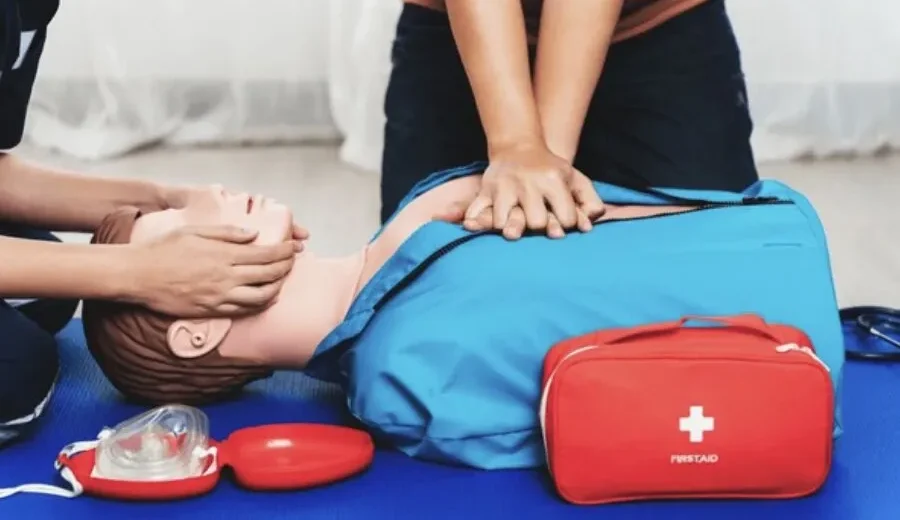
- Perform CPR and use a defibrillator (AED) with confidence
- Manage choking, bleeding, shock, and burns
- Deal with fractures, sprains, and minor injuries
- Recognise and respond to seizures, and manage someone who has fainted or lost consciousness
- Correctly complete an accident report and know when to call for professional medical help
This isn’t a course built around memorising facts for a test. It’s built around muscle memory — the kind of practical, hands-on practice that means when a real emergency happens, the response is instinctive rather than panicked.
Is This Course HSE Compliant?
Yes. The Health and Safety Executive (HSE) sets out clear expectations under the Health and Safety (First-Aid) Regulations 1981 for how UK employers must manage first aid provision in the workplace. A properly delivered Emergency First Aid at Work course meets those requirements for businesses classed as lower risk — think typical offices, retail units, small warehouses, and similar workplaces where the chance of a serious accident is relatively low.
Being HSE compliant means the course:
- Follows the recommended EFAW syllabus and minimum contact hours
- Is delivered by a qualified, experienced first aid trainer
- Includes practical, supervised assessment — not just a slideshow
- Issues a recognised certificate valid for three years
If your business has ever been through a health and safety audit, you’ll know how quickly things unravel when a first aid certificate turns out to be from an unrecognised provider, or when the training was delivered as a rushed online-only module with no practical component. Choosing an HSE compliant course from the outset saves you from having to redo it all later — and more importantly, it means your staff are genuinely equipped to help someone in a real emergency, not just equipped with a piece of paper.
Course Price: Why £89 in London?
At £89 per person, this course sits at a genuinely competitive price point for London — a city where classroom training costs are typically higher than the rest of the UK due to venue and instructor overheads. What matters more than the number itself is what’s included in it. A well-run £89 EFAW course should cover:
- The full one-day, HSE-aligned training session
- All practical equipment (manikins, AED trainers, bandages, splints)
- Course materials and a first aid quick-reference guide
- A recognised certificate valid for 3 years
- Trainer-led assessment throughout the day
Compare that to the cost of not training your staff at all. A single workplace incident that isn’t handled properly — where an untrained employee freezes, panics, or makes the situation worse — can lead to far greater costs down the line, from extended sick leave to potential legal liability for failing to meet HSE first aid duties. £89 is a small outlay against that risk.
Who Needs Emergency First Aid at Work Training in London?
This course isn’t just for people with “First Aider” written into their job title. It’s genuinely useful — and often required — for a wide range of roles and industries:
Designated first aiders. Every workplace needs at least one appointed first aider under HSE guidance, and for lower-risk environments, EFAW is the standard qualification for that role.
Office managers and HR teams. Anyone responsible for staff wellbeing benefits from understanding first aid basics, especially in larger open-plan offices where an incident can happen anywhere.
Retail and hospitality staff. With members of the public constantly on-site, retail and hospitality businesses face a higher volume of potential incidents — from allergic reactions to slips and falls.
Construction and site supervisors working in environments not quite risky enough to require the 3-day First Aid at Work (FAW) course, but still needing a certified responder on-site.
Nurseries, schools, and childcare providers, where staff-to-child ratios often require a certain number of first aid trained adults present at all times.
Freelancers, contractors, and small business owners who want the qualification either for their own peace of mind or because a client site requires proof of first aid training before granting site access.
If your role involves regular contact with the public, colleagues, or vulnerable individuals, this course is almost certainly relevant to you — and if you manage a team, keeping at least one EFAW-certified person on shift at all times is both good practice and, in many cases, a legal expectation.
What Does the 1-Day Course Actually Cover?
A typical EFAW training day in London runs from roughly 9am to 5pm and is broken into practical modules rather than long lecture blocks. Here’s what a well-structured course usually includes:
Morning Session: The Fundamentals
- Role and responsibilities of a first aider
- Assessing an emergency scene safely
- Primary survey (DR ABC – Danger, Response, Airway, Breathing, Circulation)
- Recovery position technique
- CPR — adult, with hands-on manikin practice
- Automated External Defibrillator (AED) use
Afternoon Session: Common Workplace Emergencies
- Choking (adult)
- Managing severe bleeding and shock
- Treating minor injuries — cuts, grazes, burns
- Recognising and responding to seizures
- Fainting and loss of responsiveness
- Fractures, sprains, and strains
- Anaphylaxis awareness
- Record keeping and accident reporting
Assessment
Throughout the day, the trainer observes and assesses each delegate’s practical performance — this isn’t a written exam at the end, but ongoing, scenario-based assessment that mirrors how the skills will actually be used in a real emergency.
By the time delegates leave, they’ve physically practised chest compressions, used an AED trainer, applied bandages, and worked through realistic scenarios — not just watched someone else do it.
Group Bookings for Businesses
Most companies don’t send just one person. If you’re an employer trying to meet your HSE first aid obligations across a whole team, group bookings are usually the more sensible route — both for cost efficiency and for making sure multiple staff members are certified in case someone is off sick or on leave.
On-site or in-house training is also often available, meaning the trainer comes to your London office or premises rather than your team travelling to a training centre. This is worth asking about directly, since it can save time and travel costs, especially for teams of 6 or more.
Certificate Validity and Renewal
The EFAW certificate is valid for three years from the date of the course. After that, a refresher course is needed to keep the qualification current. It’s worth noting:
- HSE recommends refresher training or practice at regular intervals during those three years, not just waiting until the certificate expires
- Many employers schedule refreshers annually as good practice, even though the certificate itself lasts three years
- Letting the certificate lapse means starting again with the full one-day course, rather than a shorter requalification session
Keeping track of renewal dates for your whole team can be a hassle, so many businesses set calendar reminders a few months ahead of expiry to book refresher training in good time.
Choosing the Right First Aid Training Provider in London
London has no shortage of first aid training providers, and the quality gap between them is bigger than most people expect. Here’s what actually separates a good course from a forgettable one:
Experienced, working trainers. Ask whether the trainer has real clinical or emergency service background, not just a training certificate.
Small class sizes. Practical skills like CPR need hands-on time with equipment. A room of 20+ people sharing two manikins isn’t going to build real confidence.
Recognised accreditation. Look for courses regulated by a recognised awarding body, and confirm the certificate will be accepted by your industry or client requirements.
Central, accessible venues. For London-based teams, a training venue with good transport links matters more than it seems — it affects attendance and punctuality on the day.
Clear, transparent pricing. Watch for hidden costs like certificate printing fees or charges for course materials that should be included in the advertised price.
If you’re comparing options, the 1-Day Emergency First Aid at Work Course in London is worth a closer look — priced at £89, HSE compliant, and structured around genuine hands-on practice rather than passive learning.
What to Bring and How to Prepare
There’s very little preparation needed for this course, which is part of its appeal. A few practical tips:
- Wear comfortable clothing — you’ll be kneeling on the floor for CPR practice
- Bring a form of ID for registration
- Eat beforehand; it’s a full, active day with limited downtime
- No prior first aid knowledge is required or expected
The Real Value: Confidence, Not Just Compliance
It’s easy to think of first aid training as another box-ticking exercise required by HSE regulations. But talk to anyone who has actually used their training in a real emergency, and the story is almost always the same: without the course, they would have frozen. With it, they knew exactly what to do in the first thirty seconds — and those thirty seconds are often what matters most.
Investing in Emergency First Aid at Work training isn’t just about meeting a legal requirement. It’s about making sure that when something goes wrong in your workplace, someone in the room can actually help — calmly, correctly, and immediately.
Frequently Asked Questions
1. What is the Emergency First Aid at Work (EFAW) course?
EFAW is a one-day, HSE-compliant training course that teaches employees how to respond to medical emergencies in the workplace, including CPR, choking, bleeding control, and managing minor injuries. It’s designed for lower-risk workplaces such as offices, shops, and small businesses.
2. How long does the Emergency First Aid at Work course take?
The course typically runs for one full day, usually from around 9am to 5pm, including both classroom instruction and hands-on practical training and assessment.
3. Is the £89 Emergency First Aid at Work course in London HSE compliant?
Yes, a properly delivered EFAW course at this price point is fully aligned with HSE guidance under the Health and Safety (First-Aid) Regulations 1981, and includes practical assessment along with a recognised three-year certificate.
4. Who needs Emergency First Aid at Work training?
Anyone who may need to act as a designated first aider in a lower-risk workplace, including office staff, retail employees, HR managers, childcare workers, and small business owners, benefits from this training. Many employers require at least one certified first aider on-site at all times.
5. How long is the EFAW certificate valid for?
The certificate is valid for three years from the date of completion. After that, a refresher or full requalification course is needed to keep the certification current.
6. What’s the difference between Emergency First Aid at Work (EFAW) and First Aid at Work (FAW)?
EFAW is a one-day course suited to lower-risk workplaces, while FAW is a more comprehensive three-day course designed for higher-risk environments such as construction sites or manufacturing. The right choice depends on your workplace risk assessment.
7. Do I need any prior experience to take this course?
No prior first aid knowledge or medical background is required. The course is designed for complete beginners and builds all necessary skills from the ground up through hands-on practice.
8. What topics are covered in the Emergency First Aid at Work course?
The course covers CPR, AED use, choking, severe bleeding, shock, burns, fractures, seizures, fainting, and basic accident reporting, along with how to safely assess an emergency scene before acting.
9. Can a whole team or company book this course together in London?
Yes, group bookings and on-site training at your London office are usually available, which can be more convenient and cost-effective for businesses needing to certify multiple employees at once.
10. Will I receive a certificate after completing the course?
Yes, delegates who complete the training and practical assessment receive a recognised Emergency First Aid at Work certificate valid for three years, which can be used to demonstrate HSE compliance to auditors, clients, or employers.
Ready to get certified? Book your place on the 1-Day Emergency First Aid at Work Course in London today for £89 and gain the skills, confidence, and HSE-compliant certification your workplace needs.